When developing Agentic AI systems, Small Language Models (SLMs) in the 70M to 500M parameter range have become a popular choice due to their ultra-low inference latency and suitability for on-device deployment. However, unlike their hundred-billion-parameter counterparts, utilizing Proximal Policy Optimization (PPO) for Reinforcement Learning from Human Feedback (RLHF) within this micro-scale regime has historically been considered highly unstable and unpredictable.
The recent paper, Towards Robust Reinforcement Learning for Small-Scale Language Model Agents, conducts a systematic and large-scale empirical study to address this issue. Through cross-experiments on 15 (model, corpus) configurations, the authors successfully deconstruct the three common failure modes of PPO at the SLM scale and propose a highly practical “Capacity-Headroom Hypothesis”.
Experimental Setup and Model Matrix
To ensure broad applicability, the research team selected two open-source SLM families with distinct architectures:
- Pythia Family: Includes 70M, 160M, and 410M variants, based on the GPT-NeoX architecture.
- SmolLM2 Family: Includes 135M and 360M variants, utilizing a Llama-style architecture (with RoPE and SwiGLU).
These models were subjected to a complete SFT -> Reward Model -> PPO training cycle across three corpora of varying difficulty (TinyStories, CNN/DailyMail, Wikitext-103).
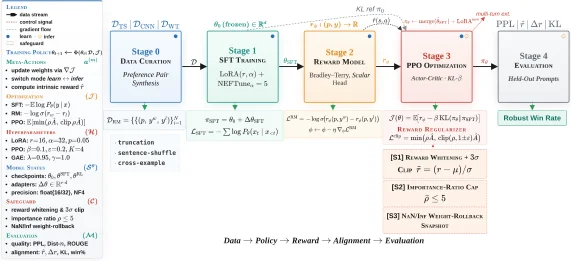 Figure 1: The end-to-end RLHF pipeline for aligning small language model agents, detailing data curation, SFT, reward modeling, and stabilized PPO fine-tuning.
Why Does PPO Fail on SLMs? Three Practical Pitfalls
When applying PPO to SLMs under 500M parameters, developers frequently encounter exploding gradients or models outputting complete gibberish. The paper summarizes three underlying structural “silent killers” that are often overlooked:
1. Gradient Flow Obstruction in PEFT
When utilizing frameworks like TRL combined with LoRA for Parameter-Efficient Fine-Tuning (PEFT), implementation loopholes can result in the LoRA parameters being silently frozen (registered as non-trainable). Consequently, the Policy model generates roll-outs and computes losses, but the underlying weights are never updated. Solution: Adopt the Merge-and-Reinitialize technique. First, merge the SFT LoRA weights into the Base Model (treating this as the Reference Model), then attach a fresh, zero-initialized LoRA for the PPO updates to ensure proper gradient flow.
2. Numerical Instability in bfloat16
In the PPO algorithm, computing the importance ratios () requires subtracting two log-probabilities. Because bfloat16 has only a 7-bit mantissa precision, this easily leads to “Catastrophic Cancellation” in models with under 200M parameters. During the initial training steps, ratio values can skyrocket past , triggering hardware-level NaN/Inf exceptions.
Solution: Force all tensor operations within the core PPO loop (including the Policy, Reference Model, Value Head, and Reward Model) to switch to float32 precision.
3. Distributional Collapse
A long-tailed reward distribution paired with an unclipped KL divergence penalty can push the optimizer toward extreme regions where the Reference Model assigns very low probabilities, ultimately yielding incoherent output. Solution: Implement a three-layer safety mechanism:
- Reward Whitening and Clipping: Bound extreme advantage estimates.
- Importance-Ratio Guard: If the batch’s mean importance ratio exceeds 5, skip that mini-batch update entirely.
- Weight-Rollback: Immediately revert to the previous optimizer state if NaN or Inf values are detected.
Comparing PPO and SFT Reward Performance
The paper contrasts the final PPO-aligned model rewards against their SFT baselines across all 15 settings:
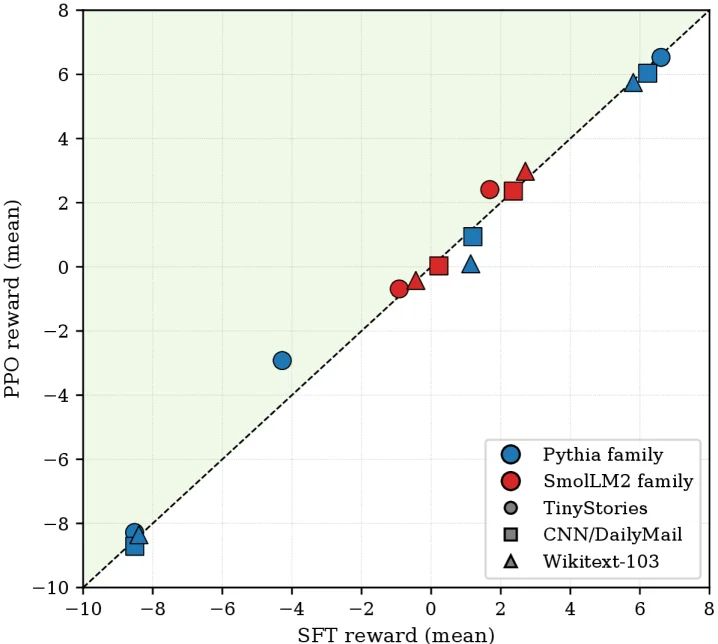 Figure 2: SFT vs. PPO reward across all 15 configurations. Markers above the dashed identity line represent successful PPO improvements.
The Pythia-410M and SmolLM2-360M models achieved the most significant reward gains on the TinyStories dataset ( and ), with preference win rates approaching 60%. Conversely, the ultra-small 70M model showed negligible improvements or even regressions.
The Capacity-Headroom Hypothesis: When Should You Use PPO?
The core practical contribution of this paper is dispelling the myth that “fewer parameters mean RL is useless,” substituting it with a clear decision criterion—the “Capacity-Headroom Hypothesis.”
Research demonstrates that PPO’s effectiveness on small models is not strictly determined by the absolute parameter count, but rather depends on two prerequisites:
- A Fluent SFT Prior
- A Discriminative Reward Signal
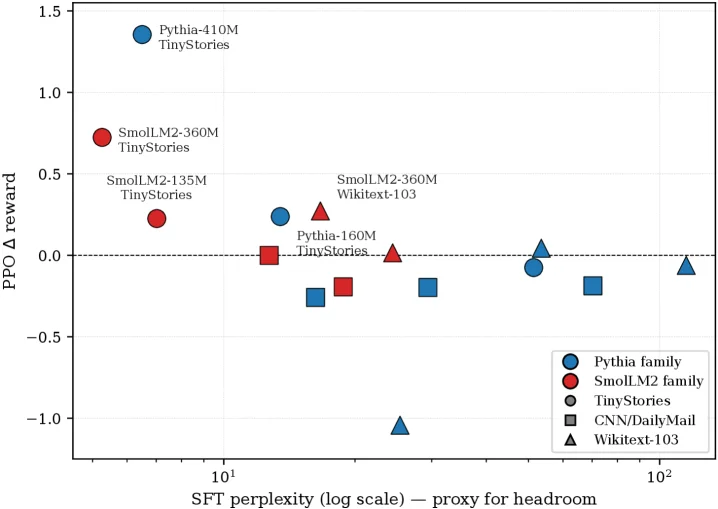 Figure 3: The capacity-headroom hypothesis. The x-axis is SFT perplexity (log scale), and the y-axis is the PPO reward delta. PPO reliably improves models only when the SFT prior is highly fluent (PPL < 20).
The Golden Threshold of PPL < 20
Experimental charts reveal a strong negative correlation between the SFT model’s perplexity (PPL) and the reward gain achieved via PPO, with a clear inflection point around :
- : The model possesses sufficient linguistic fluency to keep generated samples within the Reward Model’s reliable training distribution. Here, PPO delivers significant performance and reward enhancements.
- : Expected gains are marginal, and regressions may occur. In this regime, compute resources are better spent cleaning the SFT dataset or increasing the LoRA rank rather than forcing PPO.
- : The model struggles with basic coherence; the resulting gradients act as noise, and PPO is highly likely to collapse.
Ablation studies further prove that without the three-layer safety mechanism, even models meeting the PPL < 20 requirement would crash with NaN errors within the first few mini-batches.
Conclusion and Engineering Takeaways
Towards Robust Reinforcement Learning for Small-Scale Language Model Agents provides a highly actionable PPO playbook for teams developing Edge Agents. It teaches us that when building AI Agents for resource-constrained environments, instead of blindly scaling parameters or abandoning PPO for DPO, we should first evaluate if our SFT PPL meets the threshold, and meticulously enforce floating-point precision and safety mechanisms.
Only on a foundation of robust engineering scaffolding can compact SLMs truly exhibit intelligence that punches above their weight class.
Reading path
- Start with the AI Agent practical guide to place the small model inside the larger tools, memory, and evaluation system.
- Read chain-of-thought controllability to separate improved post-training behavior from genuinely observable reasoning.
- Continue with reinforcement-learning alignment resilience to place one PPO recipe inside the broader alignment and failure context.
Related engineering notes
- AI Engineering Self-Scaffolding for Agentic Coding: Ornith 1.0 Training and Evaluation Limits Read Ornith 1.0's self-scaffolding: what scaffolding solves in agentic coding, what benchmarks can prove, and where trust boundaries sit. Ornith is the case study, not the search entry point.

- AI Engineering How to Read AI Agent Papers: From CoT and WebGPT to ReAct One diagram shows how CoT and WebGPT merge into ReAct, then connects Gorilla and IPI to the rest of the agent-systems reading path.

- AI Engineering Holo4: One Agent Across GUIs, Code, and Tools—with Different Licenses A closer look at H Company’s cross-interface agent and long-horizon harness, its benchmark claims, public traces, and the licensing split between checkpoints.