In its September 2026 launch of System One Models and Jev, TypeSafe AI proposes a direction worth examining closely: a model does not always need to generate prose, wait for an application to parse and validate it, and then retry before software can make a decision. It can receive a state and a set of typed questions, then return options, scores, probabilities, and confidence that code can use directly.
This is more than renaming JSON mode. TypeSafe is changing the interface between AI and software: from “the model writes an answer for a person to read” to “the model supplies composable decision primitives.” Its first public model, Jev, is currently available through early access. TypeSafe says Jev targets System One tasks with lower latency and cost than general LLMs, but those performance, price, and accuracy numbers remain primarily the company’s own measurements.
This article turns the product claims into an inspectable engineering contract: how it differs from structured outputs, how the workflow evals measure it, where the design is genuinely useful, and where the evidence still stops.
The real change is the AI interface
TypeSafe calls Jev its first System One model and separates it from chat-centered LLMs. The official comparison can be reduced to four engineering differences:
| Dimension | General chat LLM | System One + Jev |
|---|---|---|
| Final output | A string that the application parses into JSON, function calls, or fields | Predefined typed values and probability distributions |
| Sampling | Sequential token generation, with each token conditioned on the previous one | A parallel sampler that, according to TypeSafe, answers questions in one query |
| Training direction | RLHF or RLVR, focused on preference or verifiable output | RLCD, focused on calibrated probabilities for decisions |
| Software responsibility | Parser, schema validation, retries, and policy sit outside the model | Schema is defined first; code composes, branches, and escalates after the answer |
This does not mean ordinary LLMs cannot produce typed output. Function calling, JSON Schema, and structured-output modes can all produce valid shapes. The difference is that TypeSafe makes the question type a first-class API primitive and returns probabilities and confidence for each question.
Jev’s input and output contract
The official documentation presents a simple abstraction: provide a state and a set of atomic questions. Its three built-in question types are:
| Primitive | What it asks | What software receives |
|---|---|---|
| Choice | Choose one option from a predefined list, such as billing, technical, or other | A choice, per-option probabilities, and confidence |
| Score | Rate the state against a discrete rubric, such as can wait, this week, or today | A score, per-level probabilities, and confidence |
| Noul | Decide whether a proposition is true | A noul value from 0 to 1 |
The TypeSafe docs say that all three can be mixed in one API call, with each question evaluated in parallel and independently against the same state. Adding several dimensions therefore does not require one increasingly large prompt, and one question’s reasoning does not have to contaminate another question’s context.
The questions should also be atomic. Do not ask “How should this support ticket be handled?” Instead decompose it into:
- Is this a billing issue?
- Is the customer calm, frustrated, or angry?
- Is the priority can wait, this week, or today?
- Does this need human review?
The application composes the final action. If policy changes, a team can adjust a weight, threshold, or branch in code instead of rewriting a giant prompt that contains every business rule.
From questions to workflows: the model judges, code owns policy
TypeSafe’s workflow pattern can be understood as five layers:
- State envelope: assemble the event, document, history, and relevant context.
- Typed questions: express each judgment as a Choice, Score, or Noul with fixed criteria.
- Parallel evaluation: let Jev answer independent questions against the same state.
- Policy composition: use probabilities, confidence, and business rules to choose close, queue, act, or escalate.
- Review boundary: route low-confidence, conflicting, or high-risk results to a person instead of automating everything.
TypeSafe’s workflow evals use security incidents, agent-trace observability, invoice processing, and customer service as examples. In the security workflow, the model does not write a long incident report. It judges unauthorized activity, evidence strength, incident state, and action, while code composes close, notify, contain, or escalate branches.
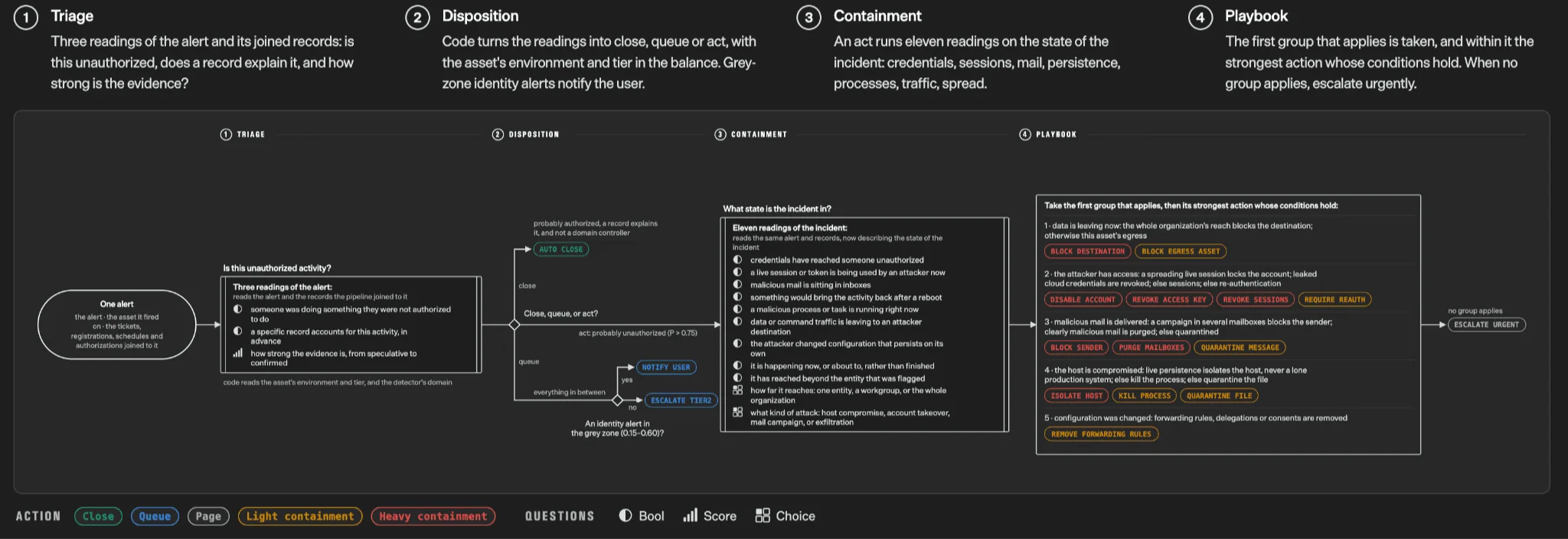
Figure: TypeSafe’s security-incident example in the official workflow evals. Narrow questions, code branches, and action playbooks form one path. Source: Workflow evals.
This architecture is especially relevant to agents. A runtime does not need to ask a prose-generating model to own every tool call. It can ask whether to escalate, which tool applies, or whether evidence is sufficient, then keep permissions, transactions, and human intervention in the runtime.
193.6x faster and 444.6x cheaper: inspect the measurement contract first
The TypeSafe homepage currently shows 193.6x faster and 444.6x cheaper. These are not universal model benchmarks; they come from the company’s workflow tasks. The workflow-evals page says the chart averages four workflows, comparing each model configuration on accuracy, cost, and time under the same workflow, and also compares structured workflows with versions that put the entire policy into a prompt.
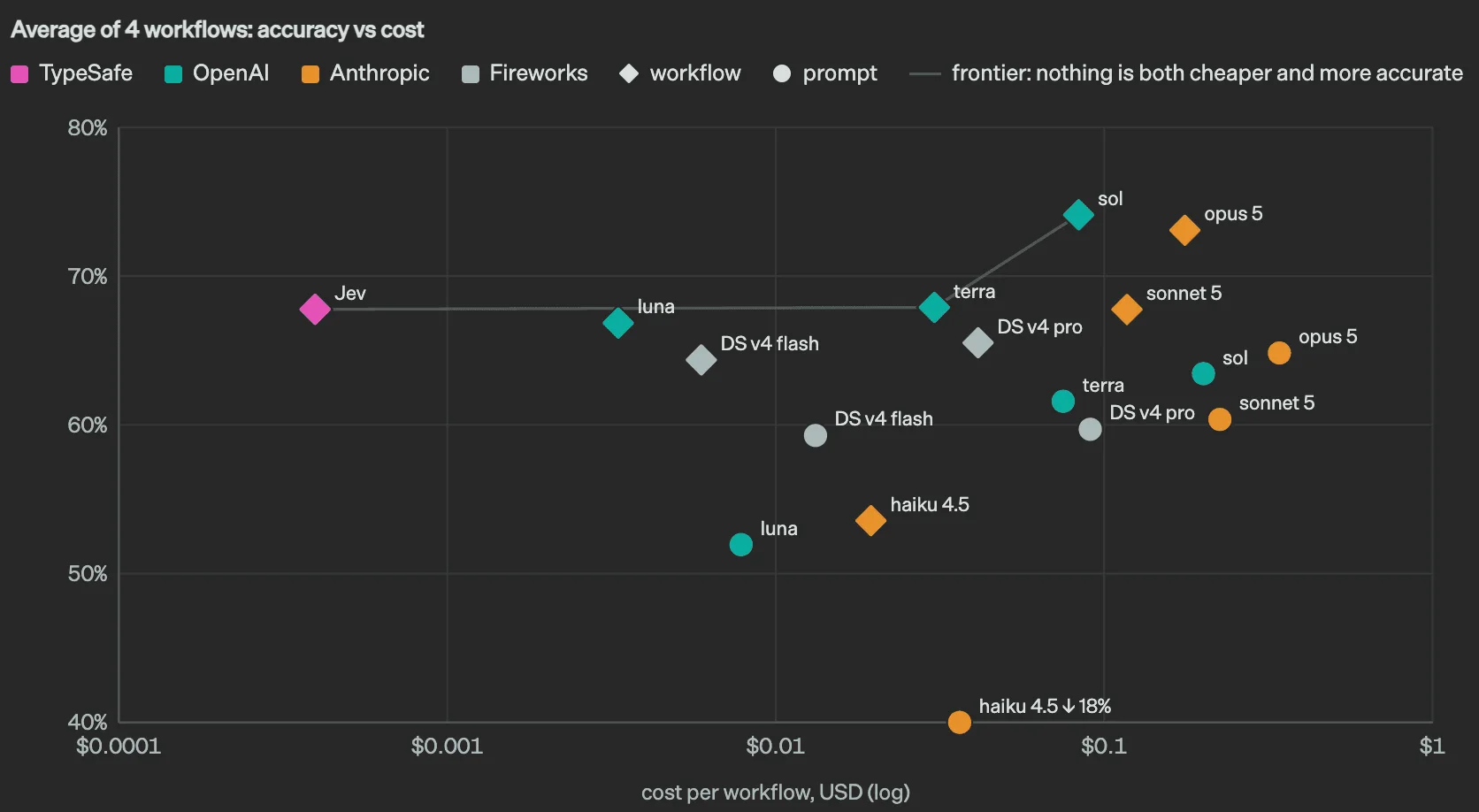
Figure: TypeSafe’s official accuracy-versus-cost chart. Jev appears at the low-cost end, but the result depends on TypeSafe’s workflows, model settings, and reference-label definition rather than an independent reproduction. Source: Workflow evals.
This evaluation direction is sensible because production cost is not only the model’s token price. It also includes:
- generating prose before parsing it;
- retries after schema failures;
- the number of narrow questions in one workflow;
- the share of low-confidence results routed to people;
- how many steps each model configuration needs to complete the same policy.
But three evidence limits matter:
- The workflow and harness were built by TypeSafe’s team. The company also notes that the model-capabilities team created them, which leaves room for selection bias.
- Reference labels come from large external models, such as GPT-6 Astra and Claude Fable 5.1. That provides a consistent anchor but can also favor the behavior of those models.
- Jev’s numbers depend on a particular set of questions, hardware, service state, and settings. They cannot be projected to every open-ended task.
The accurate reading is not “Jev is 193.6x faster than every LLM.” It is: “For a workflow designed around typed decisions, a decision primitive may be a better fit for low-cost automated judgment than putting the entire policy into a prompt.”
RLCD and the parallel sampler: what the public material supports
TypeSafe calls its training method Reinforcement Learning for Calibrated Decisions, or RLCD. The company contrasts it with RLHF and RLVR: the target is not preference for a piece of prose or verification of a string, but probabilities that better reflect epistemically honest confidence.
TypeSafe also describes a new model architecture and a parallel sampler, and says that Jev can answer multiple questions in one call. That supports a reasonable engineering inference: when the output space is a fixed decision type rather than arbitrary-length text, the model can specialize its output space, sampling strategy, and hardware utilization.
The public product material does not provide the complete model architecture, training data, mathematical definition of RLCD, weights, or an independently reproducible training recipe. This article therefore treats RLCD as TypeSafe’s method claim, not as an externally established general training paradigm.
“No hallucinations” is true only at the type boundary
One of TypeSafe’s strongest product messages is that Jev does not generate strings, so it does not produce unparseable text or hallucinated tool calls. The official page also shows 0% structured-output and tool-call error rates against other models.
The launch post contains an important nuance: TypeSafe’s 0% is a schema-matching guarantee, a type-level property, not a large empirical claim that every semantic judgment is correct. The comparison numbers for other LLMs come from OpenRouter and may be affected by which models receive more complex queries.
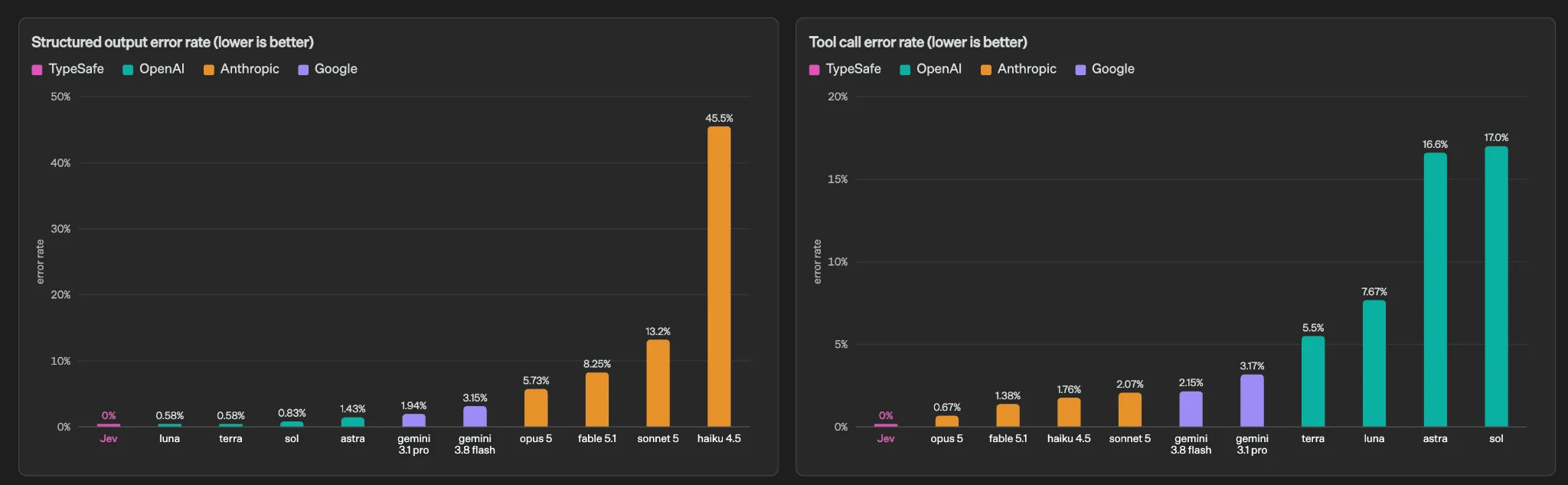
Figure: TypeSafe’s official comparison. Jev’s 0% mainly means that the output conforms to the defined schema; it does not by itself prove that the choice, score, or confidence is semantically correct. Source: Introducing System One Models & Jev.
These are three different failure modes:
- Type error: the response does not match the Choice, Score, or Noul schema. TypeSafe constrains this boundary strongly.
- Decision error: the model chooses the wrong department, misjudges an invoice, or closes a security incident incorrectly. A typed answer can still be the wrong answer.
- Calibration error: the model is highly confident while its confidence is not aligned with the observed accuracy. This needs ongoing production measurement.
“Cannot hallucinate” therefore should not become “cannot be wrong.” The more precise engineering claim is that free-form output and schema-parsing failures are removed from the interface, allowing the team to focus on judgment quality, calibration, and policy.
The SDK makes it feel like an API primitive, not a chat product
TypeSafe has published JavaScript/TypeScript and Python SDKs. The official JavaScript SDK requires Node.js 20 or newer; the Python SDK supports synchronous and asynchronous clients. Both center the System One API around state and questions.
From an integration perspective, treat the call as a small decision function:
- state is the complete context for the judgment, not a sequence of chat messages;
- questions are stable, testable decision schemas;
- response contains typed answers, probabilities, confidence, and fields code can consume;
- policy stays in your code, where permissions, transactions, human review, and side effects can be controlled.
This split also makes provider comparisons clearer. TypeSafe’s System One Adapter provides a drop-in replacement driven by OpenAI or Anthropic APIs. It can compare native structured output, prompted JSON, probability or discrete answer modes, retries, and latency. It does not prove that Jev wins; it helps you run the same questions, state, and policy against a reproducible interface.
Jev also has a cardinality boundary. TypeSafe says that above 255 choices it uses a two-stage scoring process followed by an explicit choice, which can introduce extra latency. High-cardinality classification, long documents, and tasks that require open-ended explanation should not be treated as ideal simply because the API returns typed values.
The other side of the cost advantage: you are buying workflow discipline
TypeSafe’s launch post lists input pricing at about USD 0.042 per million tokens and says output tokens are currently not separately metered; the homepage presents that as USD 42 per billion input tokens. That is attractive for high-volume routing, support triage, agent-trace review, or batch screening.
Low token prices do not automatically create low total cost. A team still has to measure:
- engineering time for building and maintaining the workflow harness;
- additional calls or data preparation caused by decomposing questions;
- queue cost for low-confidence human review;
- regression testing when schemas or policies change;
- the business cost of false approvals, false rejections, or missed escalations.
The economic value is therefore not only “cheap inference.” It is the discipline of turning a vague prompt into a measurable decision graph. If the product lacks stable rules, data, and a review boundary, inexpensive inference can simply execute a bad policy faster.
Where it fits, and where it does not
I would first put a Jev-like model in places where the output space is clear, error costs are definable, and the decision decomposes into narrow questions:
- support-ticket routing and escalation;
- risk grading and human sampling for agent traces;
- invoice or expense classification, missing-field checks, and review routing;
- security-alert triage and containment recommendations;
- tool selection, pre-authorization checks, and next-step routing inside a workflow.
I would not switch merely because a task “needs JSON” when it actually needs:
- long explanations, code, or unknown structures;
- a problem boundary whose options change constantly;
- fresh retrieval and citations rather than judgment over a known state;
- open-ended exploration, hypothesis generation, or negotiation;
- a confidence metric that the team has no data to calibrate.
The practical architecture is usually hybrid rather than replacement. Jev can handle high-frequency, low-latency, branchable judgments; a general LLM can handle explanation, summarization, open-ended planning, and exceptions; code keeps ownership of policy and side effects.
Five adoption gates
For a typed decision model in production, I would require:
- Schema gate: version the meaning, options, rubric, and semantics of every Choice, Score, and Noul.
- Calibration gate: bin held-out results and compare confidence with observed accuracy, including high-confidence errors.
- Policy gate: keep probability thresholds, human review, and high-risk actions in code rather than letting the model authorize its own side effects.
- Replay gate: retain the state, question schema, model version, response, and policy decision so a case can be replayed and audited.
- Fallback gate: define a safe path for service outages, cardinality limits, low confidence, and schema migrations, whether that path is another model or a human.
These gates also apply to ordinary structured-output LLMs. The real difference is not whose JSON looks cleaner; it is whether output shape, judgment quality, confidence, branching, and fallback are treated as one versioned interface.
A next reading path
If you are designing an agent runtime, start with the AI Agent architecture guide, then compare its execution boundaries with the Agentic AI Platform Contract. For putting Jev and general LLMs on the same cost sheet, read How to estimate LLM inference cost. For a more complete separation of planning, execution, and review, see A Gemini 3.8 Flash coding-agent workflow.
The final question is not whether Jev will replace LLMs. It is: which judgments are stable enough to become types, controlled by probabilities, and safely composed into a workflow by code?
Sources and further reading
- Introducing System One Models & Jev — TypeSafe’s launch post covering System One, RLCD, workflow evals, cost, and limitations.
- TypeSafe AI Introduction — official documentation for state, Choice, Score, Noul, and atomic questions.
- Workflow evals — official evaluation page covering four automation workflows, accuracy, cost, time, and reference labels.
- JavaScript/TypeScript SDK and Python SDK — official SDKs and quickstarts.
- System One Adapter — a way to compare the same System One-style interface against other LLM APIs.
Related engineering notes
- AI Engineering Jev in the Agent Runtime: Confidence-Gated Routing, Fan-Out, and Community Experiments A practical architecture guide to placing Jev between agents, tools, and human review through confidence-gated routing, speculative fan-out, composite scoring, and careful evaluation.

- AI Engineering How Claude Speeds Up Biomolecular Models: FlashPairformer and Reversible Inference Kits An engineering reading of Anthropic's Claude-assisted optimization of more than 30 biomolecular and genomics models, from FlashPairformer and Big mode to stock/exact/fast contracts, cost curves, and evidence limits.

- AI Engineering Forge v0.18.1: Open-Source Multi-User MCP Auth and Agent Governance A runtime-contract analysis of how Forge v0.18.1 connects multi-user MCP identity, OAuth consent, tenancy, policy, egress, and per-invocation audit—and where independent evidence is still missing.