Field guide
How to Read Harness Engineering: Setup and Verification for Long-Running Agents
Enter Bloss0m's Harness section from this page — no need to hunt through the blog index.

Bookmark this page. Later, when reading any Harness-related articles on Bloss0m, you can always return here to find links and the reading order.
Build a Mental Model First
Harness = The execution environment wrapping everything outside the model: tools, memory, planning, validation, state handover, repository conventions, and feedback loops. Harness Engineering = Deliberately designing and maintaining this environment so that an Agent’s failures become “repairable and preventable,” rather than gambling on the next model version.
Agent = Model + Harness The model determines the upper limit of capabilities; the Harness determines whether it can deliver stably during long-running tasks, multi-turn interactions, and team collaboration.
In 2025, people often asked, “Are Agents usable?”; in 2026, the question is more often, “Can you prove the system will finish running?” All articles in this section answer the latter.
Project Status
All deep-dive articles for PRD-001 have been completed (Updated 2026-06-03). The index article (this page) plus spec-002~009, totaling 8 deep-dive articles, are all online; Phase 2 (blogs 17–21), consisting of five articles, has also been published.
| Phase | Spec | Corresponding Blog | Status |
|---|---|---|---|
| Index | spec-001 | 13 This page | ✔️ Published |
| Phase 1 | spec-002~004 | 16 Hashimoto, 14 Fowler, 15 LangChain | ✔️ Published |
| Phase 2 | spec-005~009 | 17 Anthropic Parallel, 18 Phil Schmid, 19 Parallel.ai, 20 Ignorance.ai, 21 HumanLayer | ✔️ Published |
In addition, three early Harness deep dives (blogs 09–11) were published prior to the PRD planning, are still listed in the index below, and are cross-linked with this series.
Full Series Article Index (This Site)
Below is the complete list for the Harness section on Bloss0m (grouped by topic). Each article provides an interpretation in Traditional Chinese, with links to official or original sources at the end.
Index and Extensions
| Number | Article | Description |
|---|---|---|
| 13 | This Page — How to Read Harness Engineering: Setup and Verification for Long-Running Agents | The starting point of the section (you are here) |
| 09 | Harness Design for Long-Running AI Engineering | Long-running apps: generation/evaluation division, QA contracts |
Practical Application and Long Tasks (OpenAI · Anthropic)
| Number | Article |
|---|---|
| 11 | Harness Engineering: Making Codex Observable and Transferable |
| 10 | Harnesses for Long-Running Agents: Stable Delivery Across Contexts |
| 17 | 16 Parallel Claudes Building a C Compiler |
Concepts, Reviews, and Frameworks
Industry Convergence and Toolchain Implementation
| Number | Article |
|---|---|
| 20 | Ignorance.ai: The Emerging Playbook |
| 21 | HumanLayer: Practical Configuration for Skill Issues |
Entry by Scenario (How to Choose Your First Article)
| Your Scenario | Suggested Starting Point |
|---|---|
| Hearing about Harness for the first time, need to explain it to colleagues | 19 Intro → Index below |
| Managing Codex / Claude Code, need to govern the repo | 11 OpenAI → 21 HumanLayer |
| Building long-running coding agents, cross-session | 10 Long Tasks → 17 Parallel Stress Test |
| Looking for methodology, trust, and review logic | 16 Hashimoto → 14 Fowler |
| Want to compare OpenAI / Stripe / individual extreme practices | 20 Playbook |
| Long-running products, not just a single repo | Add 09 Long-Running Apps |
Recommended Reading Paths (Three Options)
Path A · The Fastest (2–3 Articles)
Path B · Systematic Engineering (Recommended)
16 → 14 → 10 + 15 → 20 → 21 → 17, 18 as needed
Path C · Including Long-Running Apps
Path B plus 09
Division of Labor with Similar Concepts
| Concept | In One Sentence |
|---|---|
| Prompt engineering | How to give instructions in a single turn |
| Context engineering | How to construct, compress, and inject context |
| Harness engineering | The entire execution environment: tools, state, validation, handover, governance |
| Eval / benchmark | Proving how good it is; Harness makes every eval comparable and cumulative |
How to Use This Guide
- Entering from the blog list: Open this page first, then follow the index to the deep dives.
- Entering from a specific deep dive: If the article links to a “Guide,” it refers to this page.
- To read the original English articles: Please use the “Original Source” links at the end of each deep dive.
All eight deep-dive articles for PRD-001 (spec-002~009) have been completed; if official sources publish important new articles, this guide’s index will be updated, and individual deep dives will be revised accordingly.
References
- Representative originals: the official article discussed in OpenAI: Harness Engineering, LangChain: The Anatomy of an Agent Harness, and Anthropic: Building a C compiler with a team of parallel Claudes
- Other topics on this site: 2026 New Rules for Startups and AI-Native Execution
- Site-wide search: Search Page (Can filter by Blog and the keyword
Harness)
Related engineering notes
- Enterprise AI 16 Parallel Claudes Building a C Compiler: Anthropic's Agent Teams and Long-Running Harness Experiments A deep dive into Nicholas Carlini's experiment: nearly 2,000 sessions, about $20,000 in API costs, and a 100,000-line Rust compiler capable of compiling Linux 6.9—exploring task locking, test harnesses, GCC oracle, multi-role specialization, and capability boundaries.
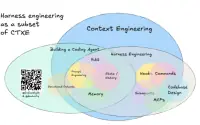
- Enterprise AI HumanLayer: The Skill Issue of Coding Agents—Practical Implementation of Five Types of Harness Configurations In-depth read of HumanLayer's long article: Failure is often a configuration issue, not a model one. Clarifying AGENTS.md, MCP, Skills, Sub-agents, Hooks, and back-pressure, and responding to ETH research and post-training overfitting debates.
- AI Engineering The New Rules of Context Engineering for Claude 5 Models: Trimming 80% of System Prompts Anthropic removed over 80% of Claude Code's system prompt for Claude Opus 5 and Claude Fable 5 without losing benchmark performance. Explore the paradigm shift from rigid instruction constraints to progressive disclosure, auto-memory, and rich reference harness engineering.