Engineering note
Ignorance.ai Playbook: The Converging Harness Practices of OpenAI, Stripe, and OpenClaw

In February 2026, Ignorance.ai (Charlie Guo) published a horizontal roundup: despite the OpenAI internal restructuring, Peter Steinberger (OpenClaw), and Stripe Minions having completely different scales and risk tolerances, they have highly converged on Harness Engineering. This is not a single company’s engineering memo, but rather a playbook that can be cross-referenced, documenting how an engineer’s work splits, how environments are designed, and how management evolves in the era of the “Agent Fleet.”
If OpenAI 11 is a deep-dive case study, and Hashimoto 16 is about naming and line-by-line AGENTS, this article is for those who, after finishing Phase 1, ask: What does the industry’s common language look like? This article is Phase 2 (List #9) of the Reading Map 13.
Original Source: Ignorance.ai (2026). The Emerging “Harness Engineering” Playbook. Source: Ignorance.ai, “The Emerging Harness Engineering Playbook”
Background: From Demo to Production-Grade Agent Fleet
The author previously described the evolution of tools: Copilot → Chat → Agent → Background Agent → Agent Fleet, with each step faster than the last. The qualitative change in recent months is that entire teams are restructuring around Agents, rather than just individuals trying new tools.
Greg Brockman (2026) relayed: Engineers inside OpenAI have stated that, since a certain point, the nature of their work has changed—previously, Codex mostly wrote unit tests; today, almost all coding and a massive amount of operations/debugging is done by Agents. For those who haven’t caught up, the bottleneck is often the environment and processes, not the ceiling of model capabilities.
Three Anchor Points (For calibrating magnitude, not exact audits)
| Entity | Phenomenon (Original Text) | Interpretation |
|---|---|---|
| Peter Steinberger / OpenClaw | Over 6600+ commits per month; often 5–10 Agents running simultaneously; code can be shipped without reading line-by-line | Extreme individual practice; humans act as “benevolent dictators” for architecture |
| OpenAI Squad | 3 engineers, 5 months, ~1 million lines, intentionally zero hand-written code; ~3.5 PRs/day per person and still growing with headcount | Internal product; harness built from scratch |
| Stripe Minions | 1000+ merged PRs per week; drop a task in Slack → Agent writes code, passes CI, opens PR | Enterprise-grade brownfield + heavy toolchain |
Common Conclusion: The bottleneck is usually not “can the model write code?”, but rather structure, tools, and feedback—consistent with OpenAI 11. Although the three cases have different risk tolerances (open-source experiment vs. internal tool vs. payment-grade production), they converge on the same points, making the signal even stronger.
Core Concept 1: The Engineer’s Work Splits in Half (and happens concurrently)
Echoing the shift “from maker schedule to manager schedule,” but more granularly:
Half A: Building the environment (Building the harness)
The OpenAI team expressed: When Codex gets stuck, the question isn’t “try tweaking the prompt again,” but rather:
What capability/structure/feedback is the environment missing that would allow the Agent to reliably proceed?
This includes: architectural boundaries, linters, CI, file systems, and observability tools—which is exactly Hashimoto 16’s “Agent makes a mistake → engineer it so it doesn’t happen again.”
Half B: Managing the work
- Steinberger: Extensive planning followed by execution; acts as an architectural gatekeeper on OpenClaw, discussing only architecture in Discord, not line-by-line code.
- Brockman: Each team appoints an agents captain to think about how Agents fit into workflows.
- The author himself: After Codex App changed his rhythm, his time shifted from implementation to scoping, directing, and reviewing.
Coupling of the Two Halves
It is not “build the harness first, then manage the Agents.” Both happen simultaneously:
- Agent fails → exposes an environment gap → patch the harness
- The better the harness → the lower the management friction → the more parallel sessions can run
Cross-referencing Fowler 14: guides (feedforward) and sensors (feedback) must be used together; you can’t just write AGENTS without validation.
Core Concept 2: Building the Harness—Four Recurring Practices
2.1 Architecture as guardrails
OpenAI (From the Harness Engineering post, cited by Playbook):
- Strict layered domain models; dependency directions and edges are mechanically enforced by Codex-generated linters + structural tests.
- Rules that are “nagging” in human processes become a multiplier in the Agent world—code it once, apply it everywhere.
Birgitta Böckeler (Fowler’s site): To increase trust in AI-generated code, we might need to narrow the solution space rather than expand the prompt—in the future, we may choose tech stacks that are best suited for harnessing, rather than the most flexible ones.
Stripe:
- Pre-warmed devbox—a development environment identical to human setups, but isolated from production/the external internet.
- 400+ internal tools accessed via Toolshed (MCP)—Agents need the same context and tool surface as humans, not an API patched on as an afterthought.
| Organization | Form of Guardrails |
|---|---|
| OpenAI Squad | Layering + mechanical linters |
| Stripe | Isomorphic devbox + tool parity |
| General Teams | ArchUnit, module boundaries, prohibiting cross-layer imports |
2.2 Tools are both foundation and feedback (Tools)
Brockman suggests:
Maintain a list of tools the team relies on, and assign an owner so Agents can access them (CLI/MCP).
Tools don’t just expand capabilities—with linters, tests, and browser automation, humans gain confidence in every diff. The author experienced this firsthand: explicitly instructing Codex to run certain linters/tests before committing significantly increased confidence.
OpenAI’s Advanced Approach (Called one of the smartest points by Playbook):
- Linter error messages = fix guidelines—when an architectural rule is violated, the message doesn’t just flag it; it teaches the Agent how to fix it.
- Tools teach the Agent during the work process (Fowler’s sensor signals designed for LLMs).
Brockman added: Fast tests + high-quality component interfaces—letting the Agent assemble within boundaries, rather than wiring things haphazardly.
2.3 Documentation is the system record (Documentation)
AGENTS.md (The agents.md consensus): A README for the Agent—build, test, conventions, architecture, and gotchas. Claude Code still defaults to CLAUDE.md, causing slight friction in the ecosystem.
Key Usage (Brockman + Hashimoto):
- Update it every time an Agent makes a mistake—don’t write it once and let it rot.
- Hashimoto’s Ghostty example: Every line corresponds to a past agent failure that is now prevented.
OpenAI’s Extension:
- A short AGENTS.md points to a deep source of truth in
docs/(design, architecture diagrams, execution plans, quality grading). - Background Agents do doc gardening—documentation is maintained by Agents, opening PRs to clean up outdated content (consistent with 11).
Anthropic’s Long Tasks (Playbook echoing 10 from another angle):
- Progress files, feature lists; even JSON tracking, which is harder for Agents to mess up compared to Markdown—like a handover between engineers who have never met.
2.4 Planning is the new “writing code” (Planning)
Industry consensus: Written plans first, reviewed by a human, before execution. Most coding tools already have a Plan mode.
Cloudflare’s Boris Tane (Cited by Playbook):
Separating planning from execution is the single most important thing I did—it saves tokens, preserves architectural decision power, and reduces wasted effort.
Anthropic initializer (10):
- Generates 200+ features from a high-level prompt, each containing test steps, initially all marked as failing—preventing one-shot attempts or premature claims of completion.
The author’s feeling: After Codex App upended his daily routine, the most important work happens before any code is written.
Core Concept 3: Becoming an AI Manager—Three Daily Skills
3.1 Say no to slop
Brockman’s 5th point:
Merged code still needs a human owner; the review standard should be at least identical to human-written code.
When Agents open PRs faster than you can review them, the temptation is to lower the bar—sources unanimously oppose this.
Although Steinberger doesn’t read line-by-line, he deeply cares about architecture and scalability—acting as OpenClaw’s architectural gatekeeper, and only discussing major decisions on Discord with contributors. The Playbook uses a master carpenter/apprentice analogy: you are hiring for the finished product and taste, not necessarily for them to manually saw the wood.
The author calls this bullshit detection—the higher the output volume, the more it is needed: is it too clever? will it be hard to maintain in six months? is the abstraction level correct?
3.2 Orchestration, not just delegation
| Mode | Who is doing it | Characteristics |
|---|---|---|
| Attended concurrency | Steinberger, the author | 5–10 or 3–4 sessions; human continuously redirects |
| Unattended concurrency | Stripe Minions | Drop task in Slack and leave; human only intervenes at review |
Unattended mode requires a much heavier harness (Toolshed, devbox, CI)—most teams aren’t there yet. The intermediate state: attended for complex tasks, unattended for clearly scoped tasks.
Cross-referencing Carlini 17: 16 parallel containers is an extreme attended + locked-task design; Stripe is productized unattended.
Core Concept 4: Four Open Questions That Remain Difficult
The Playbook honestly lists areas where there is no convincing consensus yet:
-
Functionally correct but hard-to-maintain code (entropy) Brockman’s closing question: How do we prevent slop from seeping in through different forms? OpenAI started using GC agents to sweep for inconsistencies—still emerging.
-
Behavioral validation gaps Böckeler critiques Harness articles: they lack functional/behavioral validation. Anthropic’s long-task research: Agents often mark tasks as complete without E2E testing; browser automation has a jagged frontier (e.g., Puppeteer cannot see native alerts).
-
Brownfield retrofitting Most success stories are greenfield or built with a harness from scratch. A ten-year-old codebase, lacking architecture, with sparse tests—is like running static analysis for the first time: a flood of alarms. How to harness a brownfield remains open.
-
Cultural adoption It won’t happen automatically—it requires someone to build the harness, define processes, and iterate. The good news: The investment compounds—every AGENTS update, every linter tutorial, and every MCP tool accelerates subsequent tasks.
Comparison with Phase 1 / Phase 2 Series
| Article | Position in the Playbook |
|---|---|
| OpenAI 11 | Million lines, AGENTS as directory, GC, layering |
| Fowler 14 | Constraining the solution space, guides/sensors |
| LangChain 15 | Component map, Terminal Bench |
| Hashimoto 16 | Harness naming, error-driven AGENTS |
| Schmid 18 | 2026 Strategy, build-to-delete |
| Parallel 19 | Definition and the five-step loop |
| HumanLayer 21 | Tactical checklist for configuration |
The unique value of the Playbook: Synthesizing cases into a checklist, making it easy to self-assess “are we missing environment building, work management, or validation?”
Takeaways and Recommendations (Actionable)
- Roles: Appoint a harness owner or agents captain; otherwise, the dividends of model upgrades will be consumed by environment debt.
- Linters: Error messages must teach the Agent how to fix, not just block CI.
- AGENTS.md: Keep it short, alive, and point to a deeper
docs/; update it every time a mistake is made. - Plan mode: Make it the team default, especially for architectural and cross-module changes.
- Concurrency Strategy: Strengthen the harness first before pushing for unattended; keep complex tasks attended.
- Review: Maintain the bar for slop; practice high-abstraction reviews (architecture, maintainability), not line-by-line spell checking.
Summary
The Ignorance.ai Playbook documents a discipline in the making: an intertwining of software architecture, team management, and context engineering. Steinberger observed: People who love algorithmic puzzles have a harder time being agent-native; those who love shipping products adapt faster—“letting go of writing every line by hand” is itself an emotional cost.
For readers, the most practical takeaway from this article is the two halves of work + four environment-building practices + three management skills + four open questions—you can use a single table to cross-reference your own organization, and then decide whether next quarter’s investment should be in linters, Toolshed-like integrations, or Plan/AGENTS discipline.
Series Guide
Original Source: Ignorance.ai (2026). The Emerging “Harness Engineering” Playbook. Source: Ignorance.ai, “The Emerging Harness Engineering Playbook”
Related engineering notes
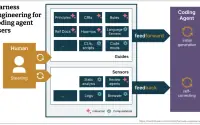
- Enterprise AI Harness Engineering Explained: Martin Fowler's AI Coding Workflow Harness Engineering, in Martin Fowler's terms, means outer control loops around coding agents—feedforward guides plus feedback sensors—so trust is designed control, not a feeling.
- Enterprise AI Mitchell Hashimoto's Six Stages of AI Adoption: From Dropping Chatbots to Harness Engineering A deep dive into Hashimoto's firsthand journey: three stages of tool adoption, redoing commits for practice, off-peak and slam dunk delegation, AGENTS.md and verifiable tools, plus the current state and limitations of 'always having an Agent running'.
- Enterprise AI HumanLayer: The Skill Issue of Coding Agents—Practical Implementation of Five Types of Harness Configurations In-depth read of HumanLayer's long article: Failure is often a configuration issue, not a model one. Clarifying AGENTS.md, MCP, Skills, Sub-agents, Hooks, and back-pressure, and responding to ETH research and post-training overfitting debates.