Engineering note
How Claude Speeds Up Biomolecular Models: FlashPairformer and Reversible Inference Kits

Anthropic’s September 17, 2026 post, How Claude is uplifting biomolecular modeling, is not another model leaderboard update. It describes a different kind of AI-assisted engineering: under researcher supervision, Claude modified and optimized the inference paths of more than 30 open-source biomolecular models, then packaged the results as public kits that can be compared with their stock versions.
The headline is less than four weeks of work and roughly 4x average speedup. The more durable lesson is the contract around that number: where the original release lives, what exact means, how much numerical drift fast mode permits, how big mode handles memory pressure, whether weights and dependencies are pinned, and whether a failed optimization can return to stock.
This article separates Anthropic’s first-party results from engineering interpretation, then examines FlashPairformer, the low-memory Big mode, protein-design cost experiments, and the rollback and supply-chain boundaries in the public repository. It is not an independent rerun, and it does not claim that Claude has replaced inference engineers.
Three different claims are hiding inside the headline
The official material covers three distinct result layers:
| Layer | What Anthropic reports | How to read it |
|---|---|---|
| Multi-model inference optimization | More than 30 biomolecular, protein, and genomics models; roughly 4x average speedup with minimal precision loss; nearly 2x when identical outputs are required; the official structure-prediction subset chart is closer to 1.6x | A first-party aggregate, not a universal benchmark across hardware, inputs, or drivers; the roughly 2x and 1.6x figures cover different scopes |
| Structure prediction and kernels | About 2.7–2.9x for triangle attention and 1.7–3.2x for triangle multiplication, depending on configuration | Operator-level results for selected settings, not an end-to-end promise for every model |
| Protein design and large systems | Comparable in-silico protein-design scores with far fewer GPU hours; Big mode makes some systems above 10,000 tokens run on one GPU node | ipSAE is a computational score, and feasibility is not the same as wet-lab or scientific validation |
The common requirement is a baseline. Without the stock version, input conditions, hardware, precision, mode, and downstream metric, speedup is just a context-free marketing number.
The real pipeline: the agent changes code, humans fix the gates
The post and technical report describe a workflow that can be summarized as:
- Select an open-source model and pinned upstream release, keeping the unmodified stock path.
- Inspect the inference graph, memory layout, repeated work, and GPU kernel hotspots.
- Build reusable kernels such as FlashPairformer, then make local changes for caching, dead branches, or layout.
- Place the optimization in an isolated kit with explicit off, exact, fast, or big semantics.
- Validate against the model’s downstream task, output differences, acceptance metrics, and memory requirements.
- Keep the upstream version, weight digest, environment, configuration, and change rationale alongside the optimized path.
Anthropic says that Claude was supervised by two staff members experienced in biomolecular modeling but not previously in kernel engineering, and that the accelerated versions were checked for downstream task performance. Those are author-reported process and results, not an external audit. The reusable engineering boundary is more important: the agent may propose and implement an optimization, but it should not rewrite the acceptance criteria, baseline, or promotion gate.
Why triangle operations become the bottleneck
Protein-structure models need to represent geometric relationships between tokens. Anthropic notes that AlphaFold3, OpenFold3, Boltz-2, and related systems spend substantial runtime and memory on triangle attention and triangle multiplication. Their cost grows at cubic scale with system size, so doubling the system can amplify both work and intermediate-memory pressure far beyond 2x.
That makes optimization more than “make one Python function faster”:
- kernels must reduce memory movement and unnecessary materialization;
- repeated work can be cached only when seed, shape, device, and state semantics line up;
- fast-mode numerical drift needs a downstream task budget;
- big mode may change tiling, multi-GPU, or host-memory behavior;
- exact mode needs an output comparison with stock rather than an aggregate-score argument.
FlashPairformer: reusable kernels plus model-specific patches
Anthropic and Claude developed FlashPairformer, custom kernels for triangle attention and triangle multiplication in the Pairformer architecture. Against the cited field standard, the post reports average improvements of roughly 2.7–2.9x for triangle attention and 1.7–3.2x for triangle multiplication, depending on pair width and model configuration.
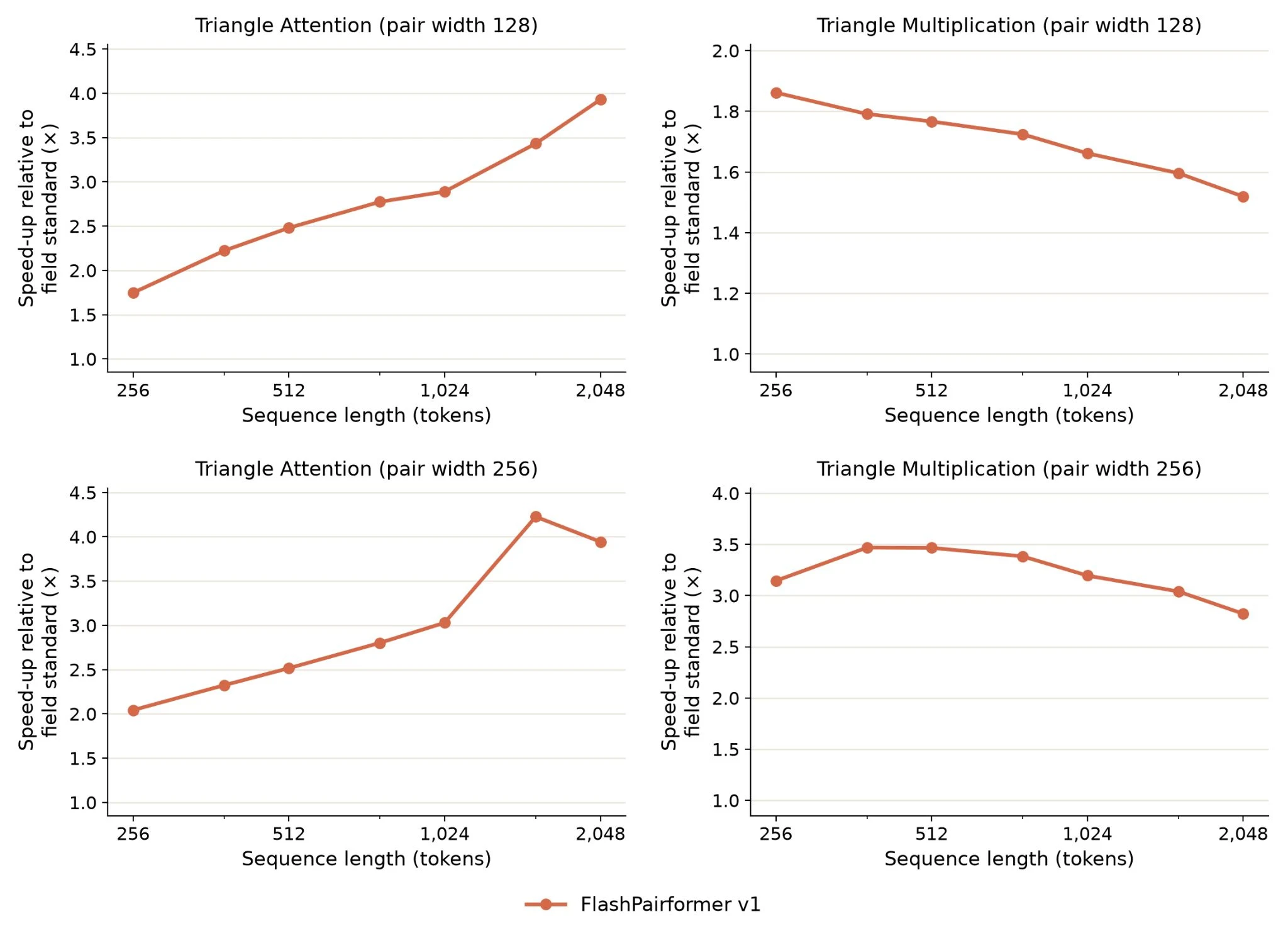
Figure: Anthropic’s FlashPairformer benchmark, showing operator speedups relative to the field standard. Source: How Claude is uplifting biomolecular modeling.
The important detail is that the curve is not flat. Sequence length, pair width, and kernel path change the gain, so turning one 3.9x configuration into a universal model-speed claim would be misleading. A production benchmark should hold at least these variables constant:
| Variable | Why it matters |
|---|---|
| Sequence length and pair width | They determine intermediate tensor size and usable parallelism |
| GPU, driver, CUDA, and backend | Bandwidth, compilation, and dispatch costs change the result |
| Mode and precision | Exact, fast, and big can use different paths and error budgets |
| Downstream metric | A faster kernel does not prove unchanged structure quality or design success |
FlashPairformer is the reusable layer. The post also describes model-specific changes such as caching redundant work and simplifying dead branches into constants. The practical gain therefore has two parts: a transferable kernel and local edits that require understanding each model’s execution graph.
The 36 kits are a rollback contract, not just packaging
The public uplifting-biomolecular-modeling repository contains 36 inference-optimization kits. Each kit keeps a pinned upstream release next to its own optimization package, environment, configuration, run scripts, STOCK.md, and CHANGES.md.
The repository defines four execution modes:
| Mode | Meaning | Question it should answer |
|---|---|---|
| off | Return to the pinned stock release | What does the upstream version do under the same input and environment? |
| exact | Preserve the stock output while accelerating it | Is output equivalence actually tested? |
| fast | Allow documented numerical differences, usually within seed-to-seed variation | Is the speed gain worth the error budget? |
| big | Reduce peak GPU memory and, for some kits, split work across GPUs on one host | Does the larger capacity remain scientifically trustworthy? |
The README also says that a mode which cannot activate on the current machine exits with NOT ACTIVE rather than silently falling back to stock. That fail-closed behavior is better for research and production debugging than an invisible fallback, because the operator knows which path ran.
Big mode changes the size frontier, not accuracy by itself
Big mode addresses a different bottleneck from ordinary speedup: it makes some previously memory-infeasible structures runnable. Anthropic shows human mitochondrial complex I, the TRiC chaperone complex, a proteasome, and a bacterial ribosome above 10,000 tokens, and reports successful predictions on a single NVIDIA GPU node.
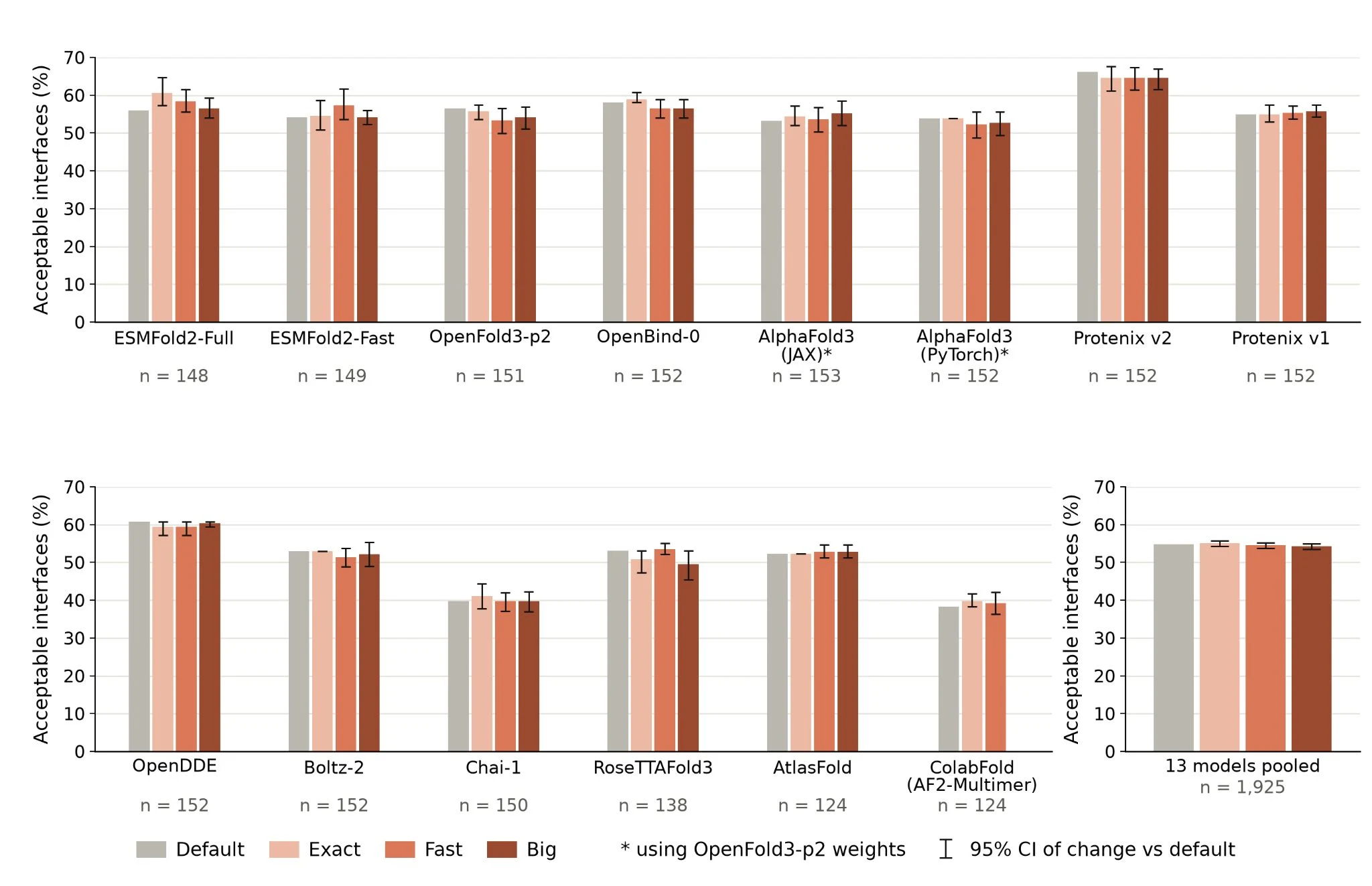
Figure: Anthropic’s chart of successful systems above 10,000 tokens and larger capability runs. Source: How Claude is uplifting biomolecular modeling.
But “runnable” and “correct” must stay separate. The same post describes capability runs from more than 31,000 to more than 70,000 tokens on one 8-GPU B300 node; these structures were not necessarily correct, and the post says some predicted structures collapsed. That creates a useful evidence boundary:
- Big mode demonstrates a lower memory barrier.
- Specific systems above 10,000 tokens have successful, experimentally aligned examples.
- Larger capability runs probe a compute boundary and are not automatically accuracy benchmarks.
- Adoption still needs domain-specific validation, external structure comparisons, and wet-lab confirmation.
If a platform records only “job completed,” it turns capacity expansion into a false scientific-validity signal. Provenance should retain mode, token count, GPU topology, recycle count, reference structure, quality metric, and uncertainty state.
The cost story is compelling, but it is in-silico evidence
The post also connects inference optimization to protein-design resource curves. Anthropic compares a prior campaign that could spend up to USD 10,000 per target, roughly 2,500 NVIDIA H100 GPU hours. In the new experiment, a single Claude model used one H200 for 24 hours, a roughly 1,100-word prompt, no sub-agents, and no human steering; three Claude models were run across 16 targets.
Anthropic reports that the median and highest-scoring designs reached roughly the earlier Mythos 5.1 campaign’s ipSAE levels while using about two orders of magnitude fewer GPU hours, with combined GPU and token spend around USD 150. Three qualifications matter:
- ipSAE is an in-silico binding score, not a wet-lab binding result.
- This is a 16-target experiment with specific models, hardware, and tools, not a universal cost guarantee.
- The announced competition’s wet-lab validation of more than 5,000 designs is a future validation program, not evidence already established by the current compute experiment.
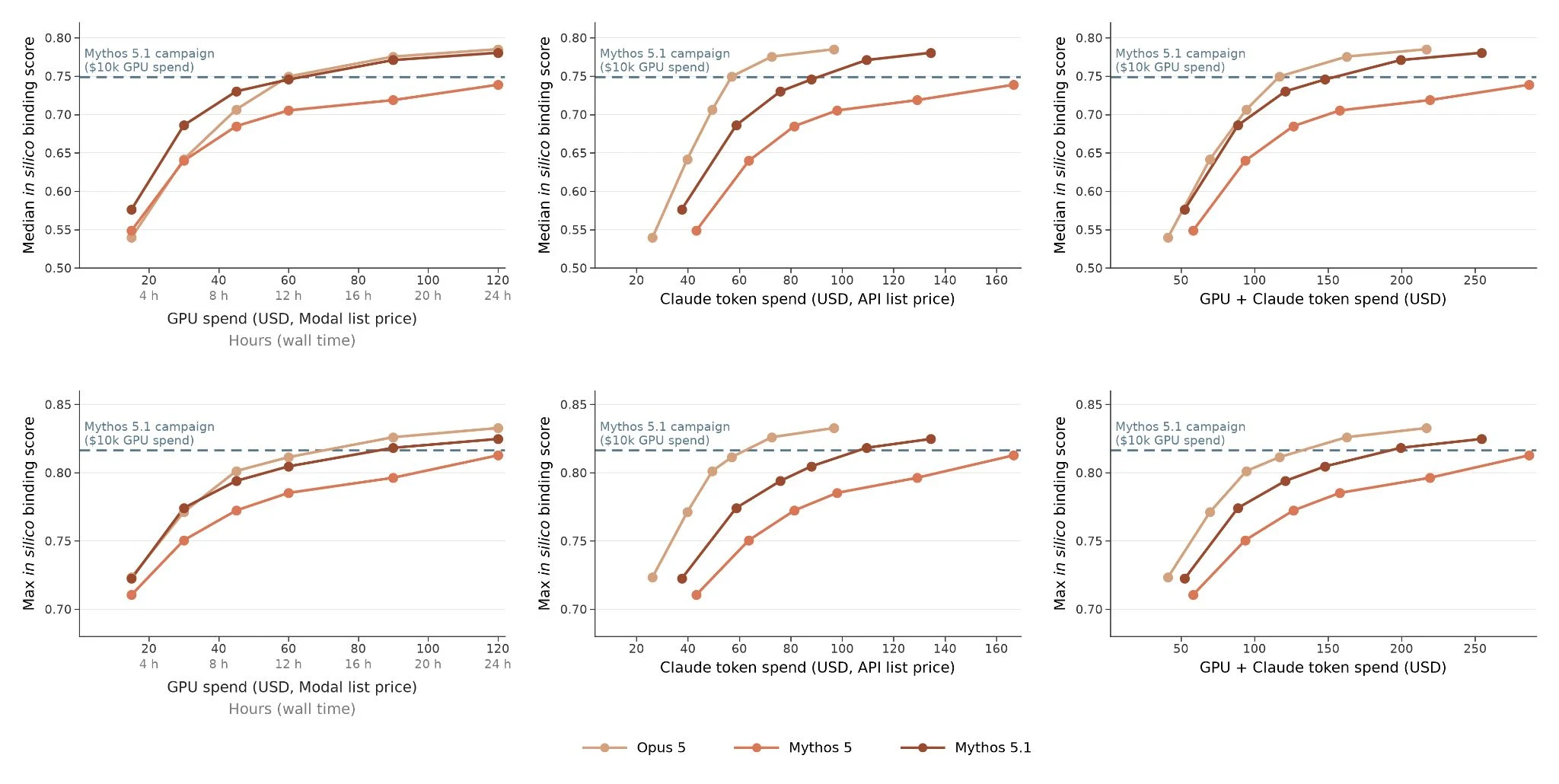
Figure: Anthropic’s cost/score frontier, separating GPU spend, Claude token spend, and their combined cost. Source: How Claude is uplifting biomolecular modeling.
The engineering lesson is not that every model should be rewritten by an agent. It is that research budgets should be decomposed into GPU hours, token spend, human review, reruns, failed experiments, and externally validated designs. Recording only API cost hides kernel review and scientific-validation cost.
What the repository still does not prove
Public code is strong evidence, but it is not independent validation. Before adopting the kits, I would keep these limitations in the same runbook as the performance numbers:
- the repository calls itself a reference release that is not maintained and does not accept contributions;
- original optimization code is Apache-2.0, while each upstream stock project keeps its own license;
- some kits use interpreter hooks, sitecustomize, editable installs, or upstream code execution that changes process behavior;
- GPU, driver, CUDA, Python, dependency locks, weight digests, and cache roots need to be pinned;
- Anthropic’s speed, precision, Big-mode, and protein-design results are author measurements; independent reruns on other hardware were not verified;
- fast-mode numerical drift still needs a task-specific scientific metric;
- protein-design ipSAE does not replace wet-lab validation.
These limits do not make the work uninteresting. They make the engineering conclusion clearer: this is a valuable acceleration reference release, not a production security certificate or a certificate of scientific correctness.
A practical adoption path for AI-assisted optimization
I would put five gates around a team adopting this style of work:
- Baseline gate: save the upstream commit, weight digest, input samples, hardware, and stock output.
- Equivalence gate: define byte-level, numerical, or task-level equality separately for exact and fast modes.
- Capacity gate: test OOM behavior, GPU topology, recycle count, quality metrics, and failure outputs for big mode.
- Supply-chain gate: review stock, opt, editable installs, interpreter hooks, download scripts, caches, and licenses.
- Promotion gate: promote a mode only after held-out inputs, downstream metrics, rollback smoke tests, and human review pass.
The same gates apply to general LLM inference. The checks may become logits, sampling distributions, tool-call schemas, long-context quality, and service latency, but the vocabulary of stock, exact, fast, big, provenance, and rollback remains useful.
A next reading path
If you are designing an agent runtime, start with the AI Agent architecture guide for execution envelopes, tool permissions, and failure recovery. For model and platform economics, read How to estimate LLM inference cost. For hardware integration boundaries, compare Model Hardware Standard; for asymmetric planning and execution, see A Gemini 3.8 Flash coding-agent workflow.
The final question is not whether Claude can “do research.” It is whether, when an agent produces an optimized path, we have enough baseline, equivalence definition, scientific validation, and rollback evidence to know what actually changed.
Sources and further reading
- How Claude is uplifting biomolecular modeling — Anthropic’s primary research post covering the multi-model optimizations, FlashPairformer, Big mode, and protein-design experiment.
- Uplifting biomolecular modeling repository — 36 inference kits, pinned stock versions, mode semantics, environments, and security notes.
- Technical report — the official technical report, treated here as first-party evidence rather than independent replication.
- NVIDIA cuEquivariance and BioNeMo Inference Runtime — related kernel and inference-tool context cited by the primary post.
Related engineering notes
- AI Engineering How to Read AI Agent Papers: From CoT and WebGPT to ReAct One diagram shows how CoT and WebGPT merge into ReAct, then connects Gorilla and IPI to the rest of the agent-systems reading path.

- AI Engineering What Is AgentEscapeBench: Measuring Out-of-Domain Tool Reasoning A deep read of AgentEscapeBench: why agents fail on out-of-domain, long tool chains, and what this benchmark can and cannot show.

- AI Engineering Self-Scaffolding for Agentic Coding: Ornith 1.0 Training and Evaluation Limits Read Ornith 1.0's self-scaffolding: what scaffolding solves in agentic coding, what benchmarks can prove, and where trust boundaries sit. Ornith is the case study, not the search entry point.