Engineering note
Parallel.ai Popular Science: Agent Harness is the Entire Lifecycle Beyond the Model

When colleagues ask, “Should we switch to a stronger model?”, this popular science article by Parallel.ai with a 23-minute read time offers another question: Is the lifecycle management wrapped around the outside of your model good enough? They define Agent Harness as: an architecture that manages the full lifecycle of context—from intent capture, specification, compilation, execution, verification to persistence, everything outside the model.
This is not “just another prompt trick,” but rather a software layer that allows pre-trained LLMs to connect to the world. This article is Phase 2 (List #8) of Reading Map 13, and it complements LangChain 15 “Inferring Components from Behavior”: this article leans towards definitions, the five-step loop, stack clarification, and FAQs, making it suitable for external presentations or onboarding.
Original Source: Parallel.ai (2025). What is an agent harness? Source: Parallel, “What is an agent harness?”
Background: From “Model + Chat” to “Orchestration + Harness”
Early ChatGPT was practically just LLM + conversational interface. Today, behind advanced assistants there is usually:
| Layer | Role |
|---|---|
| Orchestrator | Decides when and how many times to call the model (Control flow) |
| Harness | Tools, memory, long conversation structure, verification, persistence (Capabilities and side effects) |
| Model | Reasoning core |
Parallel emphasizes: The actual effect often depends on the orchestrator + harness, not just the marginal gains of model parameters or training data. This is the same narrative as the durability in Schmid 18, and the dramatic shifts in harness rankings of Terminal Bench in 15.
An architect’s definition in the original article can be condensed as:
Harness = A complete architectural system surrounding the LLM that manages the entire workflow of context from intent capture → specification → compilation → execution → verification → persistence.
Core Concept 1: Why Harness Appeared (Four Types of Practical Gaps)
When an Agent is asked to write cross-session software, query APIs, analyze long documents, or operate UIs, the bare LLM exposes four types of gaps:
1. Limited Memory and Context
Standard LLMs have a fixed context window, and each session starts from zero—Parallel compares this to an engineer with daily amnesia. Harness uses:
- Persistent logs, summaries
- External knowledge bases / vector databases
- Compaction (In the same family as the Anthropic Claude Agent SDK)
Allowing work to span across multiple context windows. Compare this to the initializer / coding agent and claude-progress.txt in Anthropic 10.
2. Models Can Only Spit Text, but Need to “Take Action”
Harness listens for tool-call instructions → pauses generation → executes search / program / API → stuffs the results back into the context, as if the model itself “wrote out” the observations. This is giving the model hands and eyes.
3. Lack of Structured Workflow
Complex tasks need to be broken down and verified at each step. Without structure, outputs are often superficially reasonable, but collapse upon closer inspection. Harness formalizes intent, sets acceptance criteria, and forces incremental progress.
4. Long-Horizon Tasks
Anthropic engineering post (cited by Parallel): No matter how strong a coding model is, without an external system for project initialization, progress tracking, and leaving artifacts for the next session, it is hard to build large apps well. What Harness fills is the glue between sessions.
Core Concept 2: How Harness Works (The Five-Step Loop)
flowchart LR
  A[Intent Capture] --> B[Tool Execution]
  B --> C[Context Compilation]
  C --> D[Verification Iteration]
  D --> E[Completion & Handoff]
E --> A-
Intent Capture and Orchestration Collaboration User goals are captured; the orchestrator breaks down sub-tasks or decides the next prompt; the harness provides tools and the context for the current step.
-
Tool Call Execution The model outputs structured tool requests → harness pauses text generation → executes in the external world → backfills the results. The model can reason over live data.
-
Context Management and Memory Before each round, compile working prompts: retain key points, summarize old conversations, and avoid context rot (same topic as isolation / reduction / retrieval in LangChain 15). Often distinguishes three layers of memory (compiled by Parallel):
Type Description Working context Instantaneous prompt for the current model call Session state Persistent log of the current task, can be cleared when the task ends Long-term memory Knowledge base / vector database across tasks -
Result Verification and Iteration Format checks, tests, security filtering; coding often sees write → test → fix unmanned loops. Harness encourages one sub-task at a time, committing / updating progress before advancing. Parallel explicitly reminds: Blindly adding “QA sub-Agents” might make things worse; it’s better to let the main Agent self-verify, escalating or resetting only when necessary.
-
Completion and Handoff Save artifacts, progress, repo states, letting the project have memory—even if the next LLM instance is brand new.
Key point: Harness does not alter model weights; it is the architectural layer that enhances the problem-solving capabilities of pre-trained models.
Core Concept 3: Common Components (Checklist)
| Component | Responsibility |
|---|---|
| Tool Integration Layer | Search, DB, code sandbox, images, etc.; default toolkit |
| Memory and State | Short/long-term memory, summaries, RAG injection |
| Context engineering | Isolation, compression, different prompts for first round vs subsequent rounds |
| Planning and Decomposition | Initializer builds list; coding agent does one feature at a time |
| Guardrails | Tests, schema, security; coding runs unit tests |
| Modularity | Pluggable perception / memory / reasoning |
Academic validation (ICML 2025 Game Agent Paper, cited by Parallel): The same GPT-4 class model, added with a harness of perception + memory + reasoning modules, has a consistently higher win rate than without harness across multiple games—proving that bottlenecks often lie in the surrounding systems, not in training a little bit more.
Core Concept 4: Examples and Stack Clarification
| Name | Harness Role |
|---|---|
| Claude Agent SDK | Anthropic calls it general-purpose harness; includes compaction |
| LangChain DeepAgents | Default prompt, planning, virtual file system; “OS out of the box” |
| AutoGPT, Copilot X, Cursor | Early or productized instances containing rudimentary harness |
| LM Evaluation Harness | ⚠️ Evaluation harness, different context from agent harness |
Harness vs Framework
- Framework (LangChain, LlamaIndex): Building blocks—tool abstraction, chains, agent loops.
- Harness: A complete runtime with defaults, often built on top of frameworks (DeepAgents uses LangChain).
Harness vs Orchestrator
- Orchestrator: Logic and control flow—when to call the model again, ReAct loops.
- Harness: Capabilities and side effects—executing tools, managing IO, compiling context.
- Both are used in tandem: the orchestrator says “run one more step”; the harness ensures that step has tools and the correct prompt.
Harness vs Prompt engineering
Prompt engineering is a technique; harness is the overall architecture including prompt decisions (tools, memory, loops, persistence).
Multi-Model Sharing
Harness can swap models without rewriting the whole system; even model routing (simple steps use smaller models). What needs adjustment are the details of tool syntax and prompt formatting for each model.
Core Concept 5: Benefits of Proper Design
| Benefit | Mechanism |
|---|---|
| Task Success Rate | Tools, memory, debugging loops compensate for model weaknesses |
| Long-Task Consistency | Load state after interruption, avoiding repetition or abandonment |
| Resource Efficiency | Precise context; knowledge graph / DB external reasoning can reduce tokens by 10–100x (magnitude claim from original text) |
| Capability Expansion Without Retraining | Vision, Python, search connected via harness |
| Reliability and Security | Filtering, process enforcement; harness acts like a governor on an engine |
Parallel’s conclusion aligns with industry slogans: “Harness makes or breaks the product”—same LLM, harness difference = user experience difference. Compare to Fowler 14, Ignorance 20.
FAQ Highlights (Original Key Points)
| Question | Short Answer |
|---|---|
| Does simple Q&A need a harness? | Not necessarily; once multi-steps, tools, or cross-session are needed, it’s almost always required (even if very thin) |
| Harness Engineering vs Traditional Software Engineering? | Borrows modules, states, tests, but must deal with a non-deterministic core, token limits, hallucinations |
| Only applicable to text LLMs? | The concept can extend to robotics, environment wrappers for RL |
Comparison with Other Articles in This Series
| You want to… | Read which post |
|---|---|
| Cybernetics and Trust | Fowler 14 |
| Components and Terminal Bench | LangChain 15 |
| Organizational-Level Practical Combat | OpenAI 11 |
| 2026 Strategy and durability | Schmid 18 |
| Industry Playbook Convergence | Ignorance 20 |
| Coding Configuration Tactics | HumanLayer 21 |
Insights and Recommendations
- External Communication: Use the “CPU / RAM / OS / App” analogy (see 18), then use the five-step loop in this article to explain what the OS does.
- Architecture Decisions: Mark new features as falling under orchestrator or harness first; avoid lacking in both.
- Long-Task Defaults: Progress file + verification steps + incremental commits, rather than infinitely lengthening the system prompt.
- Investment Sequence: First ensure a single harness path can be logged and scored (echoing Schmid’s hill climbing), before talking about swapping models.
Summary
The Parallel.ai article is a textbook-level definition piece: converging practices scattered across Anthropic, LangChain, and academic game experiments into lifecycle + five-step loop + stack vocabulary. It doesn’t replace the implementation details in 10 or the extreme stress tests in 17, but is suitable as the first reading for a team’s common language.
Editor’s Judgment: Stack analogies are convenient for external communication, but Parallel.ai did not provide a quantifiable harness ROI; in practice, it is still necessary to refer to the validation chain of OpenAI 11, avoiding treating the five-step loop as a checklist while ignoring domain constraints.
Series Guide
Original Source: Parallel.ai (2025). What is an agent harness? Source: Parallel, “What is an agent harness?”
Related engineering notes
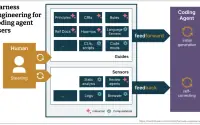
- Enterprise AI Harness Engineering Explained: Martin Fowler's AI Coding Workflow Harness Engineering, in Martin Fowler's terms, means outer control loops around coding agents—feedforward guides plus feedback sensors—so trust is designed control, not a feeling.
- Enterprise AI LangChain Dissects Agent Harness: From Model Capabilities to Deliverable Work Engines A deep dive into LangChain's long-form article: The formal definition of Harness, the component chain deduced from expected behaviors (Files, Bash, Sandbox, Memory, Context Rot, Ralph Loop), and the insights from model-harness co-training and Terminal Bench.
- Enterprise AI Mitchell Hashimoto's Six Stages of AI Adoption: From Dropping Chatbots to Harness Engineering A deep dive into Hashimoto's firsthand journey: three stages of tool adoption, redoing commits for practice, off-peak and slam dunk delegation, AGENTS.md and verifiable tools, plus the current state and limitations of 'always having an Agent running'.