As Large Language Model (LLM) agents are increasingly deployed to execute APIs, run code, and navigate multi-step workflows, evaluating their tool-grounded reasoning capabilities has become central to AI engineering. However, mainstream agent benchmarks (such as SWE-bench, BFCL, Tau2-Bench, and GAIA) operate largely within familiar domains—such as code repositories, travel booking, or customer service policies. In these environments, strong performance can reflect memorized domain conventions or short-range reactive tool calls, rather than true out-of-domain (OOD) reasoning.
A landmark paper published on arXiv, AgentEscapeBench: Evaluating Out-of-Domain Tool-Grounded Reasoning in LLM Agents (arXiv:2605.07926), addresses this gap by introducing an escape-room-style evaluation framework. Featuring 270 tasks across 5 controlled difficulty tiers (ranging from 5 to 25 DAG dependency nodes), AgentEscapeBench benchmarks sixteen LLM agents alongside human participants to diagnose how agents infer, execute, and propagate intermediate states in novel environments.
This article summarizes AgentEscapeBench’s architecture, key empirical findings, and takeaways for enterprise agent harness engineering.
1. Benchmark Architecture: Escape-Room DAG Generation
Existing benchmarks suffer from domain prior bias and shallow contextual dependency. In many benchmark tasks, an agent only needs to inspect the immediate prior observation to decide the next tool invocation. Information introduced early in an episode rarely acts as a mandatory prerequisite for downstream actions.
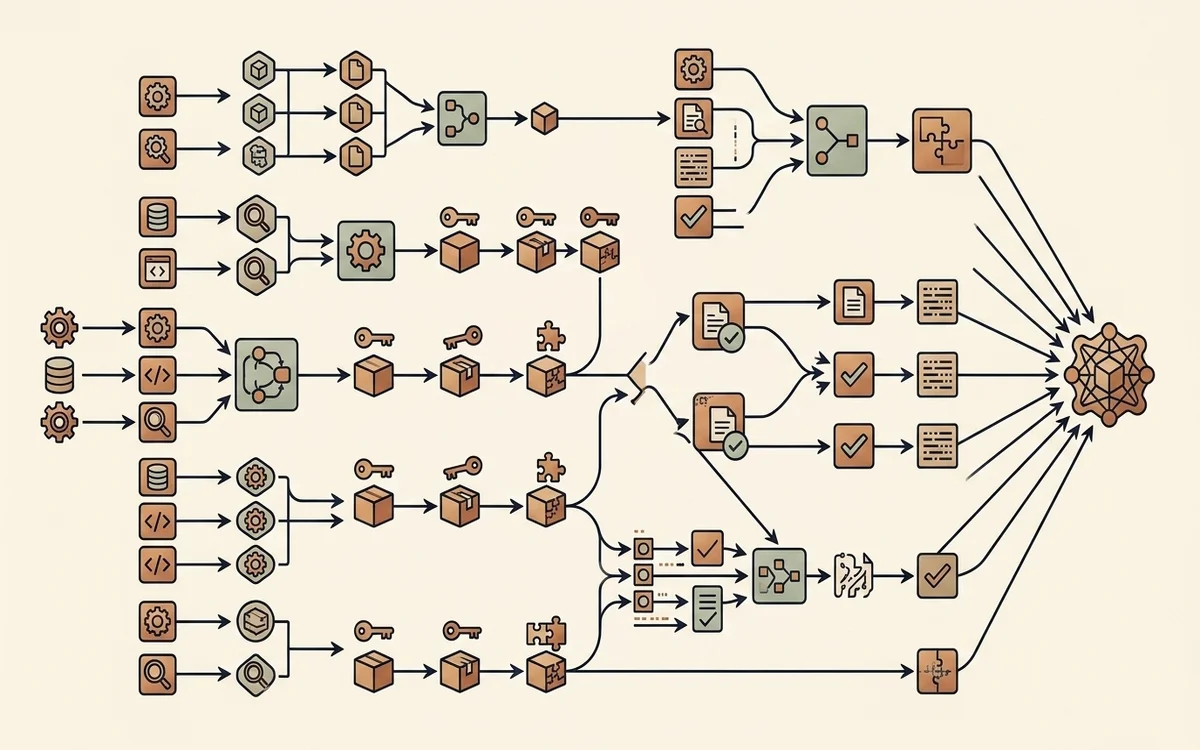
AgentEscapeBench constructs tasks using a 6-stage automated pipeline based on Directed Acyclic Graphs (DAGs):
- Template Library: Curates 32 tool templates (spanning big-integer math, cryptographic primitives, encoding/decoding, file operations, and graph algorithms), 16 item templates, and 4 container templates—each featuring typed input and output ports.
- DAG Skeleton Generation (Reverse-Generation Algorithm): Assembles a DAG skeleton backwards from a target goal node, enforcing single-use semantics and type contracts while eliminating isomorphic duplicates.
- Source Annotation & Value Instantiation: Identifies leaf input ports (unresolved seed inputs) and populates valid seed values using an LLM under strict type constraints.
- Deterministic Forward Execution: Executes the DAG in topological order, producing a deterministically verifiable ground-truth flag.
- Narrative Generation & Solvability Validation: Generates background narratives across 8 thematic styles, backed by 100% human solvability verification.
During evaluation, agents must inspect environment narratives, infer dependency structures, invoke real functions, manage incremental disclosure of hidden states, and propagate intermediate outputs along multi-hop tool chains.
2. Main Empirical Findings: Performance Collapse Under Long Dependencies
The study evaluated sixteen representative LLMs (including Claude-Opus-4.6, GPT-5.4, Gemini-3.1-Pro-Preview, DeepSeek-R1/Chat, MiniMax-M2, and Qwen3 variants) alongside human baselines:
1. Performance Degrades Monotonically with Dependency Depth
The benchmark divides 270 tasks across 5 difficulty tiers (Diff-5 to Diff-25). The following table compares the success rates of human participants against representative models:
| Target | Difficulty-5 | Difficulty-15 | Difficulty-20 | Difficulty-25 | Max Drop (ΔSR) |
|---|---|---|---|---|---|
| Human Baseline | 98.3% | 85.0% | 81.7% | 80.0% | - 18.3% |
| Claude-Opus-4.6 | 90.0% | 83.3% | 71.0% | 60.0% | - 30.0% |
| Gemini-3.1-Pro-Preview | 91.7% | - | 60.0% | 13.3% | - 78.4% |
| Doubao-Seed-2.0-Pro | High | - | - | Low | - 71.7% |
| MiniMax-M2 | High | - | 5.0% | - | Catastrophic |
As the table shows:
- Human Participants: Displayed robust capability generalization, with success rates declining gracefully from 98.3% at Difficulty-5 to 80.0% at Difficulty-25 (a modest 18.3 percentage point drop).
- Top Model (Claude-Opus-4.6): Achieved 90.0% success at Difficulty-5, but dropped to 60.0% at Difficulty-25 (a 30.0 point drop).
- Other Models: Experienced catastrophic collapse. Gemini-3.1-Pro-Preview plummeted from 91.7% at Difficulty-5 to 13.3% at Difficulty-25 (a 78.4 point drop); Doubao-Seed-2.0-Pro dropped by 71.7 points.
This demonstrates that high accuracy on shallow tasks (Difficulty-5) fails to predict long-range reasoning capability. Shallow heuristics collapse once dependency depth exceeds 15 nodes.
2. Sub-Problem Resolution Exposes the “Chaining Bottleneck”
Analyzing partial progress metrics revealed a key insight: At Difficulty-20, MiniMax-M2 solved only 5.0% of tasks end-to-end, yet resolved 43.0% of sub-problems and discovered 56.2% of hidden nodes. Gemini-3.1-Pro-Preview maintained an 82.0% sub-problem resolution rate despite its end-to-end success rate dropping to 60.0%.
This proves that the primary bottleneck in multi-step agent execution is not individual API invocation, but propagating intermediate outputs along multi-step dependency chains without loss or hallucination.
3. Explicit Reasoning (CoT) Models Do Not Dominate
Unexpectedly, models with explicit chain-of-thought (CoT) reasoning capabilities did not consistently outperform non-reasoning counterparts. For instance, DeepSeek-Reasoner (average success rate 59.6%) underperformed DeepSeek-Chat (average 63.8%) across all difficulty tiers.
Paper Authors’ Analysis: The core bottleneck in AgentEscapeBench is not internal inference depth within a single thought trace, but rather grounding reasoning in real-world tool interactions and updating beliefs based on external environment feedback. Extended internal reasoning traces can introduce overconfidence and hallucinated assumptions when external feedback is required.
3. Fine-Grained Trajectory & Error Diagnosis
Offline trajectory analysis across 240 evaluation runs per model revealed three primary failure signatures:
| Diagnostic Dimension | Metric Definition | Empirical Insight |
|---|---|---|
| Premature Invocation Rate | Fraction of tool calls executed before upstream data dependencies are resolved | At Difficulty-20, weaker models executed 35%–45% of calls prematurely. Top models (Claude-Opus-4.6: 17.1%) performed better, proving state tracking is a universal scaling bottleneck. |
| Clue Adherence Rate | Fraction of downstream tool arguments correctly populated from upstream outputs | Drops from 77%–90% at Difficulty-5 to under 20% at Difficulty-20 for weaker models (reverting to random guessing), while top models maintain 48%–52%. Strongest correlate of overall benchmark success. |
| Source Convergence Speed | Attempts required to resolve seed input nodes given parameter error feedback | Shows a 3x efficiency spread across models, highlighting varying capability in leveraging structured error feedback to narrow candidate search space. |
4. Tool-Calling Error Matrix
Beyond trajectory features, the paper categorizes specific API execution errors. Different models exhibit highly distinct failure signatures:
| Error Type | Definition & Observation | Typical Model & Specific Data |
|---|---|---|
| Missing Required Parameter | Failure to provide the complete parameter set defined by the API. | MiniMax-M2 averages 13.4 occurrences per instance at Difficulty-20; GPT-5 averages 8.7 at Difficulty-10. Indicates models easily omit parameters as tool schemas become complex. |
| Wrong Format | Failure to adhere to formatting rules for unfamiliar APIs. | GPT-5 is the only model to consistently commit this error across Difficulties 5–15 (others are near zero). Reflects a systemic format compliance deficit in GPT-5. |
| Wrong Node Type | Inability to correctly identify which nodes are executable tools. | DeepSeek-Reasoner and DeepSeek-Chat have the highest rates at Difficulty-20, reflecting hallucinated environment interactions. |
4. Four Key Takeaways for Agent Harness Engineering
AgentEscapeBench offers vital design principles for modern enterprise agent architectures:
- Shift from Prompt Management to Explicit State Machine Tracking: Do not rely on an LLM’s context memory to track 15+ dependency steps. The agent harness should manage DAG topology, dependency checks, and intermediate state caching.
- Block Premature Tool Invocations at the Harness Layer: Prevent API calls whose upstream prerequisites have not been met, saving token budget and avoiding execution errors.
- Enforce Strict Dataflow Binding (Clue Adherence): Implement explicit data binding channels that pass output values from Tool A directly into parameters for Tool B, preventing hallucinations.
- Establish Out-of-Domain Evaluation Suites: Before production deployment, build synthetic OOD benchmarks lacking domain priors to measure true agent adaptability under unfamiliar failure modes.
Conclusion
The paper AgentEscapeBench provides a diagnostic lens into current LLM agent limitations. Stripped of familiar domain memorization, an agent’s ability to maintain long-range tool dependencies degrades sharply. Bridging the gap between LLMs and human-level reasoning will require stronger harness state management, strict dataflow binding, and explicit execution guardrails.
Primary Sources and Further Reading
- Original Paper: arXiv:2605.07926 - AgentEscapeBench: Evaluating Out-of-Domain Tool-Grounded Reasoning in LLM Agents
- Related Bloss0m Guide: The New Rules of Context Engineering for Claude 5 Models
- Related Bloss0m Guide: GPT-5.6 Prompting Checklist: From Shorter Prompts to Tool Orchestration
- Related Bloss0m Guide: OpenAI Presence Enterprise Agent Platform
- Related Bloss0m Guide: AI Agent Complete Architecture Guide
Related engineering notes
- AI Engineering Self-Scaffolding for Agentic Coding: Ornith 1.0 Training and Evaluation Limits Read Ornith 1.0's self-scaffolding: what scaffolding solves in agentic coding, what benchmarks can prove, and where trust boundaries sit. Ornith is the case study, not the search entry point.

- AI Engineering How to Read AI Agent Papers: From CoT and WebGPT to ReAct One diagram shows how CoT and WebGPT merge into ReAct, then connects Gorilla and IPI to the rest of the agent-systems reading path.

- AI Engineering Holo4: One Agent Across GUIs, Code, and Tools—with Different Licenses A closer look at H Company’s cross-interface agent and long-horizon harness, its benchmark claims, public traces, and the licensing split between checkpoints.