Engineering note
DoorDash Ask Assistant Architecture: Where the 24% Conversion Lift Comes From

In the process of deploying generative AI into enterprise environments, the hardest part is often not just “calling an API”, but how to stably, safely, and efficiently integrate AI assistants into existing complex business systems.
Food delivery and retail giant DoorDash recently published a series of technical articles revealing the underlying architectural design of its generative AI assistant, “Ask DoorDash”. This assistant aims to help consumers discover restaurants, plan meals, and automatically build a cart within 2 minutes using natural language.
The most striking aspect is the real business growth it brought: During a 7-day production test, the AI assistant’s memory system increased checkout conversion for grocery shopping by 24%, increased average basket size by 17%, and reduced conversational turns by 7%. In restaurant exploration scenarios, the conversion rate for open-ended queries also increased by 15%.
Below is a breakdown of this enterprise-grade AI architecture that balances scalability and business value.
1. Separation of Concerns: Assistant Runtime and MCP Isolation Architecture
Many early AI projects hardcoded “business logic” directly into the System Prompt, leading to bloated and unmaintainable prompts. DoorDash adopted an architecture that separates the runtime from business capabilities:
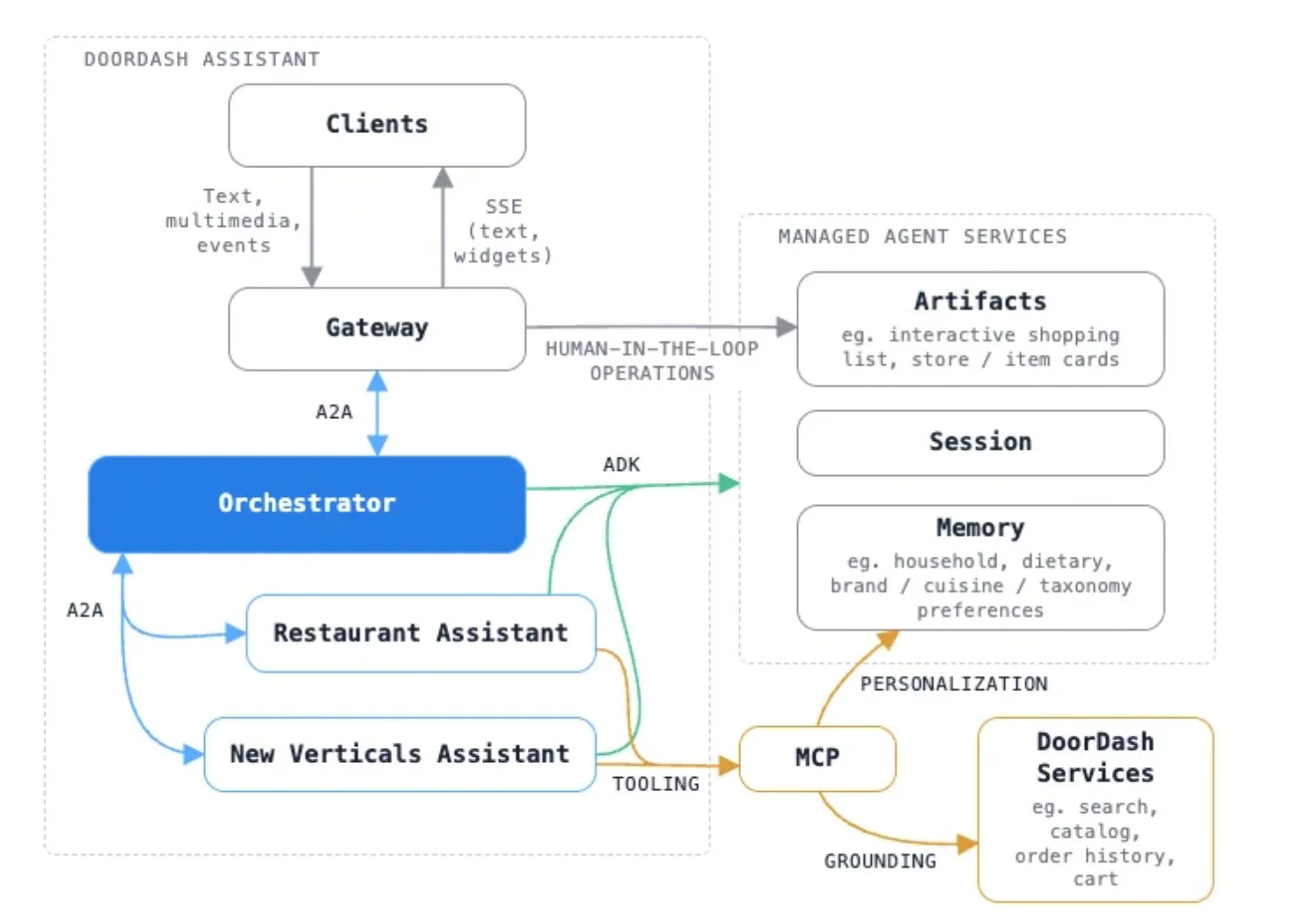 DoorDash Assistant Runtime Architecture (Source: DoorDash Engineering Blog)
Assistant Runtime
The central runtime is responsible for only three things: orchestrating user input, dispatching domain-specific Agents, and managing session state. It is a lightweight, business-agnostic Core Engine.
Model Context Protocol (MCP) Shared Layer
All specific business functions (such as catalog search, recommendations, cart operations, checkout, order history, etc.) are encapsulated in a shared MCP tool layer.
- Advantage: Rather than having the model understand “how to call the cart API,” it is better to let the model invoke predefined Tools (e.g.,
add_item_to_cart()) via the standardized MCP. This allows backend microservices to upgrade freely without breaking the AI assistant’s prompt logic, significantly enhancing platform reliability and maintainability.
2. Core Memory System (Intelligence & Memory Layer)
“Agents don’t just need access to user data; they need to provide the right context for the right task at exactly the right moment.”
To achieve the ultimate personalized experience, DoorDash introduced an intelligence layer comprising three memory mechanisms:
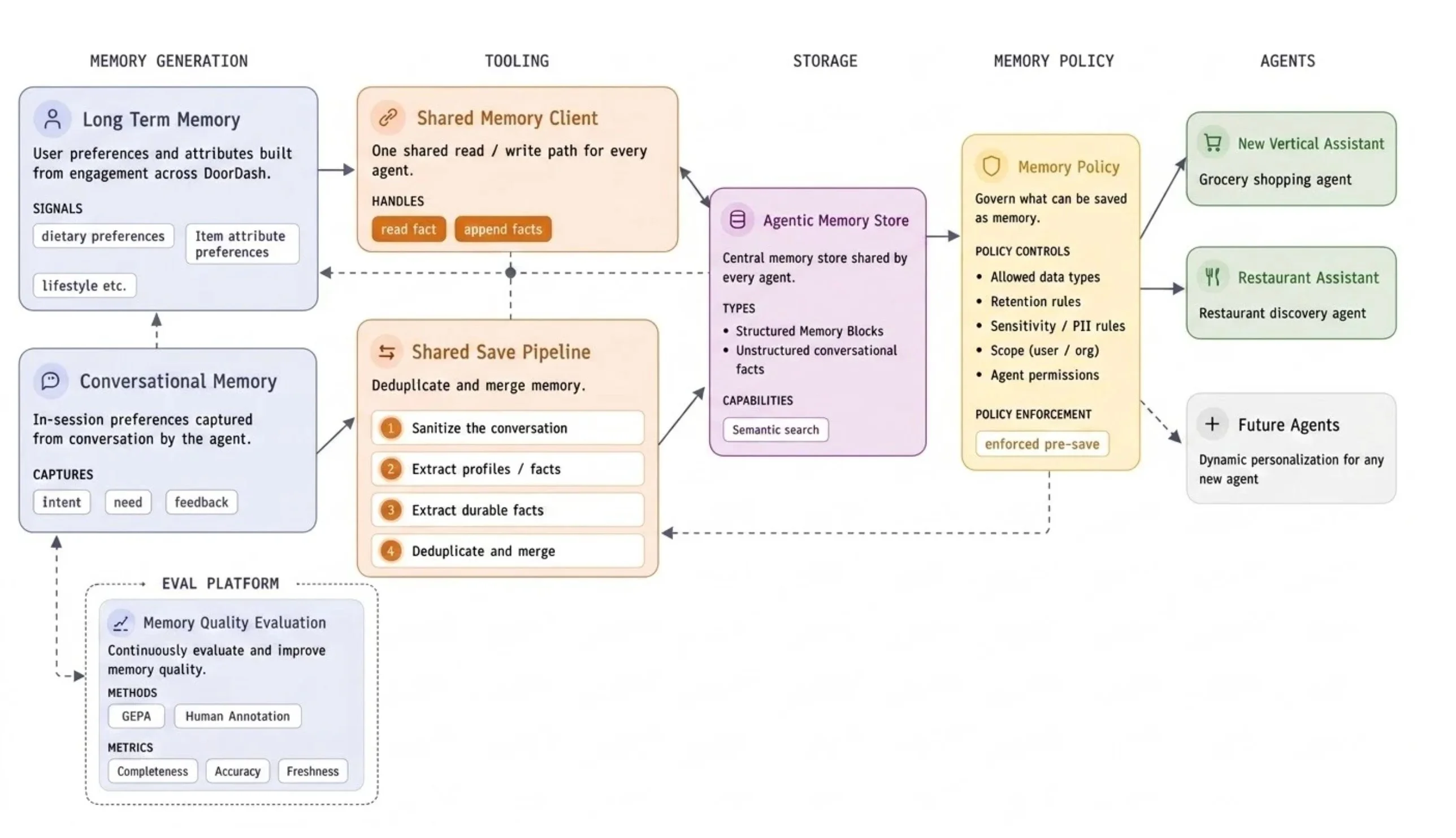 Memory architecture spanning generation, tool layer, storage, policy, and agents (Source: DoorDash Engineering Blog)
- Long-term Memory: This is generated offline based on the user’s historical consumer behavior. It captures the user’s long-term preferences, such as “favorite cuisines (e.g., Japanese, Italian)” or “dietary restrictions (e.g., vegan, gluten-free).”
- Session Memory: Maintains context continuity during a single conversational interaction. For example, if a user first says, “I want to eat ramen,” and then says, “add a soft-boiled egg,” Session Memory ensures that the second instruction correctly correlates with the ramen.
- Agentic Memory: Stores facts the user “explicitly tells” the assistant during the conversation. For example, if the user mentions, “I am allergic to peanuts,” this fact is instantly stored and takes effect in all subsequent recommendations and cart guardrails.
Memory Retrieval Flow
When a user initiates a request, the system first retrieves the most relevant data from these three memory stores via Semantic Vector Search. After ranking, the data is dynamically injected into the Prompt’s Context. This completely decouples memory management from LLM reasoning, drastically reducing token consumption.
3. Deterministic Actions and Performance Optimization
In practical operations, if every step relies on LLM generation, not only is the latency extremely high, but the system is also highly prone to errors due to model hallucinations. DoorDash implemented several key optimizations:
- Deterministic Actions: When a user says, “Checkout the items in my cart,” the system does not hand this authority over to the LLM to execute autonomously. Instead, the LLM only outputs a structured intent, and the outer deterministic code calls guardrails and confirmation workflows to ensure high-risk operations like payments are 100% secure.
- Versioned Artifacts: All cart states and recommendation results use versioned management, allowing users to “rollback” to a previous conversational state at any time, preventing the entire order from being ruined if the LLM acts erratically.
4. 2,000 Times Daily! Automated Simulation Evaluation Platform
“Building a useful AI Agent is hard, but knowing if it is actually good is even harder.”
To verify the behavior of the AI Agent in production and ensure no feature regressions occur during model upgrades (e.g., migrating to a newer, faster LLM), DoorDash built an automated simulated conversational evaluation platform:
- Dual LLM Sparring Simulation: One LLM plays the role of a “virtual customer,” adopting specific dietary preferences and a picky conversational style; the other LLM is the “DoorDash Assistant” under test. The two engage in multi-turn simulated conversations in an isolated environment.
- Recorded Tool Stubs (Fixtures): All real API responses are recorded to avoid generating real order charges during testing while ensuring reproducibility.
Remarkable Results from the Evaluation Platform
- Scale: Executes over 2,000 automated evaluations daily.
- Efficiency Boost: Drastically reduced the time for each regression testing cycle from 6 hours to 20 minutes.
- Painless Migration: During a recent model migration, this platform helped the engineering team successfully reduce system latency by 35% while maintaining an “8-point increase in quality score.”
Conclusion: A Practical Blueprint for Enterprise-Grade AI Applications
DoorDash’s Ask Assistant architecture demonstrates a practical blueprint for modern Platform Engineering in the AI era: Domain Teams focus on developing domain-specific Agents, while Platform Teams are responsible for maintaining the runtime, MCP toolchains, memory systems, and evaluation infrastructure.
By perfectly combining LLMs with deterministic systems, standardized protocols (MCP), and a three-tier memory, DoorDash proved that: Instead of letting the LLM shoulder the burden alone, placing it in a powerful “harness” is what truly allows AI to deliver massive commercial returns for an enterprise.
Further Reading
- Start with the Complete AI Agent Guide for a shared framework across tools, memory, and evaluation.
- Compare it with Amazon × TapPay Agentic Commerce to examine confirmation flows and control boundaries for high-risk actions.
- To turn runtime, permissions, and observability into platform capabilities, continue with Enterprise Agents on Bedrock AgentCore.
Reference: InfoQ - How DoorDash Built an AI Shopping Assistant That Doesn’t Rely on the LLM Alone
Related engineering notes
- AI Engineering Pydantic AI v2.45: Durable Agent Reliability Is a Session and Trace Contract A technical reading of how Pydantic AI v2.45.0 aligns DynamicToolset, MCP sessions, tool history, and usage spans with durable runs, plus the adoption boundaries for TypeSafeModel and Bedrock effort handling.

- AI Engineering Jev in the Agent Runtime: Confidence-Gated Routing, Fan-Out, and Community Experiments A practical architecture guide to placing Jev between agents, tools, and human review through confidence-gated routing, speculative fan-out, composite scoring, and careful evaluation.

- AI Engineering Forge v0.18.1: Open-Source Multi-User MCP Auth and Agent Governance A runtime-contract analysis of how Forge v0.18.1 connects multi-user MCP identity, OAuth consent, tenancy, policy, egress, and per-invocation audit—and where independent evidence is still missing.