Engineering note
OpenAI Presence Announced: Redefining Enterprise AI Agent Governance and High-Stakes Workflows

On July 22, 2026, OpenAI officially announced OpenAI Presence, a managed enterprise platform designed to build, deploy, operate, and govern AI agents for high-stakes business workflows. Rather than serving as a self-service DIY chatbot builder, Presence is engineered specifically for mission-critical enterprise environments such as customer support, claims processing, HR inquiries, and IT service desks.
As enterprise AI transitions from simple chat interfaces to autonomous agent execution, organizations face formidable challenges around reliability, safety compliance, and operational boundaries. The launch of OpenAI Presence marks a strategic milestone for OpenAI, expanding from a foundation model provider into an end-to-end managed platform providing safety guardrails, simulation testing, and expert co-deployment.
This article unpacks what OpenAI Presence is, examines its four core architectural pillars, and explores what this managed agent governance model means for enterprise AI engineering.
1. What Is OpenAI Presence? Product Positioning & Dogfooding
OpenAI Presence is a managed enterprise platform built to deploy trusted voice and chat agents for both customer-facing and internal business operations. The platform enables real-time voice and text interactions that integrate securely with enterprise backend APIs.
To prove the platform’s reliability in high-stakes environments, OpenAI dogfooded Presence for its own operations: launching AI Phone Support for English-speaking users. The agent handles real-time voice queries regarding ChatGPT and OpenAI product services, demonstrating production-grade reliability under high concurrency.
Presence is offered through a Limited General Availability (Limited GA) program. Rather than an unassisted SaaS self-serve model, deployments are co-engineered alongside OpenAI Forward Deployed Engineers (FDEs) and global systems integration partners to guarantee operational compliance.
2. Four Core Architectural Pillars
OpenAI Presence manages high-risk enterprise workflows through four foundational architectural pillars:
flowchart TD
    A[Job-Scoped Design] -->|Least privilege & bounded domain| B(Presence Agent Runtime)
    C[Governance & Guardrails] -->|Safety bounds & human escalation| B
    D[Simulation & Evaluation] -->|Pre-deployment synthetic testing| B
    E[Codex Continuous Loop] -->|Post-launch log analysis & self-healing| B
1. Job-Scoped Design
Presence rejects the concept of omnipotent, open-ended chatbots. Each Presence agent is built for a bounded, specific task (e.g., resolving billing disputes or managing employee insurance claims). Agents receive only the minimum API credentials and domain knowledge required for that role, preventing unauthorized actions or goal drift.
2. Governance, Guardrails, and Human Escalation
Administrators configure agent autonomy levels through a central control panel. High-sensitivity actions (such as issuing refunds or sending external emails) can require explicit human-in-the-loop approvals. If an agent encounters ambiguous customer requests or policy boundaries, it seamlessly escalates the session context to human support representatives.
3. Pre-Deployment Simulation and Automated Evaluation
Before deploying to production, Presence provides a synthetic simulation engine. Organizations test agents against thousands of edge cases and adversarial scenarios, automatically evaluating policy compliance, accuracy, and safety against enterprise-grade benchmarks.
4. Codex-Driven Post-Launch Continuous Loop
In traditional agent architectures, resolving edge-case failures requires engineers to manually inspect logs and write code fixes. Presence incorporates an automated optimization loop powered by OpenAI Codex:
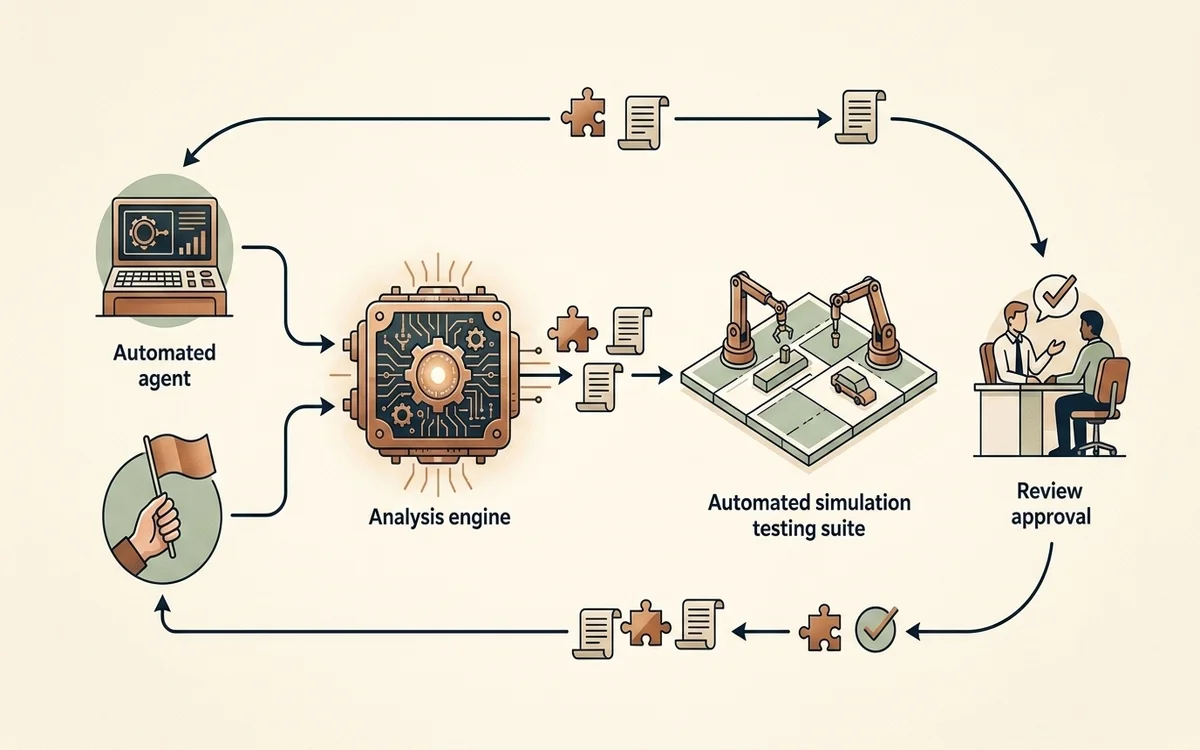
- The platform monitors production transcripts and human escalation sessions.
- Codex analyzes policy friction and knowledge gaps, generating proposed prompt and code updates.
- Human engineering teams review and test the updates in a sandbox environment before approving one-click production deployment.
3. Key Takeaways for Enterprise AI Engineering
The launch of OpenAI Presence establishes new standards for enterprise AI deployments:
- Shift from Model Capability to Governance: Frontier models are already capable; enterprise focus has shifted to operational safety, policy compliance, and deterministic execution.
- Co-Deployment Models Are Becoming Standard: Deploying high-stakes agents requires specialized Forward Deployed Engineering (FDE) support and systems integration.
- Continuous Self-Healing Loops Are Essential: Production agent platforms must integrate pre-launch simulation testing with post-launch Codex optimization loops to adapt as business policies evolve.
Conclusion
OpenAI Presence represents a mature blueprint for enterprise AI agent governance. By combining job-scoped boundaries, governance guardrails, simulation testing, and Codex-driven continuous optimization, Presence lays a solid foundation for deploying AI agents in high-value, high-stakes business environments.
Primary Sources and Further Reading
- Official Announcement: OpenAI: Introducing OpenAI Presence
- Related Bloss0m Guide: Enterprise AI Agent Governance Framework
- Related Bloss0m Guide: OpenAI GPT-5.6 Prompting Guidance: From Lean Prompts to Programmatic Tool Orchestration
- Related Bloss0m Guide: The New Rules of Context Engineering for Claude 5 Models
- Related Bloss0m Guide: AI Agent Complete Architecture Guide
Related engineering notes
- Enterprise AI GitSpawn: When Repository Git Config Runs Before a Coding Agent's Trust Boundary A technical analysis of how repository-local core.fsmonitor can trigger background commands before coding-agent workspace trust and approvals, with the archive delivery condition, patch matrix, safe lab boundary, and enterprise controls.

- Enterprise AI Model Hardware Standard: an MCP-shaped interface for physical devices An evidence-led look at Anthropic's Model Hardware Standard research preview: standardized drivers, discovery, and device control for agents, while identity, authorization, approvals, and physical safety remain platform responsibilities.

- Enterprise AI GitHub Copilot MCP Governance: From Allowlist Semantics to Agent Adoption Telemetry GitHub has added enterprise MCP allow and deny lists alongside third-party agent activity in usage metrics; this article explains the policy semantics, telemetry boundary, and a practical rollout loop.