Retrieval, RAG & Evidence Grounding
20 reading notes
Explore engineering trade-offs in multimodal retrieval, GraphRAG, ranking, evidence discovery, and traceable answers.
Reader question
How can a system keep finding verifiable evidence as its corpus and tool surface grow?
Reading library
Read this topic in depth
Every paper reading currently filed under this research topic.
-
Predicting Partial Answer Quality and Utility in Agentic Retrieval-Augmented Generation
AdvancedA deep reading of Predicting Partial Answer Quality and Utility in Agentic Retrieval-Augmented Generation: turning intermediate answer quality, utility, and trajectory signals into an early-stopping controller, then checking the savings and transfer boundary.
Understand it in 90 seconds
- Problem
- An agentic RAG system may execute several query, retrieve, read, and reasoning rounds before it produces a final answer. Running every instance to natural stopping wastes cost after the answer has saturated, while continuing after a failure pattern may only repeat the failure. The paper asks whether each partial answer can provide a prediction of quality and utility.
- Core insight
- Partial quality and incremental utility are different targets. Quality asks how close the current answer is to the gold answer; utility asks how much quality changed from the previous round. Quality is easier to predict, while the sign and magnitude of utility depend more strongly on trajectory, retrieval noise, and task.
- Strongest evidence
- On Search-R1 and R1-Searcher over HotpotQA, 2WikiMultiHopQA, and MuSiQue, the authors compare supervised and unsupervised predictors. Search-R1 reaches about 0.438 at the best quality Pearson correlation and about 0.321 for utility; with thetaP=0.3 and thetaU=0.2, the controller reduces average iterations from 3.21 to 2.86 and preserves 97.60% of natural-stopping quality.
- Main boundary
- Partial answer quality is probed with F1 against a gold answer. That is not open-ended answer quality, and it does not show that a threshold transfers to a new retriever, model, corpus, answer format, or controller. Probing itself has generation cost.
-
RAGSieve: Detecting RAG Knowledge-Poisoning Promotion with Self-Referenced Local Contrast
AdvancedA deep read of RAGSieve: query-local and corpus-local references expose suspicious retrieval promotion without a trusted clean corpus, while the paper's boundary remains essential—promotion detection is not truth verification.
Understand it in 90 seconds
- Problem
- RAG places external corpus content inside the evidence used for generation. An attacker who can get a small number of documents ingested through a public page, shared store, or connector may promote a chosen false answer into the top five for a target query. The hard part is that the attacked corpus is not a trusted reference, and natural semantic density varies by topic.
- Core insight
- Do not assume a separately clean dataset, and do not apply one global threshold across the corpus. RSQ performs query-local contrast between the top five and ranks 6–20 for the same query; RSG performs corpus-local contrast between each document's semantic neighbors and its own local floor. Both let the inspected system supply its own matched control.
- Strongest evidence
- Across nine dataset–retriever systems and six attacks, RSQ reaches 95.2% macro AUROC and detects 82.2% of poison at an operating point allowing at most 5% clean-document removal. RSG reaches 93.3% and 79.8%. Serial RSG plus RSQ lowers ASR from 67.4% to 14.0% while unpoisoned-retrieval F1 changes from 42.1% to 41.3% (Tables 1, 5, and 9).
- Main boundary
- These are results on synthetic attacks, three QA corpora, three dense retrievers, and a fixed evaluation protocol. They support the claim that suspicious promotion patterns can be exposed by local contrast; they do not support the claim that a flagged document is false, that a retrieved claim has been truth-verified, or that production-scale multi-tenant latency and zero-poison guarantees follow.
-
When Failure Propagates, Can We Still Find the Start? Causal Failure Attribution in Agentic RAG
AdvancedA deep reading of When Failures Propagate: an interventional benchmark, three-hop MuSiQue, and certified content corruption that separate failure detection, causal attribution, propagation, and recovery in agentic RAG.
Understand it in 90 seconds
- Research problem
- Agentic RAG splits retrieval, reasoning, and answering across several hops. An early bad piece of evidence can become query drift, a wrong bridge, or a wrong answer, but later retrieval can also repair it. A final answer or the last trace state therefore cannot directly tell us which hop first caused the failure.
- Core insight
- AgenticRAG-FP injects a certifiable fault at a specified hop, then resumes execution from the changed prefix and regenerates the suffix. The diagnoser is not guessing the cause of a static error trace; it is tested against the known injectedathop label with exact-hop attribution.
- Strongest evidence
- The strict dense Claude Haiku 4.5 sweep uses 80 three-hop MuSiQue questions. Among cases that still fail, coverage-based exact-hop accuracy is hop 1: 0.91 [0.81, 0.98], hop 2: 0.00 [0.00, 0.00], and hop 3: 0.00 [0.00, 0.00], with failed denominators 43, 36, and 21 respectively (Table 2, Section 7.1).
- Main boundary
- The result supports the claim that, under this strict intervention and suffix-resumption setup, coverage’s hop-level signal disappears at deeper hops. It does not support the claim that every natural agentic RAG failure is un-attributable. The content study has only 18 hop-2 failed cases and 3 hop-3 failed cases, so its method comparisons cannot be generalized.
-
REVA: Moving RAG compression into reusable evidence views instead of paying per request
AdvancedA critical reading of Nguyen et al.'s REVA (arXiv 2609.11209 v1): historical generator attention becomes a document-keyed score store, separating offline scoring from online rendering while exposing unseen-document fallback, local/global budgets, quality, and latency boundaries.
Understand it in 90 seconds
- Problem
- A post-retrieval compressor that invokes another model, scores tokens, or rewrites text on every request can erase the latency benefit of a shorter context. A model-agnostic selector may also preserve information the target generator already knows while deleting evidence it actually needs.
- Core intuition
- Historical RAG requests already contain signals about how the generator used a document. Map attention from the query and available answer/response tokens onto readable word units, average those signals across repeated document accesses, and obtain a reusable evidence prior. This is a document-level retention tendency, not a query-specific answer.
- Strongest evidence
- With a fixed top-10 retrieval cache, four QA benchmarks, and three generators, Table I's full-split B=512 REVA-local result is higher than Trunc-local on NQ, TriviaQA, HotpotQA, and 2Wiki. Table II averages 37.83 F1, 26.98 EM, and 27.5 ms online overhead across 12 generator–dataset settings. Table III's all-seen 120-cell budget grid gives REVA-global 43.72 F1, 32.75 EM, and 49 ms.
- Main boundary
- All-seen keeps only held-out queries whose retrieved documents all have scores, so it is diagnostic rather than deployment coverage. Full-split includes prefix fallback. Attention is an evidence-importance proxy, not a citation verifier, and reported online overhead excludes score-store construction and updates.
-
VikingRAG: Fewer Retrieval Rounds, Less Context Waste for Structured-Document RAG
AdvancedA deep reading of VikingRAG: hierarchy-preserving URI-addressable storage, Search/List/Grep/Read tools, reusable experience edges, and adaptive escalation for reducing repeated retrieval tokens and latency.
Understand it in 90 seconds
- Problem
- Enterprise manuals, syllabi, papers, contracts, and financial reports are not bags of unrelated chunks. An answer may require finding the right document, then following chapter, section, or subsection structure to collect facts that are far apart. Serializing every directory into the prompt makes structural context expensive; doing only one flat top-k retrieval can miss cross-section dependencies on the first pass.
- Core insight
- Move the hierarchy from the prompt into queryable external semantic storage. Every directory node, chunk, and multi-level abstract receives a URI whose prefix preserves ancestor–descendant relations. A vector result is therefore not only text; it is a navigation handle that can drive scoped List, Grep, and Read operations (Sections 2.2 and 3.1).
- Strongest evidence
- The evaluation covers six structured-document datasets and eight baselines, with default settings K=10, L=1,000, and B=15. End-to-end accuracy, latency, LLM tokens, ingestion, and deletion are measured. Figure 3 and Table 3 report 11.6%–51.9% token ratios for VikingRAG and 5.1%–32.5% for VikingRAG-E+; Figure 7 repeats the central comparison with GPT-5.5, Seed-2.0, and GLM-4.7 on VersionQA.
- Main boundary
- Accuracy is an LLM-as-a-judge semantic-consistency proxy with expert verification, not a direct retrieval-recall or independently replicated correctness proof. Experience edges are warmed with 1,000 synthetic historical questions generated from the same document corpus; false-no-escalation is still 14.4% on QASPER and 6.7% on FinanceBench (Table 7).
-
RAG: Attach Retrieval to Generation, but Do Not Treat 2020 RAG as a Production RAG Platform
Intermediate Retrieval, memory, and production RAGA source-grounded reading of Lewis et al., NeurIPS 2020: BART is paired with a dense retriever over Wikipedia, and RAG-Sequence / RAG-Token condition generation on retrieved passages. RAG-Seq reaches 44.5 Exact Match on NQ; this is a 2020 method paper, not a 2025 production RAG platform and not an agent loop.
Understand it in 90 seconds
- Problem
- Large pretrained models store facts in their parameters, yet still lag task-specific architectures on knowledge-intensive work; parametric memory is hard to update, hard to inspect, and prone to hallucination.
- Core insight
- Pair a pretrained seq2seq generator (BART) with a pretrained dense retriever (initialized from DPR) over a Wikipedia index. The decision point moves from “answer from parameters only” to “retrieve passages, then condition generation.” RAG-Sequence shares one document across the sequence; RAG-Token may switch documents per token.
- Strongest evidence
- Table 1 open-domain QA: on NQ, RAG-Seq 44.5 and RAG-Token 44.1 beat DPR 41.5, REALM 40.4, and T5-11B+SSM 36.6. Table 2 generation and classification: on Open MS-MARCO, RAG-Seq is +2.6 Bleu and +2.6 Rouge-L versus BART; on FEVER-3, 72.5 sits 4.3 points below the then pipeline SOTA of 76.8, with no intermediate retrieval supervision.
- Main boundary
- The memory is the December 2018 Wikipedia dump split into 21M 100-word chunks, not a private corpus; retrieval is dense MIPS, not a production hybrid; there is no agentic search / read / final loop, and no 2026 enterprise sense of citation faithfulness.
-
DPR: Turn Open-Domain QA into Dense Passage Retrieval, but Do Not Treat the Dual Encoder as Production RAG
Intermediate Retrieval, memory, and production RAGA source-grounded reading of Karpukhin et al., EMNLP 2020: a BERT dual encoder trained with question–passage pairs and in-batch negatives replaces BM25 over Wikipedia passages via MIPS. On NQ, top-20 retrieval is 78.4% vs BM25 59.1%; end-to-end Exact Match is 41.5. This is the retriever RAG uses, not a generation platform.
Understand it in 90 seconds
- Problem
- Open-domain QA depends on efficient passage retrieval; in practice the first stage is almost always sparse TF-IDF or BM25. Sparse matching struggles with synonyms and paraphrases, and it cannot learn a task-specific space from question–passage pairs.
- Core insight
- Replace that first stage with two independent BERT-base encoders: a passage encoder embeds Wikipedia passages offline into 768-d vectors and builds a FAISS index; a question encoder embeds the query online and retrieves with maximum inner product search (MIPS). Training uses gold positives plus in-batch negatives (and BM25 hard negatives), without ORQA/REALM-style expensive extra pretraining or periodic index rebuilds.
- Strongest evidence
- Table 2 top-20 / top-100 retrieval accuracy—on NQ, Single DPR reaches 78.4% / 85.4% versus BM25 59.1% / 73.7% (about +19.3 points at top-20); the abstract states a 9%–19% absolute gain. Table 4 end-to-end Exact Match: DPR 41.5 on NQ, above ORQA 33.3 and REALMNews 40.4. Figure 1: DPR trained on only 1,000 examples already beats BM25.
- Main boundary
- Memory is the 20 Dec 2018 English Wikipedia dump split into about 21.015 million 100-word passages; evaluation is English open-domain / extractive QA; similarity is dual-encoder dot product without late interaction; this is not a production hybrid, not citation faithfulness, and not agentic search / read / final.
-
Self-RAG: Let the Model Decide When to Retrieve, but Do Not Treat Reflection Tokens as a Production RAG Gate
Intermediate Retrieval, memory, and production RAGA source-grounded reading of Asai et al., ICLR 2024: an LM is trained with reflection tokens (Retrieve / Relevant / Supported / Useful) for on-demand retrieval and self-critique. Self-RAG 7B / 13B reach 54.9 / 55.8 on PopQA; this is a when-to-retrieve method paper, not a production RAG platform and not an agent tool loop.
Understand it in 90 seconds
- Problem
- Standard RAG retrieves a fixed number of passages whether or not retrieval helps; irrelevant context can hurt generation and reduce instruction-following versatility. Even after retrieval, the model is not guaranteed to follow the passages.
- Core insight
- Train an arbitrary LM to emit reflection tokens during generation: Retrieve decides whether to call a retriever; ISREL / ISSUP / ISUSE critique relevance, support, and utility. Retrieval becomes a decision, not a default pipeline stage.
- Strongest evidence
- Table 2’s six-task summary—Self-RAG 7B / 13B reach PopQA 54.9 / 55.8, TriviaQA 66.4 / 69.3, PubHealth 72.4 / 74.5, ARC 67.3 / 73.1; biography FactScore 81.2 / 80.2; ASQA citation precision / recall 66.9 / 67.8 and 70.3 / 71.3. Table 3a: against Self-RAG (50k) at 45.5 PopQA, No Critic falls to 42.6 PopQA and 18.1 ASQA em; Retrieve top1 falls to 41.8 PopQA.
- Main boundary
- The critic is first labeled by GPT-4 silver feedback and then distilled; reflection tokens can still be wrong; memory and evaluation stay on Wikipedia / public QA, not enterprise ACL or a citation product; this is not a tool-using agent loop.
-
REALM: Wire Retrieval into LM Pre-Training, but Do Not Treat Joint Training as a Ready-Made RAG Stack
Intermediate Retrieval, memory, and production RAGA source-grounded reading of Guu et al., ICML 2020: a differentiable knowledge retriever is pre-trained with an MLM signal, an asynchronously refreshed MIPS index, and Open-QA fine-tuning. With CC-News / Wikipedia, NQ Exact Match is 40.4, above ORQA and T5-11B. This is costly retrieval-augmented pre-training—not Lewis RAG generation and not DPR’s cheaper dual-encoder recipe.
Understand it in 90 seconds
- Problem
- Pre-trained LMs store world knowledge in parameters; covering more facts pushes networks ever larger, and the stored knowledge is hard to locate or update.
- Core insight
- During pre-training, add a learnable knowledge retriever that fetches documents $z$ from a corpus such as Wikipedia, backpropagate an MLM signal through retrieval (treating $z$ as a latent variable), and use asynchronous MIPS refreshes so the index can keep up with changing document embeddings.
- Strongest evidence
- ICML Table 1 Open-QA Exact Match—REALM with $X$=CC-News and $Z$=Wikipedia reaches NQ 40.4, WQ 40.7, CT 42.9; same-scale ORQA scores 33.3 / 36.4 / 30.1; T5-11B (11318M) reaches only 34.5 on NQ. Table 2: 30× stale MIPS drops NQ-dev Exact Match to 28.7.
- Main boundary
- Memory is the 20 Dec 2018 English Wikipedia dump (just over 13 million chunks of up to 288 wordpieces); evaluation is English Open-QA with extractive spans; training needs 64-TPU pre-training and periodic index rebuilds; this is not production RAG, not generative RAG, and not when-to-retrieve.
-
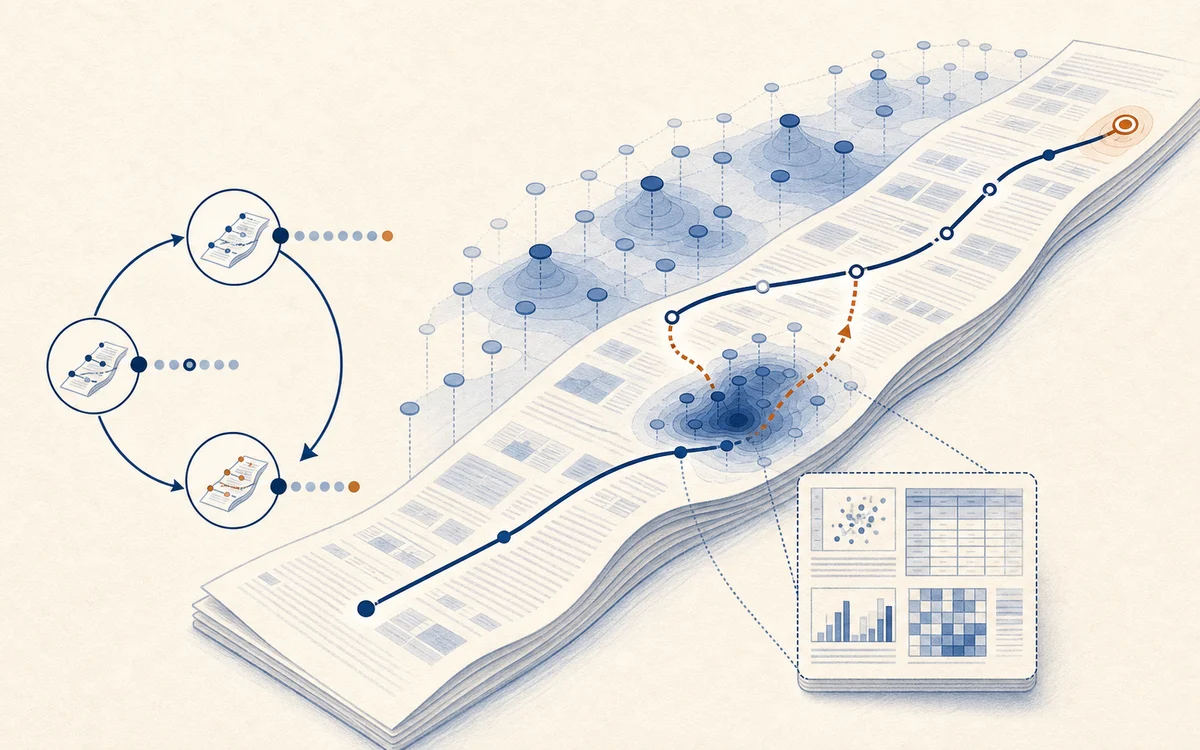
DocMemo: Letting Long-Document RAG Recover from a Bad First Retrieval
Advanced Retrieval, memory, and production RAGA deep reading of DocMemo: document schema, page belief, and question episodic memory preserve retrieval state across rounds, while Bayesian updates, Thompson sampling, and adaptive granularity recover missed evidence.
Understand it in 90 seconds
- Problem
- Evidence in long documents can be spread across dozens of pages, tables, figures, and cross-page clues. Static retrieval fixes a top-k page pool at the start; if the first pass misses evidence, the reasoner has no state that explains which pages may still help, which were ruled out, or what remains missing.
- Core insight
- Turn retrieval into dynamic evidence exploration. Document Schema Memory stores document structure, Page Belief Memory updates page relevance beliefs, and Question Episodic Memory records discoveries and query refinement for the current question.
- Strongest evidence
- On MMLongBench-Doc, LongDocURL, and PaperTab, DocMemo reports accuracy of 71.3, 81.1, and 80.4, for a 77.6 average. Table 4 also shows MMLongBench-Doc accuracy falling from 71.3 to 68.5 or 68.8 when memory or Bayesian updating is removed.
- Main boundary
- Evaluation depends on a GPT-4.1 binary judge, PDF rendering, Qwen3.5-VL-9B, ColQwen2.5, MinerU, and annotations from three benchmarks. It does not establish citation faithfulness, access-control correctness, freshness, or total cost on arbitrary enterprise corpora.
-
FinRank: Hard-Negative Retrieval Evaluation for Financial-Document RAG
Intermediate Retrieval, memory, and production RAGA deep reading of FinRank: how company, year, and disclosure boundaries create deceptively plausible evidence, and why pooled retrieval, hard negatives, and metadata filters must be evaluated together.
Understand it in 90 seconds
- Problem
- Financial-document QA fails for more than one reason. The same term can appear in different companies, filing years, and notes, while a metadata filter can remove the true supporting passage. FinRank asks whether a retriever can preserve the right evidence among these plausible but wrong alternatives.
- Core insight
- The authors build 1,185 human-authored financial QA records, a 5,230-passage pooled corpus, and 6,021 curated hard negatives, then test generalization across multiple splits, query rewrites, and provenance boundaries.
- Strongest evidence
- On the pooled corpus, the reported Recall@10 is 44.8 for e5-mistral-7b-instruct and 32.1 for BM25. Metadata-filtered BM25 reaches 55.0, but Section 7.1 notes that first-occurrence metadata can exclude the gold passage. In Section 7.3, curated hard negatives lower pairwise accuracy by 13.0–20.5 percentage points versus random negatives.
- Main boundary
- The paper does not measure answer generation, citation correctness, or faithfulness. The data is concentrated in U.S. 10-K/10-Q filings from 2024–2025, with annotation and distribution caveats. This is a strong retrieval-evaluation starting point, not proof of safe financial RAG deployment.
-
AskChem: Making Provenance-Carrying Claims the Retrieval Unit
Advanced Retrieval, memory, and production RAGA critical reading of AskChem's atomic claims, source locators, faceted taxonomy, evidence graph, and AskChem-Bench results, with a clear boundary between citation traceability and scientific correctness.
Understand it in 90 seconds
- Problem
- paper/chunk retrieval leaves a reader or agent to find the supporting sentence, establish claim location, and synthesize across papers.
- Core insight
- AskChem makes typed atomic claims with DOI and quote/evidence locators the retrieval unit, then connects them through taxonomy, an evidence graph, and shared REST/SDK/MCP interfaces.
- Strongest evidence
- the 2.4M-claim, 147K-paper system reports 100% DOI resolvability for AskChem-grounded answers versus 88.3% for LLM-only on 30 chemistry synthesis questions (Section 7; Table 1).
- Main boundary
- DOI resolvability and citation density are provenance proxies, not proof of claim truth, complete literature coverage, or usable chemical conclusions.
-
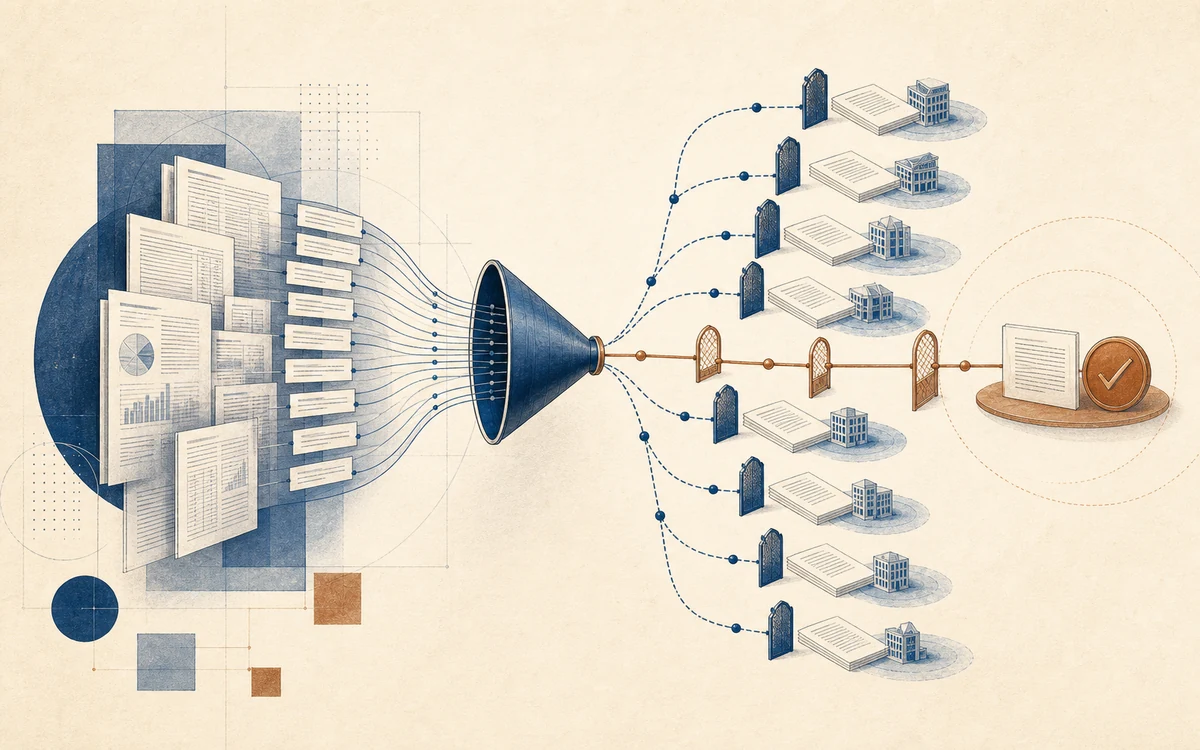
BM25 Wins at Scale: A Scaling Study of Retrieval-Augmented Generation Paradigms
Intermediate Retrieval, memory, and production RAGA deep reading of Wang et al.'s arXiv v3 study: across 28 nested enterprise-shaped corpus tiers with fixed questions, evidence, and adversarial documents, why BM25 crosses over at roughly 10 million corpus tokens and why agents should begin after global candidate discovery.
Understand it in 90 seconds
- Problem
- RAG paradigms are often compared at one corpus size, hiding joint accuracy, construction-cost, query-cost, and latency scaling.
- Core insight
- 28 nested corpus tiers (1,144 to 511,959 documents) hold reader/judge and adversarial bedrock fixed while comparing lexical, dense, graph, and file-system agency; a retrieval-swap control isolates access substrate.
- Strongest evidence
- at large shared tiers, BM25 reportedly overtakes raw file-system agency around 10M corpus tokens; a matched 150-question resweep gives Agent+BM25 69.4 versus raw-file agency 36.9 (Section 5.1; Figure 4; Table 4).
- Main boundary
- EnterpriseRAG-Bench is fictional and enterprise-shaped, with 500 questions and one main reader/judge; no public executable data/benchmark artifact is confirmed, so this is not “BM25 always wins.”
-
Before Reasoning Can Fail: Pre-Evidence Procedural Failures in Agentic RAG
Advanced Retrieval, memory, and production RAGA deep read of how Before Reasoning Can Fail turns answer-before-reading into an observable trajectory failure, and tests whether Read-Gate actually improves multi-hop QA.
Understand it in 90 seconds
- Problem
- an agentic RAG system can search snippets but finalize before reading. That is a procedural failure before evidence-conditioned reasoning, distinct from being wrong after reading gold evidence.
- Core insight
- saved tool traces, retrieved/read passages, and final answers define discipline and post-gold-read failure; Read-Gate requires at least one read after search and before final, without changing model, retriever, or reasoning budget.
- Strongest evidence
- 12,000 paired trajectories over HotpotQA, 2WikiMultiHopQA, and MuSiQue; forced reading adds 14.9–19.9 LLM-Acc points on the zero-read subset and 3.2–9.4 on full minimal-reasoning cells (Table 1; Section 5.2).
- Main boundary
- it applies to systems with observable search/read/final actions; reading does not guarantee the right evidence or reasoning, and incomplete MuSiQue gold chunks limit post-gold-read analysis.
-
RubricRanker Deep Read: RAG Needs the Right Document Set, Not Just the Most Relevant Documents
Advanced Retrieval, memory, and production RAGA close reading of how RubricRanker uses query-specific search rubrics, SFT, and GRPO to train a document reranker, and what its deep-research and RAG benchmark results actually establish.
Understand it in 90 seconds
- Problem
- Traditional rerankers score documents independently, so the top k need not be complete, concise, consistent, or authoritative as a set.
- Core insight
- Change the output target from a document ranking to an evidence set that jointly supports the answer, using query-specific rubrics for labels and rewards.
- Strongest evidence
- Tables 1–3 show downstream gains, while the ablation points to rubric labels and cold-start SFT rather than RL alone.
- Main boundary
- Final answers are still produced by agents and scored by LLM judges; a better evidence set does not guarantee correct citation, reasoning, or facts.
-
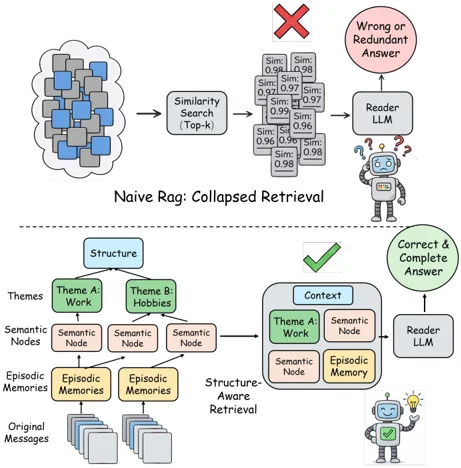
Beyond RAG for Agent Memory: Detailed Notes on xMemory
Intermediate Retrieval, memory, and production RAGAn interpretation of arXiv:2602.02007 covering xMemory's four-tier hierarchy, sparsity–semantics objective, two-stage top-down retrieval, and empirical results on LoCoMo/PerLTQA.
Understand it in 90 seconds
- Problem
- agent memory is a temporally connected, near-duplicate, highly relevant interaction stream; fixed top-k chunks can crowd into one local region, while pruning can sever dependencies.
- Core insight
- xMemory decouples and aggregates raw messages into message, episode, semantic, and theme levels, uses a sparsity–semantics objective for split/merge, and retrieves top-down to spend detail only when needed.
- Strongest evidence
- LoCoMo, PerLTQA, and long-dialogue comparisons use Table 1, Figure 2, Figure 3, and appendix ablations to support hierarchy, retrieval, and efficiency claims.
- Main boundary
- hierarchy quality depends on segmentation, embeddings, and budget; benchmark QA does not establish safe production updates or governance of long-term memory.
-
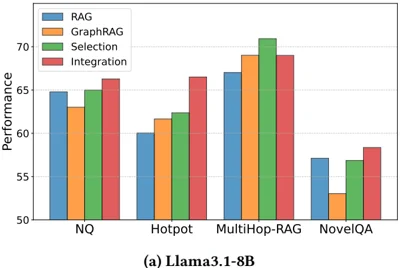
RAG vs GraphRAG: A Systematic Evaluation and Hybrid Strategies (Detailed Notes)
Intermediate Retrieval, memory, and production RAGInterpreting the unified evaluation protocol, four types of GraphRAG, figures in Tables 1-5, efficiency trade-offs, and Selection/Integration hybrid strategies based on arXiv:2502.11371.
Understand it in 90 seconds
- Problem
- GraphRAG systems change graph construction, retrieval, context budget, and generation at once, so individual papers do not answer when graph cost is worthwhile.
- Core insight
- under unified preprocessing, retrieval budgets, and generation scripts, the paper separates RAG from KG-based, community-based, text-centric, and hierarchical GraphRAG, then proposes Selection/Integration hybrids.
- Strongest evidence
- QA and query-based-summarization comparisons in Tables 1–5 and Sections 4–5 show that benefits vary by query type, global context, and graph-building cost.
- Main boundary
- tested systems, corpora, Llama-3.1-8B-Instruct, and fixed budgets limit transfer; a benchmark win is not ROI for your documents or SLA.
-
RAG-Anything: Multimodal Document Retrieval Is Not Just Text Conversion
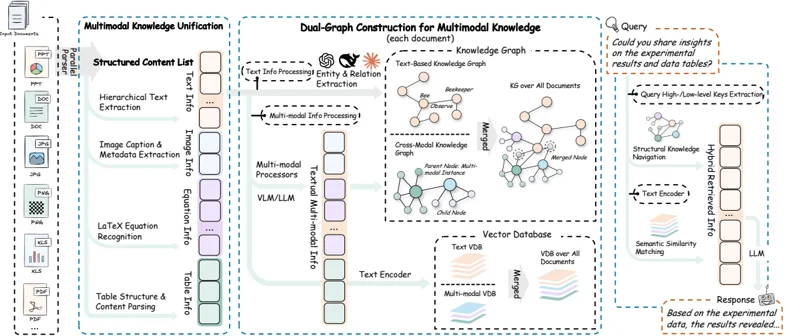
Intermediate Retrieval, memory, and production RAGA source-grounded reading of RAG-Anything's dual graph, experimental evidence, failure cases, artifact status, and engineering adoption boundary.
Understand it in 90 seconds
- Problem
- Traditional approaches often collapse figures and tables into captions, losing cells, panels, axes, and cross-page relationships.
- Core insight
- Use textual proxies for retrieval while preserving dereferenceable raw artifacts; combine explicit graph relations with dense similarity to find evidence.
- Strongest evidence
- Tables 2–4 and Figure 2 show an overall lead, attribute most of the gain to graph construction, and show a larger gap on long-document slices.
- Main boundary
- Abstention, parser errors, entity alignment, cost, and latency are not solved by aggregate accuracy.
-
RAG-MCP: Retrieve Tool Discovery, but Account for Routing Failure
Intermediate Retrieval, memory, and production RAGA source-grounded reading of RAG-MCP's tool-routing pipeline, 11,100-tool stress test, MCPBench result, scale failure, and incomplete artifacts.
Understand it in 90 seconds
- Problem
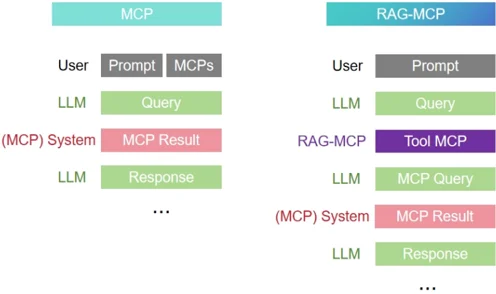
- placing every MCP tool schema in a prompt increases tokens, distractors, and wrong-tool selection.
- Core insight
- index MCP metadata, retrieve a small top-k schema set, then validate and invoke inside that set. Retrieval generates candidates; it does not authorize a decision.
- Strongest evidence
- on MCPBench web search, RAG-MCP reports 43.13% ground-truth MCP top-1 accuracy versus 18.20% for keyword pre-filter and 13.62% for all-schema prompting (Section 4.2; Table 1).
- Main boundary
- v1 does not fully expose retriever metadata, embedding/version, schema drift, permission, p95 latency, or real invocation success; top-1 routing is not task success.
-
RAG without Forgetting: Writing Successful Query Expansion Back into the Index
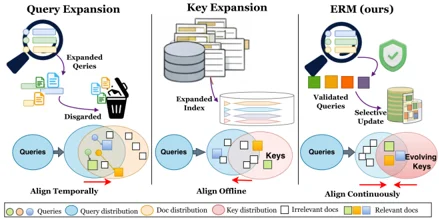
Intermediate Retrieval, memory, and production RAGA source-grounded assessment of ERM's correctness gate, selective attribution, bounded key updates, BEIR/BRIGHT results, and missing artifacts.
Understand it in 90 seconds
- Problem
- query expansion can bridge query–document mismatch but regenerates work on every request; persistent key expansion can write bad feedback into the index.
- Core insight
- ERM accepts an expansion unit only through a correctness gate, attributes it to document keys whose similarity it improves, and applies a bounded update. It updates keys, not retriever parameters.
- Strongest evidence
- the paper reports retrieval and generation results across 13 BEIR/BRIGHT domains, with Table 1, Table 2, Figure 3, and Appendix B.9 separating quality, latency, budget, and transfer.
- Main boundary
- there is no public implementation, live A/B, attack/privacy, or rollback study; a bad gate can turn a wrong association into persistent index state.





For speaking invitations, internal engineering sessions, or architecture exchange, see the topics and public work I can bring into the conversation.
Speaking & contact