Self-RAG deep reading
Series · 1 posts
-
Self-RAG: Let the Model Decide When to Retrieve, but Do Not Treat Reflection Tokens as a Production RAG Gate
Intermediate Retrieval, memory, and production RAGA source-grounded reading of Asai et al., ICLR 2024: an LM is trained with reflection tokens (Retrieve / Relevant / Supported / Useful) for on-demand retrieval and self-critique. Self-RAG 7B / 13B reach 54.9 / 55.8 on PopQA; this is a when-to-retrieve method paper, not a production RAG platform and not an agent tool loop.
Understand it in 90 seconds
- Problem
- Standard RAG retrieves a fixed number of passages whether or not retrieval helps; irrelevant context can hurt generation and reduce instruction-following versatility. Even after retrieval, the model is not guaranteed to follow the passages.
- Core insight
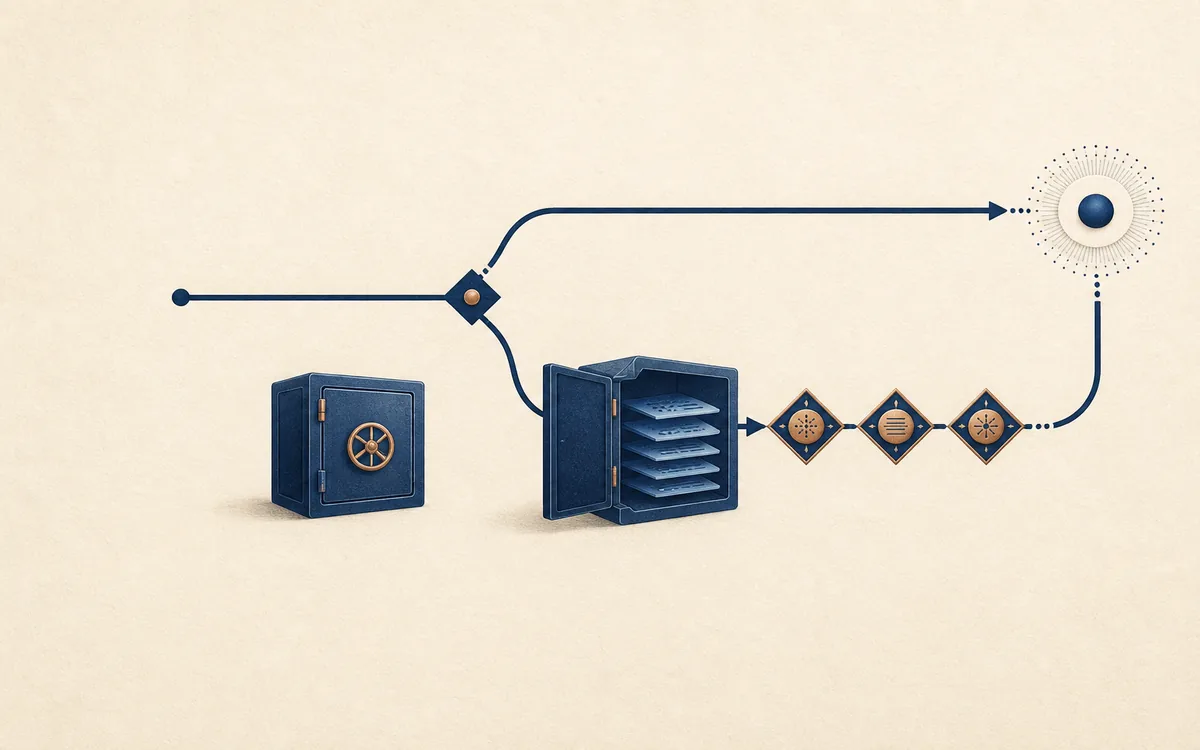
- Train an arbitrary LM to emit reflection tokens during generation: Retrieve decides whether to call a retriever; ISREL / ISSUP / ISUSE critique relevance, support, and utility. Retrieval becomes a decision, not a default pipeline stage.
- Strongest evidence
- Table 2’s six-task summary—Self-RAG 7B / 13B reach PopQA 54.9 / 55.8, TriviaQA 66.4 / 69.3, PubHealth 72.4 / 74.5, ARC 67.3 / 73.1; biography FactScore 81.2 / 80.2; ASQA citation precision / recall 66.9 / 67.8 and 70.3 / 71.3. Table 3a: against Self-RAG (50k) at 45.5 PopQA, No Critic falls to 42.6 PopQA and 18.1 ASQA em; Retrieve top1 falls to 41.8 PopQA.
- Main boundary
- The critic is first labeled by GPT-4 silver feedback and then distilled; reflection tokens can still be wrong; memory and evaluation stay on Wikipedia / public QA, not enterprise ACL or a citation product; this is not a tool-using agent loop.
For speaking invitations, internal engineering sessions, or architecture exchange, see the topics and public work I can bring into the conversation.
Speaking & contact