Paper reading
Self-RAG: Let the Model Decide When to Retrieve, but Do Not Treat Reflection Tokens as a Production RAG Gate
For the reading method itself, pair this with the three-pass approach. This note sits after Lewis RAG: Lewis RAG changes whether generation may condition on retrieved ; Self-RAG changes whether and when to call retrieval, then how to critique the model’s own generations.
For a procedural read-before-final contrast, see Before Reasoning Can Fail. The RAG foundations reading map shows the full method relationship.
The paper in 90 seconds
- Problem: Standard RAG retrieves a fixed number of passages whether or not retrieval helps; irrelevant context can hurt generation and reduce instruction-following versatility. Even after retrieval, the model is not guaranteed to follow the passages.
- Core insight: Train an arbitrary LM to emit reflection tokens during generation:
Retrievedecides whether to call a retriever;ISREL/ISSUP/ISUSEcritique relevance, support, and utility. Retrieval becomes a decision, not a default pipeline stage. - Strongest evidence: Table 2’s six-task summary—Self-RAG 7B / 13B reach PopQA 54.9 / 55.8, TriviaQA 66.4 / 69.3, PubHealth 72.4 / 74.5, ARC 67.3 / 73.1; biography FactScore 81.2 / 80.2; ASQA citation precision / recall 66.9 / 67.8 and 70.3 / 71.3. Table 3a: against Self-RAG (50k) at 45.5 PopQA, No Critic falls to 42.6 PopQA and 18.1 ASQA em; Retrieve top1 falls to 41.8 PopQA.
- Main boundary: The critic is first labeled by GPT-4 silver feedback and then distilled; reflection tokens can still be wrong; memory and evaluation stay on Wikipedia / public QA, not enterprise ACL or a citation product; this is not a tool-using agent loop.
My conclusion: Self-RAG’s lasting contribution is to make retrieval a learnable decision and use critique tokens to filter generations. It is not a complete production RAG gate; silver critic labels are not gold labels, and later agentic RAG leaderboard numbers do not belong in these tables.
Version and reading scope
This note reads Asai et al., ICLR 2024 against arXiv:2310.11511 v1. The version was first posted on 2023-10-17 and, as of 2026-08-27, remains the only arXiv version. The HTML is marked CC BY 4.0, and the source package uses the iclr2024_conference style.
The authors’ repository cites ICLR 2024 Oral, while the PDF header still says Preprint. This note therefore follows the v1 PDF / HTML tables. Author order follows the PDF: Akari Asai, Zeqiu Wu, Yizhong Wang, Avirup Sil, and Hannaneh Hajishirzi (UW / AI2 / IBM).
Beyond the abstract, the note checks Section 3’s formalization and train / infer path, Tables 1–3, Figures 1–4, Appendix critic agreement and training-scale details, and artifact endpoints as of 2026-08-27.
Comparisons link only notes that already exist on this site: Lewis RAG, DPR, and Before Reasoning Can Fail. Numbers from RAG-Anything, DocMemo, FinRank, 2025–26 agentic RAG leaderboards, and Deep Research products remain outside this paper’s evidence.
This is a published ICLR paper; evidence checking in this note is pinned to the arXiv v1 snapshot.
The question the reader actually needs
Once a system can already “retrieve passages, then generate,” should engineering keep calling top- on every input, or let the model decide when to retrieve and then critique relevance, support, and utility? Asai et al. answer by putting those decisions into special vocabulary tokens and training one LM end to end.
The precise reading is not “is Self-RAG today’s enterprise citation product?” The real question is: after retrieval stops being a default stage and becomes a learnable decision, on which tasks do the scores move, and where does the claim stop because the critic is silver, the memory is public Wikipedia, or the reflection tokens themselves are wrong?
Evidence map
| Layer | How this note uses it |
|---|---|
| Paper directly supports | Figure 1 contrasts always-retrieve RAG with on-demand Self-RAG; Table 1 defines four reflection-token families; Algorithm 1 and Section 3.3 describe inference; Table 2 reports six tasks; Table 3a / Figure 3 cover train and inference ablations, weight customization, and retrieval frequency; Figure 4 covers data scale and a 50-example human study; the Appendix reports critic agreement with GPT-4 and about 145k training instances. |
| Author claims | On-demand retrieval plus self-reflection can improve short-form QA, fact verification, reasoning, and long-form citation together; reflection tokens make inference controllable; beating several retrieval-augmented baselines does not require a larger proprietary stack. |
| Not established | Private corpora and ACL; a production hybrid / reranker stack; reflection tokens as gold labels; a tool-using agent loop; swapping Read-Gate procedural failure rates for Self-RAG scores; 2025–26 agentic RAG or DocMemo numbers. |
| Bloss0m engineering judgment | Place this note at the “when to retrieve” point in the retrieval method sequence. For fixed retrieval, see Lewis RAG; for procedural read-before-final, see Before Reasoning Can Fail; for dense retrieval, see DPR. They answer different questions, so their tables are not interchangeable. |
Later sections keep numbers, author claims, and engineering judgment separate. “SOTA” means only the in-table claim at paper time.
Why the previous approach is insufficient
Section 1 draws two pre-2023 lines clearly.
Always-retrieve RAG (such as Lewis et al. 2020): every input is prepended with a fixed number of retrieved passages. The upside is external knowledge when parametric memory is insufficient. The downside is that whether retrieval is needed never becomes a decision. Tasks that do not need factual grounding can still be hurt by off-topic passages; the authors cite Shi et al. on low-quality context harming generation.
Retrieve without a follow guarantee: even relevant passages do not guarantee that the generation stays consistent with them (the authors cite Gao et al.). The model is not explicitly trained to critique whether “this passage supports the sentence I just wrote.”
So the prior approach is insufficient not because “nobody thought of retrieval,” but because the control point stays always-on: retrieval is a pipeline default, and critique lives in external evaluation or post-hoc prompting rather than in the model’s own token decisions. Self-RAG changes exactly that step: Retrieve / Critique enter the same next-token objective.
Core intuition
Ignore the tables for a moment. Imagine two open-book habits. Lewis RAG stacks five reference books on the desk for every question, even when closed-book would have been fine. Self-RAG first asks “does this next sentence need a lookup?”; only then retrieves, marks whether the passage is relevant / supportive / useful, and chooses a continuation.
Contrast three next steps that are easy to confuse:
- Lewis RAG (note 31): the next step is almost always “retrieve , then condition generation of .” There is no learned when-to-retrieve token.
- Self-RAG (this note): the next step first decodes
Retrieve; only on Yes does it call a retriever, generate per candidate, decodeISREL/ISSUP/ISUSE, and pick a segment with critique scores. - Read-Gate / Before Reasoning Can Fail (note 15): the changed control point is whether evidence is read after search and before final—a procedural gate, not trained reflection tokens.
Walk one example through the method
The following uses a PopQA teaching trace from the paper’s Appendix. It explains the mechanism; it is not an independent experimental result. The input is Who is the author of The Lie?.
- Input: a short factual question. There is no MCP, no private PDF, and no agent browser tool. The system is a Llama2-family generator trained with reflection tokens, plus an offline Contriever retriever.
- Intermediate representation: the model first decodes
Retrieve=Yes; the retriever returns passages, including one about Sam Harris’s Lying. Passages are wrapped in<p>…</p>-style markers (those chunks are masked from the training loss). - Model or system decision: for that passage the model decodes
ISREL=Relevant, writes “The author of The Lie is Sam Harris.”, then decodesISSUP=Fully SupportedandISUSE=5. With multiple candidates in parallel, Section 3.3 ranks segments by weighted relevance, support, and utility scores. - Output: a short answer string plus visible reflection tokens (soft weights or hard constraints can reshape behavior at inference).
- Likely failure point: the same Appendix shows a plausible-but-unsupported case—a near-title book about a different author. If
ISREL/ISSUPfollow the error, the critique gate fails with it. The human study (Figure 4d, 50 examples each) reports PopQA S&P 92.5, ISREL 95.0, ISSUP 90.0, but biography S&P only 70.0—long-form is easier to get wrong while still looking relevant.
This PopQA item teaches how the mechanism runs end to end. For six-task scores, return to Table 2; for “are critique and on-demand retrieval doing real work?”, return to Table 3a.
Technical mechanism
There are three pieces: retriever , critic , and generator (at inference, one vocabulary-expanded LM usually covers generation and critique).
Reflection tokens (Table 1)
| Type | Inputs | Values | Role |
|---|---|---|---|
| Retrieve | or | yes / no / continue | Whether to call retrieval, or keep using prior evidence |
| ISREL | relevant / irrelevant | Whether the passage helps solve | |
| ISSUP | fully / partially / no support | Whether the generation is supported by the passage | |
| ISUSE | 5…1 | Overall response utility |
Bold values in the paper mark the more desirable critique outcomes.
Two-stage training (Section 3.2)
- Critic learning: for each reflection family, GPT-4 few-shot labels create silver supervision (author spot checks: about 95% agreement on relevance and retrieval necessity, about 90% on support, about 80% on usefulness). A Llama2-7B-initialized is then trained to predict those tokens. Appendix table: Llama2-7B critic agreement with GPT-4 is Retrieve 93.8, ISSUP 93.5, ISREL 80.2, ISUSE 73.5.
- Generator learning: and expand each into a supervised sequence interleaved with passages and reflection tokens (about 145,619 instances; the prose often rounds to 150k). is trained with a standard next-token objective; loss skips retrieved chunk text; the vocabulary is expanded with reflection tokens.
This differs from PPO / RLHF: critique is computed offline and inserted into the corpus, so training stays ordinary LM loss rather than an online reward model plus PPO.
Inference (Algorithm 1 / Section 3.3)
For each segment, first predict Retrieve. If No, generate and score ISUSE. If Yes, retrieve multiple , generate candidates in parallel, score ISREL / ISSUP / ISUSE, then run segment-level beam search with weighted critique scores (experiments default to beam width 2). Alternatively, compare the normalized Retrieve=Yes probability to a threshold : larger means less retrieval (Figure 3c).
Operational constraints in the paper’s experiments:
- Retriever: Contriever-MS MARCO by default; top-5 for most tasks, up to top-10. PopQA / biography add web-search top-5; ASQA uses author-provided GTR-XXL top-5 for every baseline.
- Memory: official Wikipedia embeddings (2018 English Wikipedia); PopQA switches to a 2020-12 dump because entities are newer (Appendix).
- Threshold: retrieval threshold 0.2 for most tasks; 0 for ALCE / ASQA because of citation needs.
- Backbone: Self-RAG 7B / 13B are based on Llama2.
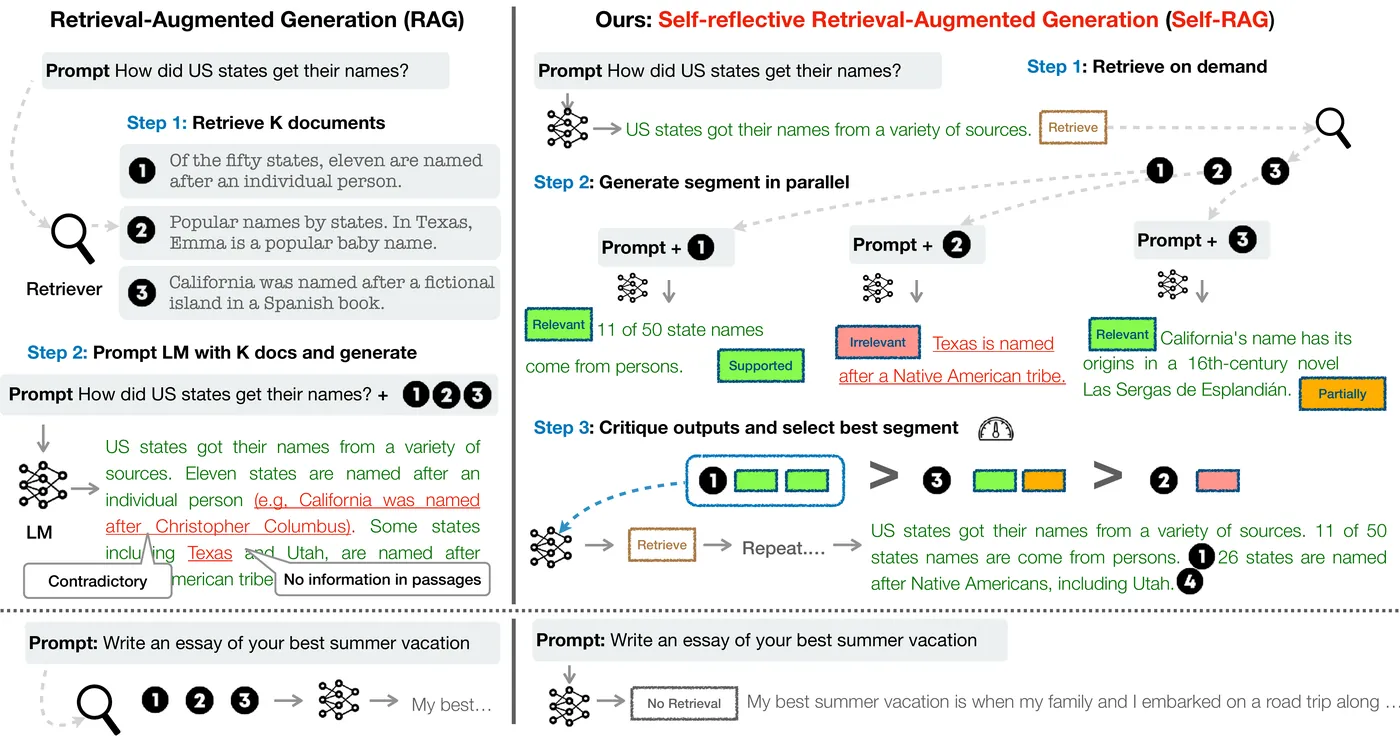
Figure 1, paper Introduction: left, RAG that always retrieves passages before generation; right, Self-RAG’s three steps—decide whether to retrieve, generate over multiple candidates, and pick a segment with critique tokens. Locatable at Figure 1; SVG endpoint teaser_self_rag_v8.svg. From arXiv v1 HTML / source figures; the page marks CC BY 4.0. Reused here for teaching under that license.

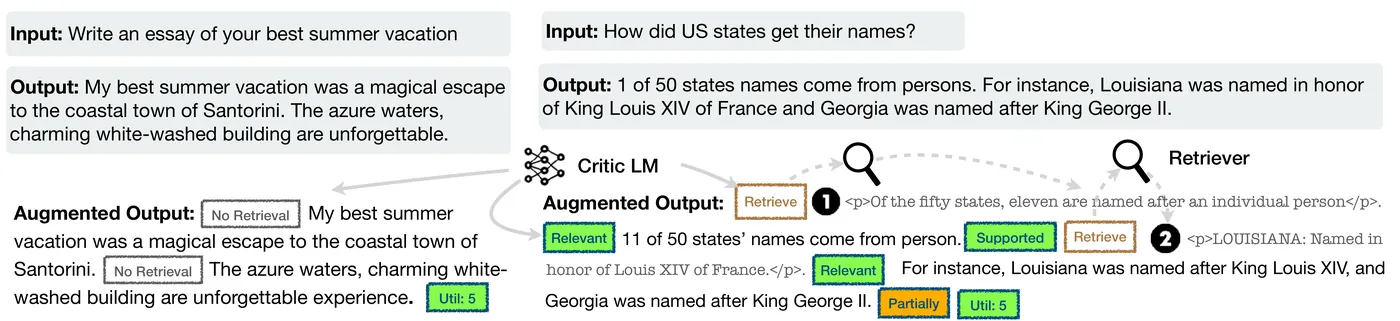
Figure 2, paper Section 3.2: generator training examples. Left: Retrieve=No, then generate and score utility. Right: Retrieve=Yes, insert <p> passages, and interleave ISREL / ISSUP. Locatable at Figure 2; SVG endpoint training_examples.svg. Same license note as Figure 1.

How to read the evidence
Short-form QA, closed-set classification, and long-form citation are not one question. PopQA / TriviaQA score answer containment; PubHealth / ARC score classification / multiple-choice accuracy; Bio uses FactScore; ASQA jointly scores correctness, fluency, and citation precision / recall. Do not read ASQA citation precision as PopQA accuracy.
Table 2: the headline is a six-task panel, not a single leaderboard
This table asks: on the same public tasks, how does Self-RAG compare with non-retrieval LMs, test-time RAG, and some systems trained with private data? What stays fixed is the public evaluation setup and the authors’ stated retriever; what changes is whether reflection tokens are trained and how inference retrieves and critiques on demand.
Selected rows (full table in the paper’s Table 2):
| Model | PopQA | TQA | Pub | ARC | Bio FS | ASQA pre / rec |
|---|---|---|---|---|---|---|
| ChatGPT | 29.3 | 74.3 | 70.1 | 75.3 | 71.8 | — / — |
| Ret-ChatGPT | 50.8 | 65.7 | 54.7 | 75.3 | — | 65.1 / 76.6 |
| Ret-Llama2-chat 13B | 51.8 | 59.8 | 52.1 | 37.9 | 79.9 | 19.8 / 36.1 |
| Alpaca 13B + retrieval | 46.1 | 66.9 | 51.1 | 57.6 | 77.7 | 2.0 / 3.8 |
| Llama2-FT 7B + retrieval | 48.7 | 57.3 | 64.3 | 65.8 | 78.2 | 5.0 / 7.5 |
| Self-RAG 7B | 54.9 | 66.4 | 72.4 | 67.3 | 81.2 | 66.9 / 67.8 |
| Self-RAG 13B | 55.8 | 69.3 | 74.5 | 73.1 | 80.2 | 70.3 / 71.3 |
Observation: on the open-domain / fact-verification axis, Self-RAG 7B already exceeds ChatGPT’s PopQA 29.3 and PubHealth 70.1; on ARC, 13B’s 73.1 still sits below ChatGPT / Ret-ChatGPT at 75.3. On TriviaQA, ChatGPT’s 74.3 remains highest. On ASQA, Self-RAG citation precision meets or exceeds Ret-ChatGPT’s 65.1, but recall stays below Ret-ChatGPT’s 76.6; str-em / rouge also lag Ret-ChatGPT. The authors note that on factual-precision metrics the 7B model sometimes beats the 13B because the smaller model tends to emit shorter, more tightly grounded text.
The table supports “on-demand retrieval plus reflection beats same-size always-retrieve instruction-tuned baselines on several public tasks.” It does not support “beats every closed system” or “already a citation product.”
Table 3a / Figure 3: critique and on-demand are not decoration
Ablations run at a 50k training scale (not the final 150k) and ask what happens if retriever / critic training is removed, or if inference collapses to always top-1.
| Setting | PopQA | PubHealth | ASQA em |
|---|---|---|---|
| Self-RAG (50k) | 45.5 | 73.5 | 32.1 |
| No Retriever | 43.6 | 67.8 | 31.0 |
| No Critic | 42.6 | 72.0 | 18.1 |
| No retrieval (test) | 24.7 | 73.0 | — |
| Hard constraints | 28.3 | 72.6 | — |
| Retrieve top1 | 41.8 | 73.1 | 28.6 |
| Remove ISSUP | 44.1 | 73.2 | 30.6 |
No Critic drops ASQA em from 32.1 to 18.1; Retrieve top1 drops PopQA from 45.5 to 41.8. That supports “critique and multi-candidate selection contribute.” It does not let the 50k ablation row stand in for the final 7B / 13B Table 2 numbers.
Figure 3b: raising the ISSUP weight lifts ASQA citation precision and lowers MAUVE—more grounded generations are often shorter and less “fluent.” Figure 3c: raising sharply cuts retrieval frequency; PubHealth loses less accuracy than PopQA—long-tail entity questions depend more on retrieval.
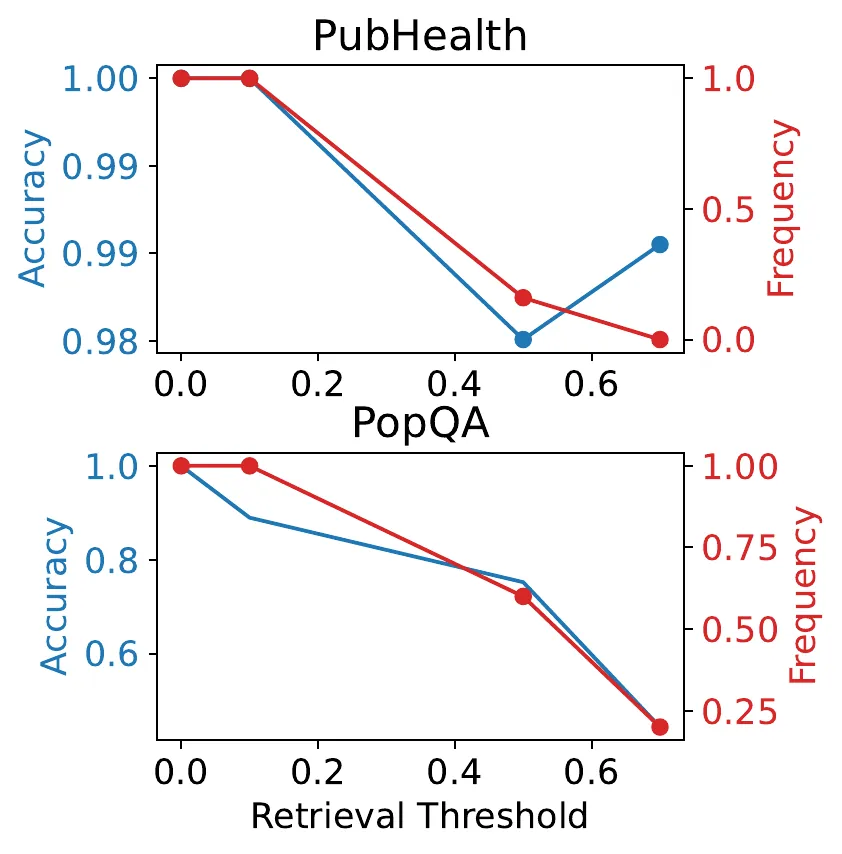
Figure 3c, paper Section 5.2: how adaptive threshold changes retrieval frequency and accuracy. Locatable at Figure 3; SVG endpoint tradeoff_fever.svg. Same license note as Figure 1. If a crop shows only one panel, treat the full three-column Figure 3 (ablation / customization / retrieval) in the HTML as authoritative.

Figure 4: scale helps; the human study is small
From 5k to 150k, PopQA and ASQA citation precision rise more clearly than PubHealth. Llama2-FT does not show a matching lift from 50k to 150k—the authors use that gap to argue the gain is not “just more instruction data.” The human study uses 50 examples per task: short PopQA S&P / token agreement looks strong; biography S&P 70.0 warns that long-form can still look right while going wrong.
Limitations and threats to validity
The Ethical Concerns section states that even with self-reflection and fine-grained attribution, outputs may still not be fully supported by citations. Keep these boundaries when reading the tables:
- Silver critic. GPT-4 labels are not gold; usefulness bins are unstable even for humans (1 vs 2, 4 vs 5). Treating reflection tokens as a production gate writes distillation error into the control plane.
- Not a production RAG platform. There is no ACL, private-corpus governance, hybrid stack, or citation SLA. ASQA precision / recall are evaluation metrics, not a product guarantee.
- Not an agent tool loop. There is no browser action, no MCP, and no multi-step tool policy. Contrast Toolformer or the agent spine as a different path.
- Not Read-Gate. Before Reasoning Can Fail measures procedural failure to read after search; Self-RAG measures learned when-to-retrieve / critique. Do not swap those numbers.
- Smaller ablation scale. Table 3a uses 50k; ASQA ablations also use a 150-example subset. The main table is the full-data 7B / 13B result.
- Public Wikipedia evaluation memory. PopQA even switches dumps to 2020; private knowledge bases are not established.
- Do not back-port later papers. DocMemo, RAG-Anything, FinRank, 2025–26 agentic RAG leaderboards, and Deep Research products do not belong in these tables.
Engineering decision and when not to use it
When is this paper worth borrowing? When work switches between knowledge-intensive QA and long-form generation, you are willing to maintain a queryable non-parametric index, and you accept that whether to retrieve is a model-token decision whose critique weights can be tuned at inference. In that case, log separately: the Retrieve decision, retrieved , generated , and ISREL / ISSUP / ISUSE—fully supported from a token is not an audit pass.
When should you not treat this paper as a construction drawing?
- If you need the 2020 fixed-retrieval design, read Lewis RAG.
- If you need the dense dual-encoder first stage, read DPR.
- If the failure mode is “searched but answered without reading,” read Before Reasoning Can Fail. That is a runtime invariant, not a reflection-token training recipe.
- If you need multimodal originals, tool-schema routing, graphs, or multi-hop dynamic evidence, read the corresponding later work; do not mix those scores into Self-RAG.
Artifacts and reproducibility
Direct endpoint status as of 2026-08-27:
- Paper: arXiv abs, v1 PDF, and HTML are readable under CC BY 4.0. The OpenReview forum resolves (this environment sometimes hits a challenge page; ICLR 2024 status is cross-checked via the GitHub citation and forum id).
- Project page: selfrag.github.io returns 200.
- Code: AkariAsai/self-rag returns 200 under MIT.
- Model cards (usable): selfrag/selfrag_llama2_7b and selfrag/selfrag_llama2_13b return 200.
- Training environment (author-stated): Stability AI compute for train / eval; OpenAI APIs for GPT-4 silver labels. The main experiment is not “download one notebook and reproduce Table 2.”
The smallest useful reproduction is to load public selfrag_llama2_7b, run a handful of long-tail PopQA items, and confirm that Retrieve / critique tokens appear and that retrieved passages show up only after Retrieve=Yes. Do not claim that this reproduces Table 2’s 54.9.
Three things to remember
- Technical idea: Self-RAG writes when-to-retrieve and self-critique into reflection tokens so one LM learns to retrieve, generate, and critique; retrieval becomes a decision rather than an always-on pipeline stage.
- Evidence: On Table 2, 7B / 13B beat several retrieval-augmented baselines on PopQA, PubHealth, and related tasks, with ASQA citation precision 66.9 / 70.3; Table 3a shows No Critic and Retrieve top1 hurt.
- Boundary: silver critic, public Wikipedia setup, not an agent tool loop. Do not read it as a production RAG gate or mix later results into these tables.
Further reading
Self-RAG answers whether and when to retrieve, then how to critique generations. For fixed retrieval, read Lewis RAG; for dense retrieval, read DPR; for procedural read-before-final, read Before Reasoning Can Fail. The RAG foundations reading map shows the full relationship, and the three-pass approach covers the reading method.