本篇讀的是 REVA: Reusable Evidence View Aggregation for Context-Efficient RAG Serving v1(2026-09-10)。arXiv HTML 把它標成作者接受稿,接受刊登於 IEEE ICDM 2026;截至本篇撰寫時,讀到的是 arXiv v1 與作者提供的 artifact,不把它寫成已可在正式 proceedings 取得的版本。閱讀範圍包括 完整 paper HTML 的 Sections I–VI、Figures 1–4、Tables I–VI,以及 REVA GitHub artifact 的 README、src/reva.py、pyproject.toml、uv.lock 與暫存資料下載入口。
如果你已讀過 RAG 基礎 或 Self-RAG,這篇不是再問「要不要檢索」。它問的是下一個 serving 問題:同一批文件會被許多相近 query 重複取回,為什麼每次都要重新做 context importance scoring?如果某份文件從未被歷史 store 看過,系統要怎麼在不改 generator 介面的前提下繼續服務?
90 秒掌握論文
- 問題:post-retrieval compressor 如果在每個 request 上另外呼叫 model、做 token scoring 或生成式 rewriting,縮短 context 的收益可能被 compression latency 抵消;model-agnostic 的 selector 也可能保留模型本來就知道的內容,反而刪掉真正需要的 evidence。
- 核心直覺:歷史 RAG request 已經留下 generator 如何使用文件的訊號。把 query 與可用的 answer/response 對文件 token 的 attention 映射到可讀的 word units,再跨重複 document access 平均,就能得到一份可重用的 evidence prior。它不是 query-specific answer,而是文件層級的 retention tendency。
- 最強證據:在固定 top-10 retrieval cache、四個 QA benchmark 與三個 generator 上,B=512 full-split Table I 的 REVA-local 在 NQ、TriviaQA、HotpotQA、2Wiki 都比 Trunc-local 高;Table II 的 12 個 generator–dataset 設定平均為 37.83 F1、26.98 EM、27.5 ms online overhead。all-seen Table III 的 120 個 budget cells 則讓 REVA-global 達 43.72 F1、32.75 EM、49 ms。
- 主要邊界:all-seen 只保留所有 top-K 文件都有分數的 held-out query,不能代表正式環境 coverage;full-split 才含 prefix fallback。attention 也只是 evidence importance proxy,不是 citation correctness 的驗證器;報告的 online overhead 排除 score-store 建置與更新。
我的 bounded verdict 是:REVA 最有價值的改變,是把 compression 的 control point 從「每個 query 都重新判斷」搬到「歷史 interaction 產生可版本化的 document view,再在 request path 輕量 materialize」。 如果你的 RAG workload 有高文件重複率、generator 相對固定、可以治理 corpus/tokenizer/template/scoring mode 的相容性,這是一個務實的 serving layer。若語料高速變動、query 分布漂移、文件 coverage 很低,或產品要求的是可證明的 citation chain,它仍不能取代 freshness、provenance 與 faithfulness 控制。
論文身分、閱讀問題與證據地圖
論文作者是 Tuan Nguyen、Qiran Hu、Banruo Liu、Khoa D. Doan、Kok-Seng Wong、Fan Lai。arXiv record 的 v1 日期是 2026-09-10;HTML 頁首同時載明「accepted for publication in the 2026 IEEE International Conference on Data Mining (ICDM)」與 © 2026 IEEE 的 accepted-manuscript reuse restriction。這兩件事要分開:接受刊登是 paper status,並不等於本篇已引用正式會議版;圖像再利用也不等於自由授權。
本篇選的讀者問題是:歷史 query–document–model trace 能否被壓成一份可重用、可讀、budget-agnostic 的文件 view,讓線上 RAG 只付 materialization 成本? 它位於檢索系統主線的 production-rag gap:不像 DPR 改第一階段的召回,也不像 Self-RAG 改「何時呼叫檢索」,REVA 改的是 retrieval 與 generation 之間的 post-retrieval evidence serving。
先把本文的三種聲音分開:
| 層次 | 本篇採用的說法 |
|---|---|
| Paper 直接支持 | Section III 的 overhead、model-agnostic 與 repeated-access motivation;Section IV 的 attention mining、word-unit materialization、document-keyed store、local/global allocation 與 fallback;Tables I–VI、Figures 1–4 的品質、延遲、coverage 與消融。 |
| 作者主張 | 歷史 generator attention 可以形成 reusable evidence view,在四個 benchmark 與三個 generator 上取得接近或超過多個 compressor 的 quality–overhead frontier。 |
| 證據沒有支持 | attention 分數本身不是 citation faithfulness;重複取回率不保證跨時間分布穩定;all-seen 結果不是全量部署結果;online overhead 不包含 offline build/update,也沒有直接轉換成某家雲端帳單。 |
| Bloss0m 工程判斷 | 把 REVA 當成有明確 compatibility key、coverage SLO、fallback、staleness policy 的 serving artifact,而不是一個只要接上就能安全壓縮所有 RAG context 的通用 compressor。 |
前一種作法為什麼不夠:短 context 不等於低總成本
傳統 post-retrieval compression 的資料流通常是:
query → retrieve top-K → request-time compressor → compressed context → generator
它的直覺很合理:先取多一點 evidence,再在送給 generator 前刪掉不重要的 token 或句子。但這條路有兩個 operational 問題。
第一,selector、scorer 或 rewriter 常常跟目前 query、文件集合與文件排列綁在一起,所以每次 request 都重新做工作。論文 Section III 與 Figure 1(a) 把這件事畫成 overhead:代表性的 request-time compressor 可能多出數百毫秒,這與 sub-200 ms time-to-first-token 的 serving 目標不容易同時成立。第二,model-agnostic 的重要性判斷不知道目標 generator 已經知道什麼、又會依賴哪些 evidence。Figure 1(b) 因而提醒讀者:在相同 budget 下,先進 compressor 不一定穩定勝過很簡單的 global prefix truncation。
REVA 的切入點不是宣稱 prefix truncation 沒用,而是問是否能把昂貴判斷做一次、重複使用很多次。Figure 1(c) 在作者的設定裡顯示 85–92% 的 held-out query,其 top-10 retrieval 至少含有一份 training prefix 曾存取過的文件。這個比例不是所有 production corpus 的定律,但它提供一個值得測量的條件:若 document recurrence 高,歷史 trace 就可能有 amortization value。
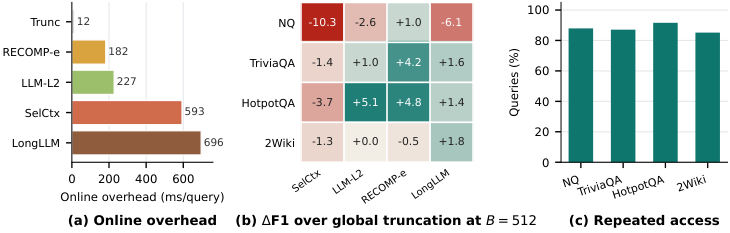
圖 1:論文 Figure 1,定位在 Section I Introduction 的 Figure 1 anchor,並在 Section III 解讀。它支持「online compressor 的成本與收益必須同時量測」和「文件重複使用提供可挖掘訊號」,不代表每個工作負載都會有 85–92% coverage。圖檔是依 arXiv HTML 的原始 endpoint 保存;頁面標示作者 accepted IEEE manuscript © 2026 IEEE,personal use permitted,其他重印、再發布或重用需取得 IEEE permission;此處的版權/reuse restriction 仍然有效。
核心直覺:把文件的過去使用痕跡變成 evidence prior
先不用公式,可以把 REVA 想成一個「文件級 evidence notebook」。某份文件第一次被 query A 取回時,目標 generator 在 forward pass 中已經產生 attention trace;如果 query B、C 之後也取回同一份文件,就繼續累積哪些 word units 被模型反覆看重。到下一個 query D 時,系統不必先用另一個 compressor 重新讀完全文,而是查這份 notebook,選高分單位,再把它們按照原文順序拼回普通文字。
這個直覺有三個刻意的取捨:
- model-aware,但不是 query-bound:分數來自目標 generator,會保留該模型實際使用 evidence 的傾向;但分數不是對某一個新 query 的保證,因此需要 coverage 與 drift 監控。
- budget-agnostic,但不是 text-cache per budget:store 不保存 B=256、B=512、B=1024 三份壓縮文字,而保存 word-unit score、sum、count 與原文邊界。改 budget 時重新 materialize,不需重跑 attention scoring。
- plain-text,但不是 token bag:保留文字介面,不要求 generator 支援 KV-cache API 或 latent memory;同時先以 word unit 選擇、再按原始位置輸出,避免留下破碎數字或錯亂句序。
論文 Section IV-B 用 co-retrieval 做一個有條件的幾何動機。令 是 unit-norm retrieval embedding,歷史 query 為 、未來 query 為 、共同取回文件為 ,並令 、。若兩者都至少為 ,論文給出:
這個式子只說 retrieval space 裡的 query 相似度在額外條件成立時有下界;它不是 attention similarity 的 theorem,也不是 top-K retrieval 自動保證的條件。作者自己在 Section IV-B 說明這點,所以本文不把「共同取回」誇大成「相同 evidence need」。
方法流程:offline score store 與 online rendering 的邊界
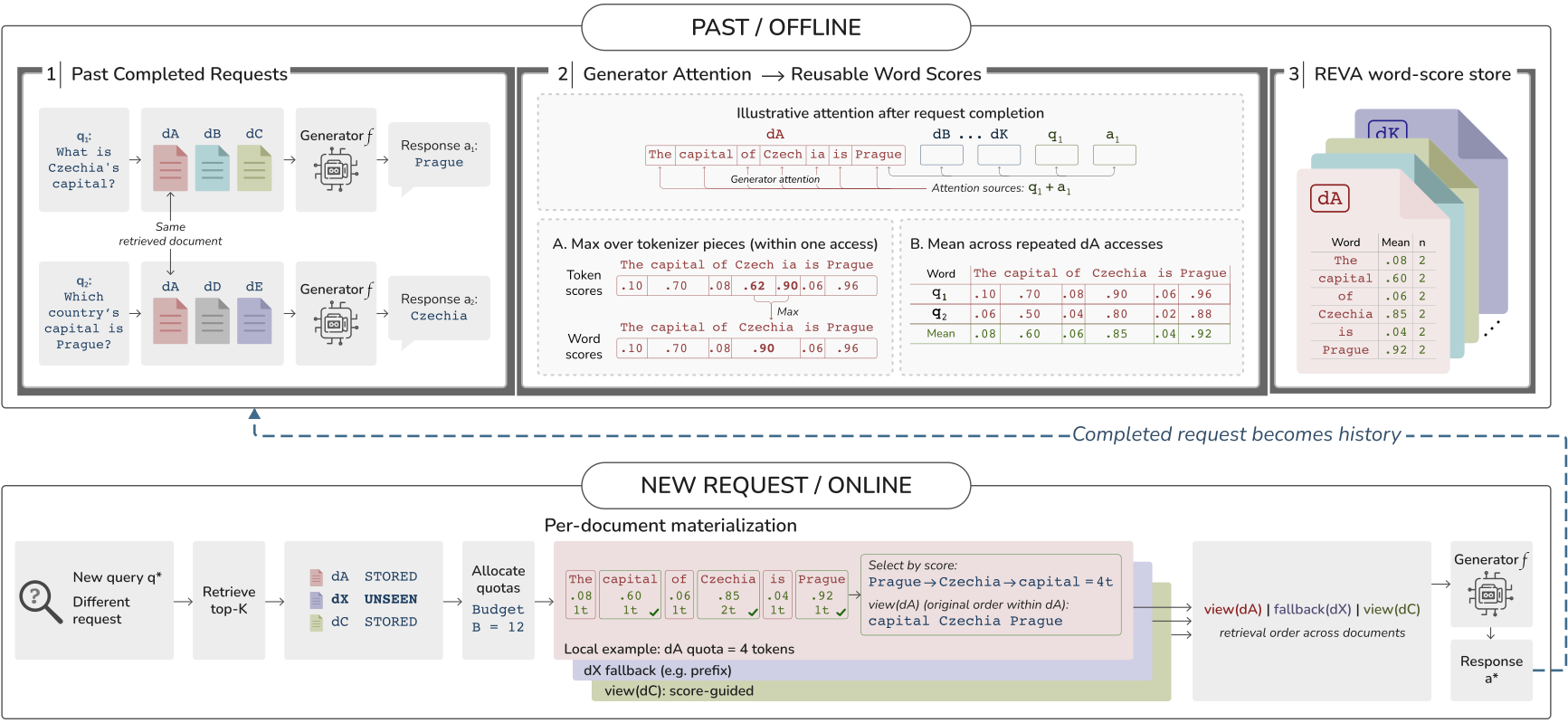
圖 2:論文 Figure 2,定位在 Section IV-A Design Overview 的 Figure 2 anchor。它是本文理解 offline/online boundary 的核心圖:歷史或非同步 access 產生 score,線上只 lookup、allocate、render,未命中文件走 prefix fallback。圖檔保留自 arXiv 的原始 SVG endpoint;原頁標示 © 2026 IEEE accepted manuscript,personal use permitted,其他 reuse 需 IEEE permission,故此處保留 attribution 與 restriction note。
可以把 Algorithm 1 重新寫成下列四段:
-
收集歷史 interaction:對每筆歷史
(q, D(q), a),用目標 generator 的 attention-enabled forward pass,來源可以只有 query,也可以包含已有的 answer/response。這裡的a是離線訊號,不是把未來 test answer 偷塞進同一筆 served context。 -
把 token trace 變成可讀單位:對每個 document-body token ,把來源 token 集合 對它的 attention 做 head average、source-position sum:
是 head 中來源 token 指向文件 token 的權重, 是 head 數。分數越高表示在這份離線 forward trace 中,更多來源位置把權重放到這個文件位置;它不是「這個 token 必然是真實引用」的標籤。相鄰 tokenizer pieces 以 whitespace-start boundary 組成 word unit,日期、百分比、逗號分隔數字、hyphenated word、capitalized multiword name 等短結構做 protection;一個 unit 的分數取成成員 token 的 max。
-
按文件累積:對文件或 chunk 的每個 unit ,累積 與 ,最後使用:
是 compatibility key,至少要綁定文字/文件身份、generator 、tokenizer 、scoring template 、scoring mode 與 corpus/chunk version 。平均的 operational meaning 是降低一次 access 的 noise;在論文的理想獨立 noise 假設下, 次平均的 variance 上界從 降到 。實際上若 query distribution 漂移,作者建議 refresh 或 exponential decay,而不是無限相信舊樣本。
-
線上 materialize:新 query 仍照平常 retrieval 取回 top-K,先依內容 key 去重,再分配 token quota。命中相容分數的文件按 選 unit,最後按原文件順序輸出;沒有相容分數的文件則使用 fallback。輸出合併後再做 final budget repair,交給沒有改過的 generator。
這個 boundary 是 REVA 的主張,也是它的責任轉移:online latency 降低,是因為 attention scoring 被放到 offline/async;它並沒有讓 scoring 消失。若團隊沒有歷史 log、無法重跑目標 generator、或 corpus 很少重複,REVA 的 amortization 前提就不足。
用一個文件走一遍:從 unseen fallback 到可重用 view
以下是依 Section IV 與 Algorithm 1 組合出的 faithful explanatory example,不是論文額外報告的單筆案例:
- Input:一個新的 query 取回十個文件,其中
d7是 FAQ 內容,過去 40 次 request 都曾取回;d9是剛上線的新 chunk,score store 完全沒有它的 compatible row。服務 budget 設為 。 - Offline intermediate representation:對
d7的歷史 access,系統以同一 generator、tokenizer、template 與 scoring mode 取得 token attention,把「2024-09-18」、「$12,400」等不應被切碎的 pieces 保護成 word units;每一單位保存原文 offset、token boundary、score sum 與 count。d7的 key 也記住 corpus version。d9沒有這條兼容 key。 - Online decision:REVA-local 先給每份 deduplicated document 約 的 quota;
d7在自己的 quota 內依平均分數挑 unit,d9則對同一 quota 做 prefix truncation。REVA-global 若啟用,會用高分 unit 的 bounded utility,在保護高排名文件與 per-document cap 下重新分配剩餘 budget;它不會因為d9沒有 score 就假裝知道d9的 salience。 - Output:
d7的高分 units 可能分散在原文中,但 renderer 依原始 order 合併回可讀片段;十份結果依 retrieval order 合成 plain-text context,generator 仍收到原本格式的文字。沒有 KV tensor、沒有新的 latent interface。 - Likely failure point:如果
d7的文字被 corpus update 改過、tokenizer 或 template 換過,key 不應命中舊分數;若錯誤地只用 document ID 而忽略 version,過期 score 可能把新 evidence 選錯。若d9在真正 workload 中占大多數,fallback 會讓 REVA 的實際品質靠近 truncation,而不是 all-seen 曲線。這也是為什麼 coverage 應是 dashboard、SLO 與 cache invalidation policy 的一部分。
Compatibility key:可重用的前提不是「同一個 doc_id」
REVA 的 reusable artifact 不是任意一段文字上的全域 salience。Section IV-C 的 composite key 是:
k_text(d) 可以由 document ID 與 chunk ID 組成;若沒有穩定 ID,則需要 text fingerprint。其餘欄位分別是 generator、tokenizer、scoring template、scoring mode 與 corpus/chunk version。這幾個欄位並非 metadata 裝飾,而是「這份 score 能否安全重用」的 compatibility contract:
- generator 改變,模型的 knowledge gap 與 attention 使用方式可能改變;
- tokenizer 改變,word-unit 邊界、token count 與 budget accounting 可能改變;
- template 改變,query、答案、文件在 prompt 的位置與來源 token 集合可能改變;
- scoring mode 從 Q 改成 Q+A,分數的語義就從 query lexical signal 變成加入 response trajectory 的 signal;
- version 改變,舊 offset、舊 word unit 與新文件內容不能直接疊加。
真正落地時,我會把 compatibility miss 當成一個可觀測事件,而非靜默 fallback:記錄命中/未命中原因、store version、document version、generator hash、tokenizer hash、fallback token 比例與 answer quality。這段是 Bloss0m 的工程建議,論文只直接要求相容 key 與 fallback semantics,不是已完成的 production telemetry specification。
值得注意的是 artifact 與 paper claim 要分開讀。paper Section IV 描述包含 generator、tokenizer、template、mode、version 的 composite key;我核對的 GitHub main 版本則以 doc_key(doc_id 與 optional chunk_id)查 store,並在 score row 的 metadata 保存 scoring_model_name、word-unit type、training hits、raw token 等欄位;validate_score_doc 會檢查 doc/chunk identity 與 raw text。這個公開實作足以教你資料結構與 fallback 介面,但不能把它說成已完整實作 paper 文字中的所有 deployment-level compatibility dimensions。部署者仍需自己把其餘欄位納入 namespace 或 wrapper。
Local 與 Global budget:coverage 與 salience 的政策選擇
給定 total context budget 與 deduplicated retrieved documents ,REVA-local 的基本 quota 是:
其中 是文件 的原始 token length。每份文件獨立挑高分 units,所以一份很有 salience 的文件不能吃掉全部 budget;同一份文件換了鄰居,也可以重用自己的 view。這是較容易預測、也較容易維持 evidence coverage 的 policy。
REVA-global 使用同一套 unit score 與 within-document selection,但允許文件之間重新分配剩餘 budget。作者在 Section V-A 固定的設定中,以每份文件最高分 10% units(數量限制 1–32)估計 historical utility,再除以未壓縮 token length 的平方根;top 文件先拿 protected quota,每份 document cap 為 ,剩餘 budget 依 utility 分配,超過 cap 或文件長度就回收。若 utility 全為零,則對 eligible documents 均分。
這裡的設計訊息比「global 比 local 好」更細:global 必須保留 floor、cap 與 coverage repair,否則 naive global 只把所有 units 丟到一個大 pool,可能把某份文件的幾個高分片段全部塞滿,品質與 latency 都變差。若任何 document 沒有 compatible score,論文的 online policy 退回 equal document quotas;covered 文件 score-guided,uncovered 文件 prefix fallback。
Table V 把這個取捨拆開:在 HotpotQA,global 的 F1 是 43.25,比 Trunc-local 高 5.16,也比 RECOMP-e 高 1.67,且 30 個 cells 中有 26 個至少達到 RECOMP-e;TriviaQA 的 global dataset-slice F1 是 68.74,略低於 local 的 68.86;2Wiki 也幾乎相同。最穩妥的解讀是:當 decisive evidence 在文件間分布不均,protected global allocation 有機會把 budget 放到更有用的文件;當 workload 沒有這種不均,local 的較低 overhead 與 coverage guarantee 可能更適合作為預設。
實驗設計:先確認比較的分母
論文 Section V-A 把 retrieval variance 固定住:四個 open-domain QA benchmark 是 Natural Questions、TriviaQA、HotpotQA、2WikiMultihopQA;generator family 是 Llama-3.1-8B-Instruct、Qwen3.5-9B、Gemma-4-E4B-it;所有方法共享預先建立的 top- retrieval cache,retriever 是 intfloat/e5-base-v2 mean pooling、maximum encoder length 512、FAISS flat inner-product search。實驗在 four-H100 server 上進行。
主要 metrics 是 token-level F1、exact match(EM)、ROUGE-L、emitted context tokens 與 online overhead(OO)。OO 是 request-time compression/materialization wall-clock latency,排除 retrieval、offline score-store construction、answer generation 與 asynchronous update。這個定義對讀表很重要:短 context 與低 OO 仍可能伴隨高離線建置成本;而 generator 最後的 generation time 也不是 OO 本身。
作者用三個 evaluation regime 把 transfer 與 coverage 分開:
- Full-split strict reuse:score store 只由 training split 建立並 freeze;held-out query 的 top-K 可混有 covered 與 uncovered documents,後者走 prefix fallback。這是最接近部署的主結果。
- All-seen strict reuse:只保留所有 retrieved documents 都有 stored score 的 held-out query,測的是「coverage 已存在時,歷史 score 能否 transfer」。它是 diagnostic subset,不是 deployment distribution。
- Component ablation:沿用 strict reuse 規則,改變 Q vs Q+A scoring、local vs global allocation、word-unit materialization 與 rendering order。
Baselines 涵蓋 Trunc-local/Trunc-global、Selective Context、LLMLingua-2、RECOMP-e、LongLLM、EXIT 與 FaviComp。比較時不能把所有列當成 matched-budget:EXIT 很短但它的 B 是 post-selection guard,FaviComp 把 B 當 maximum decoding length,可能提早停止。作者也明確把它們視為 inference-time stress tests。
證據一:partial coverage 仍能提升,但 coverage 不是免費的
Table I 是 full-split、B=512、三個 generator 平均的 any-seen coverage 與 quality。NQ 的 any-seen 是 87.9%,Trunc-local F1/EM 是 33.68/22.56,REVA-local 是 38.12/25.23;TriviaQA 為 87.1% 與 53.70/42.64 對 58.18/47.57;HotpotQA 為 91.6% 與 27.48/16.99 對 31.03/20.79;2Wiki 為 85.2% 與 21.60/12.87 對 23.99/14.90。
這支持一個窄而有用的結論:只要 query 的 top-10 裡至少有一份文件命中 store,score-guided view 加上 fallback 可以在這四個 benchmark 的 full split 中比 document-local prefix truncation 好。 它不支持「所有文件都已被重用」;any-seen 是 query-level 至少命中一份,很多個別文件仍 uncovered。工程上因此要同時記錄 query-level any-seen 與 document-level coverage,否則 87–92% 容易掩蓋大量 fallback。
證據二:品質與線上成本的 trade-off
Table II 在同一個 B=512 比較 12 個 generator–dataset settings 的平均。Trunc-local 是 34.11 F1、24.10 EM、30.43 ROUGE-L、512.0 context tokens、17.0 ms OO;REVA-local 是 37.83、26.98、33.65、502.3 tokens、27.5 ms。REVA-local 相對 Trunc-local 提升 3.72 F1、2.88 EM、3.22 ROUGE-L,而 OO 多 10.5 ms。這個多出來的 materialization cost 與 request-time compressor 的尺度不同:SelCtx-local 822.6 ms、LLM-L2-local 343.0 ms、RECOMP-e 120.0 ms、LongLLM 598.9 ms。
REVA-local 的 F1 距離 LLM-L2 variants 與 LongLLM 約 0.44–0.81 points,但距離 RECOMP-e 仍有 2.36 points;所以作者的「near-frontier」比「uniformly best」準確。若你的 KPI 是每毫秒多拿到的 answer quality,REVA 的主張很強;若只挑最高 F1,Table II 的 RECOMP-e 仍是較高的一列,但付出更高 OO。
all-seen Table III 進一步把 120 個 cells(3 generators × 4 datasets × 10 budgets)聚合。REVA-local 的 mean F1/EM/OO 是 43.34/32.73/31 ms;REVA-global 是 43.72/32.75/49 ms;RECOMP-e 是 43.66/32.69/155 ms。換句話說,在這個診斷分母內,global 的 F1 略高於 RECOMP-e,local 只差 0.32 F1,兩者 OO 都遠低於 RECOMP-e。可是這個比較不能抹掉 all-seen filter;正式環境需把 fallback 後的 full-split 數字和 coverage 一起看。
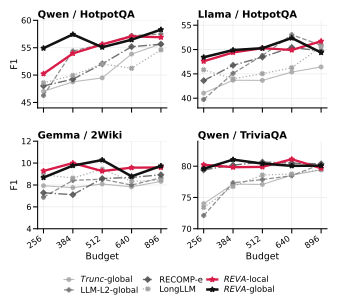
圖 3:論文 Figure 3,定位在 Section V-B Main Results 的 Figure 3 anchor。它的教學用途是看跨 budget 的 frontier 是否穩定:REVA-local/global 多數設定接近或超過 inference-time compressor,但不是每一條曲線都 uniformly dominant。原始 SVG 來自 arXiv endpoint;© 2026 IEEE accepted manuscript 的 personal-use-only 與其他 reuse 需 IEEE permission restriction 同樣適用。
Figure 3 對採用決策的價值,在於它迫使我們不要只記 B=512 的單點。budget 變小時,word-unit 完整性與文件 coverage 的代價可能更明顯;budget 變大時,prefix truncation 也可能追回部分差距。作者的結論是 near-frontier across budgets,而不是一個所有 workload、所有 budget 都勝出的單調 theorem。
證據三:Q+A scoring、global allocation 與 word order 各自做什麼
Table IV 是最值得讀的 component ablation。以 all-seen grid 平均:Trunc-local 是 38.75 F1、28.81 EM、15.6 ms;REVA-local + query-only(Q)是 42.29/31.85/28.5;REVA-local + query-plus-answer/response(Q+A)是 43.34/32.73/31.5;REVA-global + Q+A 是 43.72/32.75/48.7。這支持作者的解釋:response trajectory 暴露 answer-bearing spans,Q+A 因而比 Q 更強;但它也表示離線 scoring 需要已完成 response,資料 pipeline 不能只靠 query log。
Naive global + Q 的 41.76 F1、92.9 ms,Naive global + Q+A 的 42.04、105.8 ms,都低於相應的 protected REVA policy,雖然它們都把全體候選放進大 pool。這個反例很有工程含義:global allocation 不是「全域排序」四個字,而是「在 per-document floor、cap、coverage repair 下重新分配剩餘 budget」。
作者也在 Table V 把 generator 與 dataset 拆出來。REVA-global 對三個 generator average 都比 REVA-local 高一點,但 dataset pattern 不一致:HotpotQA 的 global uplift 最清楚,TriviaQA 與 2Wiki 的 local/global 差異混合。這讓「local 是安全 default、global 是對 evidence uneven distribution 的選項」比「global 永遠比較好」更可信。
最後是 Figure 4 的 materialization ablation。以 Qwen3.5-9B、B=512 為例,移除 word-unit materialization,F1 從 53.52 降到 52.23、EM 從 46.13 降到 44.47、ROUGE-L 從 47.22 降到 45.95;將同一批 selected units 依 score order 輸出,F1 為 50.61、EM 42.85、ROUGE-L 44.02,而原始 order 的 context 約 488.3 tokens,score-order 約 487.3。分數選得對不代表排列可以亂掉:可讀性與原文結構本身是 evidence interface 的一部分。
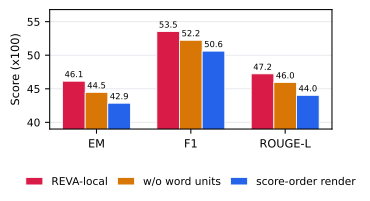
圖 4:論文 Figure 4,定位在 Section V-C Performance Breakdown and Ablation Studies 的 Figure 4 anchor。它支持兩個不同機制:word-unit 把 token selection 變成完整可讀單位,original order 保留文件結構;它不是額外的 benchmark overview。原始 SVG endpoint 依 accepted IEEE manuscript 保存;arXiv 頁面准許 personal use,但其他重印/再發布/重用需 IEEE permission,故此處保留來源與版權/restriction note。
Table VI 的 EXIT/FaviComp stress test 也值得保留:EXIT 平均 107.5 context tokens,卻有 3,858.2 ms OO;FaviComp 234.6 tokens、12,837.7 ms OO;REVA-local/global 分別 491.5/491.9 tokens、26.2/40.6 ms。這不是 matched-budget 的公平勝負表,因為三者的 B semantics 不同;它比較像提醒:極短 context 可能換來更大的 request-time compression bill。
Attention 的證據邊界:有用的 proxy,不是 faithfulness proof
REVA 把 attention 當成「模型在 forward trajectory 中如何分配權重」的低成本 trace。這個訊號很適合做 ranking prior,因為它來自目標 generator 自己,且 query token 與 generated response token 的重複關注能累積 recurring spans。但從「模型注意到某段」到「某段足以支持正確、完整、可引用的答案」中間,仍有多個未驗證跳躍:
- attention 可能同時反映 lexical match、位置偏好、prompt template 與模型內部既有知識,不等於 causal evidence use;
- Q+A scoring 要依賴歷史 answer/response,若歷史答案錯,store 可能把錯誤的 span 變成高分 prior;
- max over member tokens 的 word-unit score 會保留一個高分 piece,這提升完整性,但不保證保留跨句 bridge evidence;
- 平均降低的是 access-specific noise,不是 distribution shift、corpus edit 或 answer policy shift;
- 文章報 F1、EM、ROUGE-L 與 latency,沒有用 citation-level evaluator 證明 retained span 對每個答案都是真正支持。
因此,REVA view 應與原文 offset、document version、score provenance 一起保存,讓除錯者可以問「哪一段被選了、為何被選、依據哪些歷史 hits、當時 generator/template 是什麼」。產品若要求 citation faithfulness,仍需另外保留 citation verifier、support entailment、missing-evidence abstention 或 human escalation;不能把 attention score 當作它們的替代品。
All-seen 是診斷 subset,不是 deployment shortcut
all-seen 讀法很容易被誤解。它並不是把 test query 的 answer 放進 store:論文說 held-out query 與 answer 不會用來建構它自己被服務的 context;這點是嚴格 reuse 的好處。但 all-seen 會先篩掉任何含有未命中文件的 query,因此它回答的是「在 coverage 已經完整時,歷史分數 transfer 得如何」,不是「真實流量有多少 request 能完整享受 view」。
full-split 的 Table I 才讓 unseen-document fallback 出現在端到端分母;其 any-seen 85.2–91.6% 仍是至少一個文件命中的 query rate,不是 top-10 每份文件都 covered。這兩種分母不能混成一個 headline。我的建議是部署前至少畫四條曲線:query any-seen、document coverage、fallback token share、quality by coverage bucket。若 all-seen F1 很高但 fallback token share 也很高,系統的實際收益仍會被 truncation 拉回。
Artifact、環境與可重現性:可檢查,不等於一鍵重現
截至 2026-09-15,我核對到的 artifact 狀態如下:
| Artifact | 狀態與可用性 | 對重現的意義 |
|---|---|---|
GitHub repository、src/reva.py、src/cli.py、metrics、runner、README | accessible/usable for inspection;公開 repository 有 uv.lock、quick start、JSONL schema 與 figures | 可以讀 implementation、建立小型 score store、用 prebuilt store 跑 reva;不等於已在本站獨立重跑 paper benchmark。 |
| Python environment | README 要求 uv sync --locked;Python >=3.10,<3.13;依賴 pinned Transformers commit、Torch >=2.11,<2.12、Accelerate、Safetensors、SentencePiece;retrieval extra 是 FAISS、Hugging Face Hub、NumPy | 需要可用的 attention-enabled generator、fast tokenizer、模型權重與可能的 GPU memory;paper evaluation 使用 four-H100 server。 |
| Retrieval top-20 artifact | README 提供 temporary Google Drive endpoint,直接頁面在核查日可到達;README 說 Zenodo DOI 尚未就緒 | 不能把暫存 Drive link 當成永久 archival DOI;下載後仍要核對資料內容與 checksum/manifest。 |
| Compact REVA score cache | README 提供 temporary Google Drive endpoint,直接頁面在核查日可到達 | 包含 manifest、verify TSV、SHA-256 checksums 與六組 generator/scoring-mode 檔名;尚未驗證下載內容是否能完整重建所有 paper table。 |
| Paper global allocator | Paper Sections IV-D/V-A、Tables III–V 有定義與數字; inspected main 的 select() 仍路由到 document-wise selection,quick start 只展示 --method reva | global 是 paper evidence,但不是我能從目前公開 quick start 直接確認的一鍵 reproducer;要重建需先核對 artifact 版本或自行實作 allocator。 |
README 的最小可行流程是:用 JSONL 的 question、answers、contexts[{doc_id,title,text,chunk_id}] 準備 training examples;執行 PYTHONPATH=src uv run python -m cli build-store --input data/train.jsonl --model meta-llama/Llama-3.1-8B-Instruct --option max_scoring_tokens=8192 --output outputs/reva_store;再以 --method reva --budget 512 --option score_store_path=outputs/reva_store/score_store.jsonl 跑 test input。若只是理解 rendering,README 也提供 Doc: "Paris is the capital of France." 的 word-unit score example:先以分數挑 Paris, France, capital,最後按原文順序渲染成 Paris capital France。這個例子是介面示意,不是 paper benchmark。
最小而有意義的 reproduction plan 不是直接重跑四個 benchmark,而是先做三個 controlled cases:
- Seen:以少量 historical JSONL 建 store,固定 generator/tokenizer/template,確認高分 unit 在原文順序輸出。
- Unseen:拿一份未出現在 store 的 document,確認 prefix fallback、quota、fallback count 與 final budget repair 都可觀測。
- Mismatch:改變 raw text、chunk ID、generator metadata 或 template namespace,確認不會靜默重用舊 score;若 artifact 的當前 key 只涵蓋 doc/chunk,則在 wrapper 層補足 compatibility key。
只有完成這三件事,才值得把模型下載、四個 dataset 與多 budget grid 的結果拿來對照。完整重現仍受 temporary data、model weights、four-H100 scale、pinned nightly-ish Transformers commit 與 baseline extras 影響;本文沒有聲稱已完成 independent full benchmark run。
工程決策:什麼時候值得用,什麼時候不要用
適合先做 PoC 的條件:文件有高 recurrence;retriever cache 可記錄穩定 document/chunk identity;目標 generator、tokenizer 與 prompt template 相對固定;團隊能在 offline/async pipeline 使用 attention-enabled forward;產品願意接受 score-guided view 是 evidence prior,不是 citation proof。先量測 document coverage、any-seen、fallback token share、store bytes、建置 throughput、update lag、p50/p95/p99 OO 與不同 budget 的 F1/EM。
不要直接採用的條件:每個 query 幾乎都取回新文件;corpus 內容頻繁編輯但沒有 versioned invalidation;generator 常切換且沒有 namespace;歷史回答品質不穩或包含敏感內容,卻沒有 provenance/retention policy;產品需要逐句 citation correctness、法律可稽核性或拒答保證;線上 context 生成還有未被 reva 覆蓋的 alternate path。此時簡單 truncation、sentence-level selector 或 citation verifier 可能仍要存在,REVA 只能是分層中的一部分。
採用時我會把它拆成四個 operational contract:
| Contract | 必須觀察的量 | 失效時的動作 |
|---|---|---|
| Compatibility | key 欄位、model/tokenizer/template/corpus version、raw-text digest | miss 時 fail safe 到 fallback;禁止以 doc ID 靜默重用不相容分數。 |
| Coverage | query any-seen、document hit rate、fallback documents、fallback token share | 低 coverage 時回退基線,並把收益歸因到 covered bucket,而非全流量平均。 |
| Freshness | store age、update lag、score decay、corpus edit rate | 版本變更或 drift 超過門檻時 invalidation/rebuild;不要只累加歷史 counts。 |
| Evidence quality | answer F1/EM 之外的 citation support、missing bridge span、human audit | attention 只能排名,faithfulness 需另一條 verifier 與 escalation path。 |
這份矩陣是 Bloss0m 的工程轉譯,不是 paper 已測試的 production control plane。論文證明的是在它的固定 cache、模型、資料集、budget 與 strict reuse protocol 下,這種 artifact 可以產生有競爭力的 quality–OO 曲線。
三個記憶點
- 技術想法:REVA 把歷史 generator attention 映射成 document-keyed word-unit average,將同一份文件的 evidence selection 從每次 query 的現場工作,變成可跨 budget 重用的 score store。
- 最強證據:full-split partial coverage 在四個 benchmark 都勝過 Trunc-local;all-seen budget grid 的 REVA-global 43.72 F1/32.75 EM/49 ms、REVA-local 43.34/32.73/31 ms,說明 reusable view 能靠近 frontier 且顯著減少 request-time compression overhead;但分母不同,不能混讀。
- 採用邊界:attention 是 proxy,all-seen 是 diagnostic,online OO 排除 offline build/update。真正的 production readiness 取決於 compatibility key、coverage、freshness、fallback 與 citation verifier 是否被治理。
下一步閱讀與原始出處
- 如果你要先理解 RAG 如何把檢索結果接給 generator,讀 RAG:把檢索接上生成。
- 如果你要理解 dense retriever 如何建立第一段候選,讀 DPR。
- 如果你要比較「模型何時檢索」與「檢索後如何壓縮」,讀 Self-RAG。
原始出處
- Nguyen, Hu, Liu, Doan, Wong, and Lai, REVA arXiv record, v1 submitted 2026-09-10; author accepted manuscript, accepted for IEEE ICDM 2026.
- REVA full paper HTML:Sections III–V、Algorithm 1、Figures 1–4、Tables I–VI。
- Official REVA artifact repository:README、
src/reva.py、src/cli.py、pyproject.toml、uv.lock與 temporary data links;狀態於 2026-09-15 核查。 - Retrieval top-20 temporary data link;compact score-cache temporary data link。兩者均是 README 指向的暫存 endpoint,Zenodo DOI 在核查時尚未就緒。