Paper reading
YOLO: Detect From One Full-Image Pass, but VOC 2016 Does Not Represent the Later YOLO Family
Pair this with the three-pass approach. In this site’s CV foundations sequence, YOLO follows AlexNet part 1, part 2, and ResNet. AlexNet shows that large CNNs can train; ResNet makes deeper classification backbones optimizable; YOLO performs object detection in one full-image pass, regressing boxes and classes together while treating latency (FPS) as primary evidence.
The paper in 90 seconds
- Problem: Pre-2016 detectors (DPM, R-CNN, Fast/Faster R-CNN) split proposals, features, scoring, and post-processing into separate stages that are hard to optimize end-to-end and slow at test time (for example R-CNN over 40 seconds per image; Fast R-CNN about 0.5 FPS).
- Core insight: Recast detection as single regression: one CNN maps the full image directly to spatially separated bounding boxes and class probabilities. The control point is one-shot global reasoning versus two-stage propose-then-classify; the whole pipeline is one network trained end-to-end on detection loss (Sections 1-2, Figures 1-2).
- Strongest evidence: PASCAL VOC 2007 (Table 1, train 2007+2012): YOLO 63.4% mAP at 45 FPS (Titan X, no batching); Fast YOLO 52.7% mAP at 155 FPS. Same table: Fast R-CNN 70.0% mAP at 0.5 FPS; Faster R-CNN VGG-16 73.2% mAP at 7 FPS. Figure 4: YOLO’s top error bucket is localization at 19.0%; background false positives are 4.75% versus Fast R-CNN 13.6%.
- Main boundary: Coarse grid (two boxes and one class set per cell), VOC’s 20 classes, not instance segmentation; VOC 2012 test 57.9% mAP trails leaderboard leaders. YOLOv2/v3/v8, COCO 2017, and Ultralytics product mAP are not in this PDF; ResNet-152 ImageNet 4.49% is not a detection contract either.
My conclusion: YOLO’s lasting contribution is one-pass detection with mAP and FPS reported together. VOC 2007’s 63.4% / 45 FPS cannot serve as a 2026 video-streaming or COCO product SLA.
Version and reading scope
This note reads Redmon et al., CVPR 2016 against arXiv:1506.02640 v5 (revised 2016-05-09). The PDF is marked with the arXiv.org perpetual non-exclusive license; the CVPR camera-ready is additionally under IEEE terms. Author order follows the PDF: Joseph Redmon, Santosh Divvala, Ross Girshick, and Ali Farhadi (University of Washington, Allen Institute for AI, Facebook AI Research).
Beyond the abstract, the note checks Section 2 unified detection and network design, Sections 2.2-2.4 training/inference/limits, Section 3 comparisons to two-stage detectors, and Section 4.1-4.4 experiments (Tables 1-3, Figures 4-5), plus pjreddie.com/yolo and Darknet endpoints as of 2026-08-28. Post-YOLO versions, COCO 2017 leaderboards, and ResNet classification tables are not written back.
The question the reader actually needs
Once you can train AlexNet/ResNet-scale CNNs, how do you build a deployable multi-object, multi-class, boxed detector? Keep the R-CNN recipe of propose-then-classify, or encode the whole image once and regress boxes and probabilities? Redmon et al. choose the latter and report VOC mAP and FPS on the same table.
The precise reading is not “is YOLO the most accurate 2026 detector?” The real question is: how single-pass regression rewrites the pipeline and error profile, what VOC-era numbers support, and which later product numbers must not be imported.
Evidence map
| Layer | How this article uses it |
|---|---|
| Paper directly supports | Figures 1-3 define the single-pass pipeline, S×S grid, and 24 conv + 2 fc stack; Equations (1)(3) with S=7, B=2, C=20 to 7×7×30; Table 1 VOC 2007 mAP/FPS; Figure 4 error breakdown; Table 2 Fast R-CNN+YOLO 75.0% mAP; Table 3 VOC 2012 YOLO 57.9% mAP. |
| Author claims | Unified architecture is extremely fast; full-image context reduces background mistakes; representations generalize to artwork (Figure 5); YOLO can rescore Fast R-CNN to complement errors. |
| Not established | Beating every contemporary mAP leader; small or densely grouped objects; a real-time SLA on arbitrary data; later YOLO family or COCO numbers. |
| Bloss0m engineering judgment | Place this note in the detection section of the CV foundations sequence, after ResNet classification. Ultralytics, YOLOv8 COCO, and ResNet ImageNet results are not evidence for this paper. |
Why the previous approach is insufficient
Sections 1 and 3 set the stage. DPM uses sliding windows with a disjoint feature/classification pipeline. R-CNN runs Selective Search for about 2000 boxes, then CNN features, SVM, box refinement, and NMS—each stage tuned separately, over 40 seconds per image at test. Fast R-CNN speeds classification but still needs Selective Search (about 2 seconds per image for proposals), landing at 0.5 FPS (Table 1). Faster R-CNN neural proposals reach 7 FPS and 73.2% mAP with VGG-16—still not real-time.
ResNet fixes ImageNet classification depth; its COCO table is a Faster R-CNN backbone swap, not one-stage regression. The AlexNet pair teaches a large CNN classification system; it does not address multi-box detection with latency as a first-class metric.
Core intuition
Ignore the 24-layer laundry list for a moment. A street scene with people, dogs, and cars: two-stage methods ask “where might objects be?” then classify patches; YOLO resizes to 448×448, runs one CNN, and outputs a 7×7 grid where each cell owns objects whose center falls inside it, predicting two boxes (coordinates and confidence) plus 20 conditional class probabilities, packed as 7×7×30 (Figure 2, Section 2).
At inference the network emits up to 98 candidates (7×7×2), thresholds class×confidence scores, and optionally applies NMS for +2-3% mAP (Section 2.3)—far less pipeline than R-CNN.
Contrast three next steps that later writing often collapses:
- Faster R-CNN (two-stage): RPN proposals plus RoI classification; 73.2% mAP, 7 FPS (Table 1)—accurate but slow.
- YOLO (this paper): single-network regression; 63.4% mAP, 45 FPS—trades some mAP for real-time throughput.
- Later YOLO product lines: anchors, FPN, COCO training, and more—numbers outside the 2016 PDF.
Walk one example through the method
The walk follows Figure 1’s street scene for PASCAL VOC inference, not a standalone experiment ID.
- Input: RGB image resized to 448×448×3 (Figure 1 step 1).
- Intermediate representation: 24 conv layers plus 2 fc layers output a 7×7×30 tensor—per cell two groups and 20-dimensional (Figures 2-3, Section 2).
- Model or system decision: compute Equation (1) class scores per box; threshold low scores; run NMS (Section 2.3).
- Output: a handful of boxes and labels on the image (Figure 1 step 3, for example Person 94%, Dog 92%).
- Likely failure point: objects straddling cell boundaries or small/dense groups—only two boxes and one class vector per cell (Section 2.4); localization hurts IOU on small boxes, so Figure 4 shows localization at 19.0% as YOLO’s dominant error.
Technical mechanism
Grid, boxes, and classes (Section 2)
- Split the image into an S×S grid; the cell containing an object’s center is responsible for detecting it.
- Each cell predicts B boxes with ; confidence .
- Each cell has C conditional class probabilities. On VOC: S=7, B=2, C=20 to 7×7×30.
Loss and training (Equation 3, Section 2.2)
Multi-part sum-squared error: coordinates (), object confidence, no-object confidence (), and classes. Training assigns each object to the box predictor with highest IOU. Train on VOC 2007+2012 for about 135 epochs; batch 64, momentum 0.9, weight decay 0.0005; learning rate for 75 epochs then decay. Pretrain the first 20 conv layers on ImageNet at 224 input, then raise to 448 for detection.
Architecture (Figure 3, Section 2.1)
24 conv + 2 fc (GoogLeNet-inspired, using 1×1 reduction plus 3×3 conv instead of inception modules). Fast YOLO uses 9 conv layers with the same training/testing recipe.
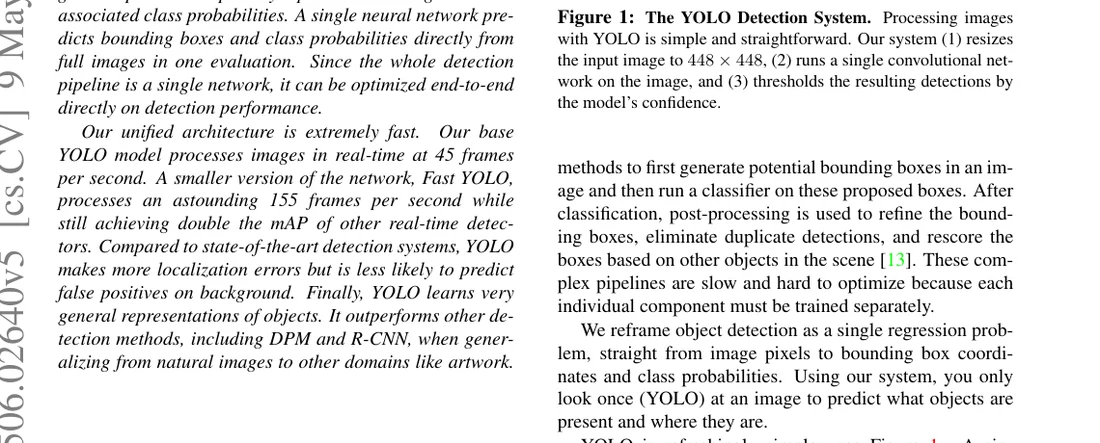
Figure 1, Section 1: unified detection pipeline. See arXiv PDF Figure 1. Cropped from the CVPR 2016 camera-ready PDF; copyright remains with the authors/IEEE. This note preserves attribution for scholarly commentary and cites arXiv reuse terms.
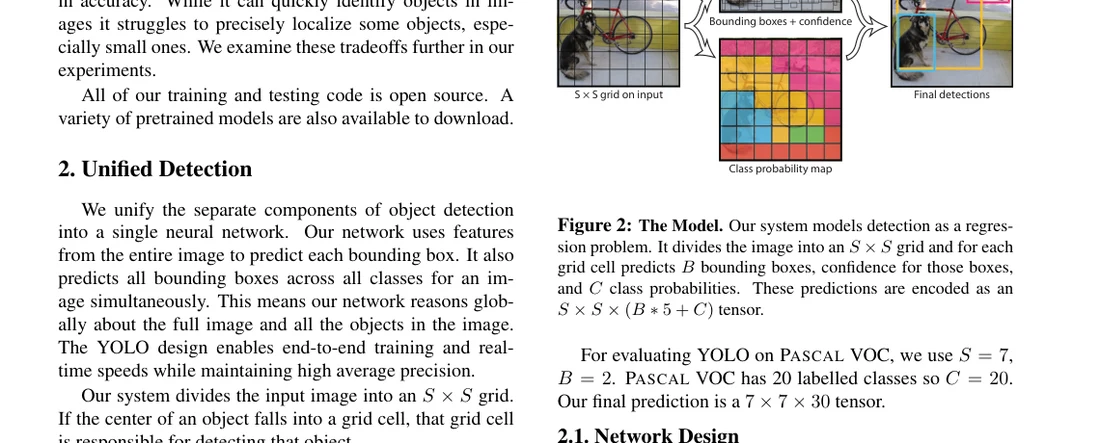
Figure 2, Section 2: detection as regression. See arXiv PDF Figure 2. Crop and license note match Figure 1.
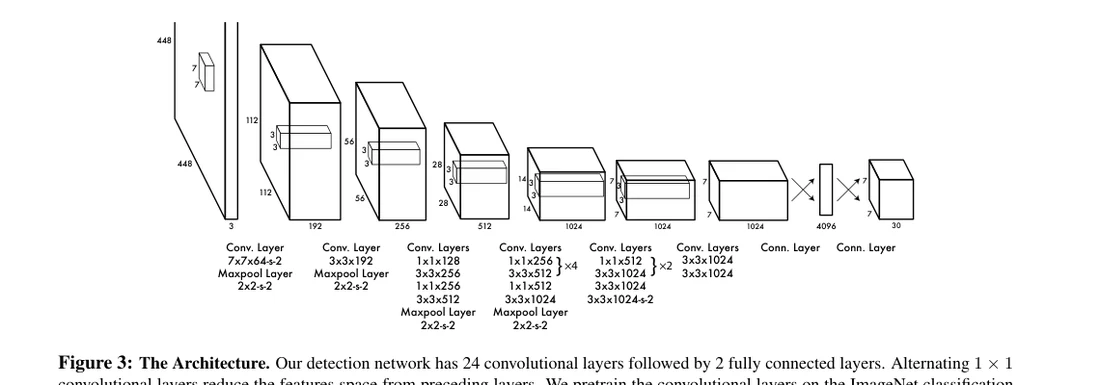
Figure 3, Section 2.1: detection network at 448 input. See arXiv PDF Figure 3. Crop and license note match Figure 1; the tall architecture strip is cramped in narrow layouts—use the PDF for layer-by-layer detail.
How to read the evidence
Table 1: mAP and FPS together (Section 4.1)
Question: Is there a detector above 30 FPS with much higher mAP than prior real-time systems? Controls: PASCAL VOC 2007 test; YOLO/Fast YOLO trained on 2007+2012. Observation: Fast YOLO 52.7% mAP at 155 FPS; YOLO 63.4% mAP at 45 FPS—the authors report Fast YOLO at roughly twice other real-time mAP. Boundary: Faster R-CNN VGG-16 is ~10 mAP higher at 73.2% but only 7 FPS; Fast R-CNN is 70.0% mAP at 0.5 FPS. This is a speed-accuracy tradeoff table, not a COCO contract.
Figure 4: complementary error profiles (Section 4.2)
Question: Why can YOLO boost Fast R-CNN despite lower standalone mAP? Method: Hoiem et al. error taxonomy (correct/localization/background, and others). Observation: YOLO localization 19.0% versus Fast R-CNN 8.6%; YOLO background 4.75% versus Fast R-CNN 13.6% (about 3×). Boundary: explains Table 2’s +3.2 mAP rescoring, not unconditional single-model dominance.
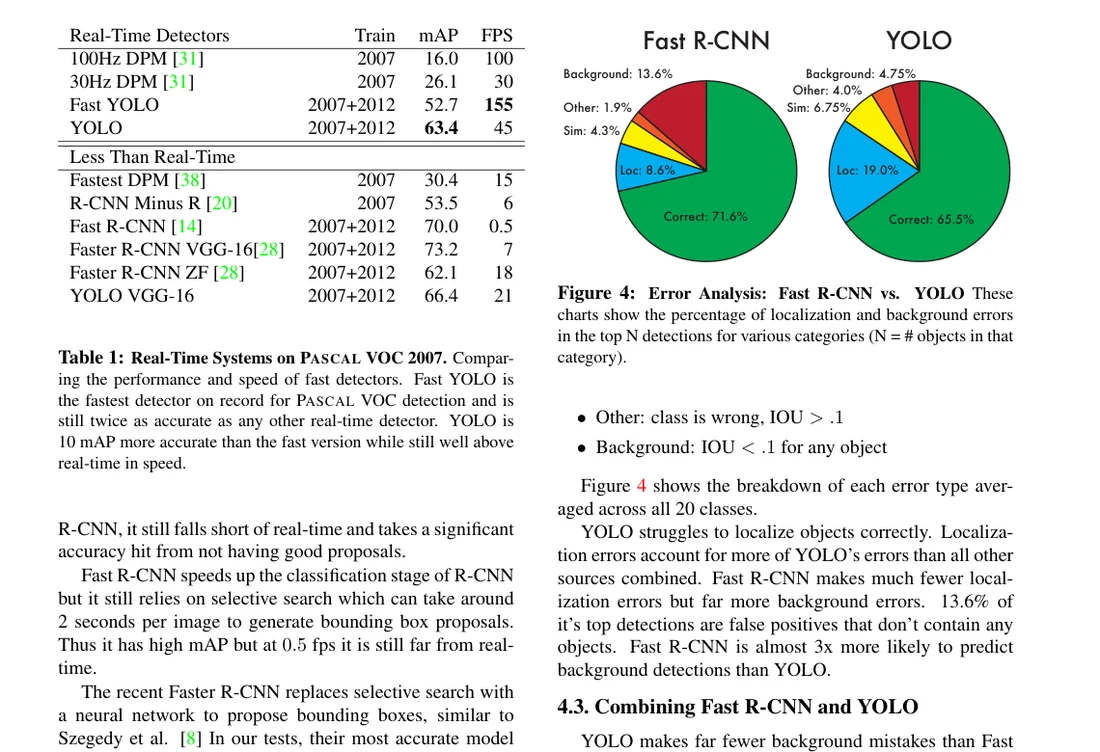
Figure 4 with Tables 1-2, Sections 4.1-4.3. See arXiv PDF page 6. This crop bundles tables and pie charts; numbers follow the PDF. Crop and license note match Figure 1.
Tables 2-3: ensembles and VOC 2012 (Sections 4.3-4.4)
Table 2: best Fast R-CNN 71.8%; add YOLO rescoring to 75.0% (+3.2); ensembling Fast R-CNN variants alone adds only +0.3 to +0.6. Table 3: on VOC 2012 test public leaderboard YOLO is 57.9% mAP (only real-time row); Fast R-CNN+YOLO is 70.7%. YOLO trails R-CNN by 8-10% on bottle, sheep, and tv (small objects) but wins on categories like cat and train—per-class slices resist a single win/loss sentence.
Ablations and design choices
- Coarse grid: S=7 forces spatial specialization and caps objects per cell (Section 2.4).
- / : balance empty-cell confidence gradients (Section 2.2).
- : penalize small-box deviations less in large boxes (Section 2.2).
- NMS: +2-3% mAP, unlike R-CNN-level dependence (Section 2.3).
- YOLO VGG-16 (Table 1): 66.4% mAP at 21 FPS—more accurate but the paper focuses on faster models afterward.
Limitations and threats to validity
- Two boxes and one class vector per cell: struggles with bird flocks and dense small objects (Section 2.4).
- Localization dominates errors: Figure 4; do not blame VOC mAP gaps on classification alone.
- Data and classes: VOC’s 20 natural-image classes are not open-vocabulary or COCO-80.
- Hardware era: 45 FPS on Titan X; remeasure on your device and resolution.
- Do not mix in later results: YOLOv2 anchors, YOLOv3 COCO, YOLOv8, RT-DETR, and others are later methods.
- Keep ResNet separate: ResNet teaches classification residuals; this paper teaches the detection pipeline—COCO +6 mAP transfer tables do not reverse into YOLO single-pass evidence.
Engineering decision and when not to use it
When to borrow this paper: your product puts end-to-end latency and detection quality on the same decision table and can accept single-pass full-image decoding. Measure one forward pass plus NMS before debating mAP.
When not to copy it wholesale:
- You need SOTA mAP and can pay two-stage cost—Table 1 still favors Faster R-CNN on mAP.
- Small or crowded objects—read Section 2.4 and VOC 2012 per-class slices first.
- You embed 63.4% VOC 2007 in a COCO or YOLOv8 product SLA.
- You confuse the Ultralytics repo with the 2016 paper—the latter is the historical starting point, not a deployment contract.
Huahua’s judgment
From ResNet, keep “rewrite the control point”; from YOLO, add one rule—latency is a first-class metric, but VOC 2016 mAP/FPS is not a 2026 detector product guarantee.
Artifacts and reproducibility
As of 2026-08-28:
- Paper: arXiv abs and PDF are readable; CVF open-access HTML opens.
- Code/models: the authors state training/testing code is open source with pretrained models (abstract, Section 6); project page
http://pjreddie.com/yolo/and the Darknet framework (Section 2.2). Modern PyTorch reimplementations are downstream ports, not identical training logs. - Data: PASCAL VOC 2007/2012 are obtainable; ImageNet pretraining uses a different split.
A minimal useful reproduction: run single forward plus 7×7×30 decode on a VOC subset and compare FPS versus localization/background error rates—validate the mechanism, not 63.4%.
Three things to remember
- Technical idea: detection equals one CNN regression over an S×S grid of boxes and classes—the control point is removing propose-then-classify pipelines.
- Evidence: VOC 2007 Table 1—YOLO 63.4% mAP at 45 FPS; Fast YOLO 52.7% at 155 FPS; Figure 4 shows more localization errors and fewer background errors; Fast R-CNN+YOLO 75.0% comes from complementary mistakes.
- Boundary: VOC 2012 is 57.9%, with coarse-grid and small-object limits; these are not YOLOv3/v8 or COCO results. The sequence from AlexNet to ResNet to YOLO moves from trainable classification to residual depth and unified real-time detection.
Further reading
If you have not read the entry points, return to AlexNet part 1, part 2, and ResNet. For reading method, see the three-pass approach. This note covers original YOLO only; the original Transformer is the next note in the broader foundations sequence. Later YOLO versions and COCO-era detection methods are intentionally out of scope.