Original YOLO deep reading
Series · 1 posts
-
YOLO: Detect From One Full-Image Pass, but VOC 2016 Does Not Represent the Later YOLO Family
Intermediate Build the foundations firstA source-grounded reading of Redmon et al., CVPR 2016 / arXiv:1506.02640: object detection as a single forward-pass regression—an S×S grid, B boxes, and C class probabilities in one shot. On VOC 2007, YOLO reaches 63.4% mAP at 45 FPS; this is 2016 unified-detection evidence, not YOLOv3 COCO or Ultralytics product numbers.
Understand it in 90 seconds
- Problem
- Pre-2016 detectors (DPM, R-CNN, Fast/Faster R-CNN) split proposals, features, scoring, and post-processing into separate stages that are hard to optimize end-to-end and slow at test time (for example R-CNN over 40 seconds per image; Fast R-CNN about 0.5 FPS).
- Core insight
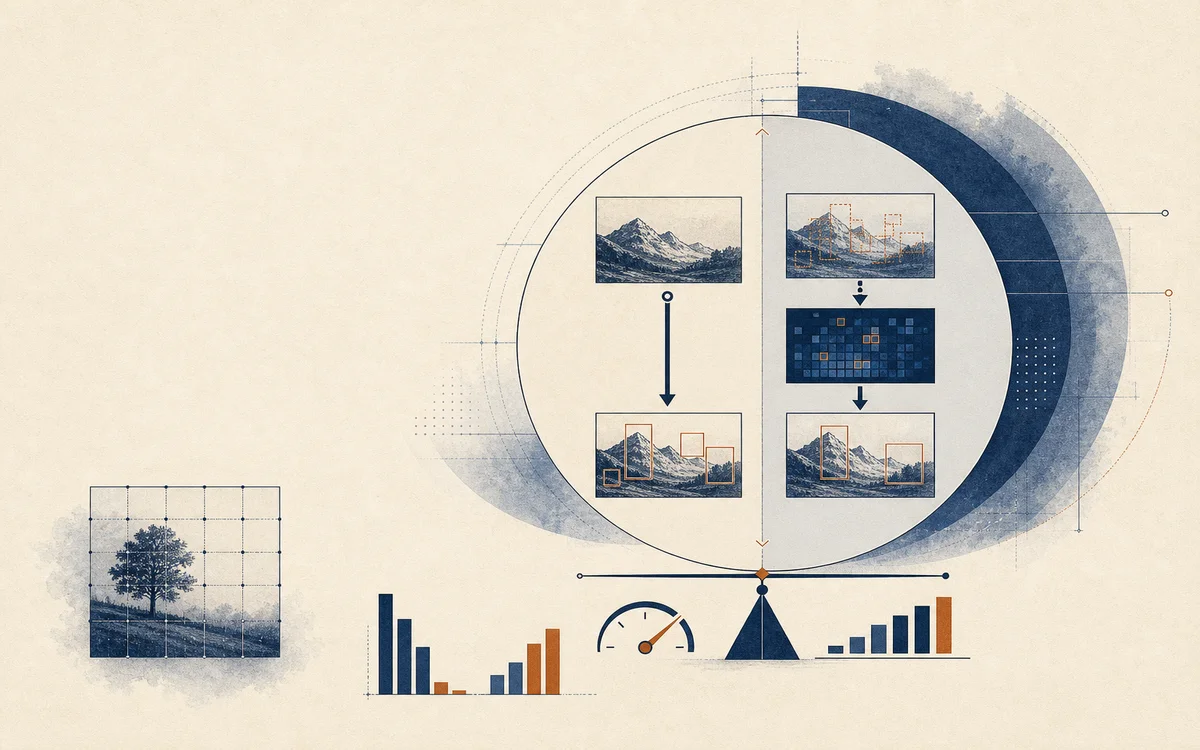
- Recast detection as single regression: one CNN maps the full image directly to spatially separated bounding boxes and class probabilities. The control point is one-shot global reasoning versus two-stage propose-then-classify; the whole pipeline is one network trained end-to-end on detection loss (Sections 1-2, Figures 1-2).
- Strongest evidence
- PASCAL VOC 2007 (Table 1, train 2007+2012): YOLO 63.4% mAP at 45 FPS (Titan X, no batching); Fast YOLO 52.7% mAP at 155 FPS. Same table: Fast R-CNN 70.0% mAP at 0.5 FPS; Faster R-CNN VGG-16 73.2% mAP at 7 FPS. Figure 4: YOLO's top error bucket is localization at 19.0%; background false positives are 4.75% versus Fast R-CNN 13.6%.
- Main boundary
- Coarse grid (two boxes and one class set per cell), VOC's 20 classes, not instance segmentation; VOC 2012 test 57.9% mAP trails leaderboard leaders. YOLOv2/v3/v8, COCO 2017, and Ultralytics product mAP are not in this PDF; ResNet-152 ImageNet 4.49% is not a detection contract either.
For speaking invitations, internal engineering sessions, or architecture exchange, see the topics and public work I can bring into the conversation.
Speaking & contact