Paper reading
Transformer: Drop Recurrence for Self-Attention, but WMT 2017 BLEU Does Not Represent Later LLMs
Pair this with the three-pass approach. In this site’s foundations sequence, the note follows AlexNet part 1, part 2, ResNet, and YOLO. Those papers cover CV classification and detection; Transformer moves sequence transduction to attention-only stacks, with training parallelism and WMT BLEU as its core evidence.
The paper in 90 seconds
- Problem: Before 2017, state-of-the-art sequence transduction (seq2seq) relied on RNN/LSTM/GRU encoder-decoders whose computation unfolds along time steps, limiting within-example parallelism on long sequences. Bahdanau et al. already attached attention to RNNs, but recurrence remained the backbone (Sections 1-2).
- Core insight: The Transformer stacks multi-head self-attention and position-wise FFN in both encoder and decoder, injects order with sinusoidal positional encodings, and removes recurrence and convolutions entirely. The control point is parallel global attention versus sequential hidden states; path length for long-range dependencies is per layer (Table 1).
- Strongest evidence: WMT 2014 newstest2014 (Table 2): Transformer (big) reaches 28.4 BLEU EN-DE (above prior bests including ensembles) and 41.8 BLEU EN-FR; big-model training takes 3.5 days on 8xP100 GPUs (300K steps). The base model reaches 27.3 BLEU EN-DE with training FLOPs of , below GNMT+RL at . Hardware text: base training 12 hours / 100K steps at 0.4 seconds per step (Section 5.2).
- Main boundary: The task is supervised MT encoder-decoder, not a pretrained language model, not bidirectional BERT, not decoder-only GPT, and not ViT. BERT, GPT-2/3, T5, LLaMA, and ChatGPT benchmarks are not in this PDF; YOLO VOC mAP and ResNet ImageNet 4.49% are not MT contracts either.
My conclusion: Transformer’s lasting contribution is making attention a new sequential inductive bias while enabling parallel training. WMT 28.4 / 41.8 BLEU and 12-hour / 3.5-day training times cannot serve as 2026 LLM product SLAs.
Huahua’s one-liner
RNNs pass hidden state one step at a time; Transformer lets every token attend across the whole sentence—but Table 2 BLEU is a translation contest score, not a ChatGPT user contract.
Version and reading scope
This article reads Vaswani et al., NeurIPS 2017 as arXiv:1706.03762 v7 (revised 2017-12-06). The PDF and arXiv HTML carry the arXiv.org perpetual non-exclusive license; Google additionally grants permission to reproduce tables and figures for scholarly commentary. Author order follows v7 (randomized, equal contribution): Ashish Vaswani, Noam Shazeer, Niki Parmar, Jakob Uszkoreit, Llion Jones, Aidan N. Gomez, Łukasz Kaiser, and Illia Polosukhin.
Beyond the abstract, I checked Section 3 architecture and attention, Section 4 complexity versus RNN/CNN (Table 1), Section 5 training, Section 6 results (Tables 2-4, appendix Figures 3-5), and artifacts as of 2026-08-28. BERT, GPT-2/3, T5, ViT, and LLaMA numbers are not written back.
The question a reader should answer
When you need sequence-to-sequence transformation (here, English-German and English-French translation), should you keep an RNN encoder-decoder with Bahdanau attention, or replace recurrence with self-attention throughout? Vaswani et al. choose the latter and report WMT BLEU together with training FLOPs and wall-clock time.
The precise read is not “Transformer is the best 2026 LLM.” The real question is: how global parallel attention rewires seq2seq data flow and training cost, what WMT-era numbers actually support, and which later pretrained-LM scores must not be copied into this paper’s tables.
Evidence map
| Layer | How this article uses it |
|---|---|
| Paper directly supports | Figure 1 encoder-decoder stack; Figure 2 scaled dot-product and multi-head attention; Equations (1)-(2); Table 1 path length and parallelism; Table 2 WMT BLEU and training FLOPs; Table 3 base/big ablations; Table 4 parsing F1; appendix Figures 3-5 attention visualizations. |
| Author claims | An attention-only transduction model can be higher quality, more parallelizable, and faster to train; shorter paths help long-range dependencies; the architecture transfers to constituency parsing. |
| Not established | Bidirectional pretraining (BERT); decoder-only generative pretraining (GPT); vision Transformers (ViT); instruction tuning / RLHF; arbitrary-length inference product SLAs. |
| Bloss0m engineering judgment | Place this note in the sequence-transduction section of the foundations sequence. CV starting points are AlexNet, ResNet, and YOLO. BERT GLUE, GPT-3 few-shot, and ViT ImageNet results are not part of the original Transformer tables. |
Why the previous approach is insufficient
Sections 1-2 set the context. RNN/LSTM/GRU seq2seq (Sutskever et al., Cho et al.) updates along time, so computation is inherently sequential and hard to parallelize within long examples. Bahdanau et al. add additive attention between encoder and decoder, but recurrence remains the backbone. ConvS2S and ByteNet parallelize with convolutions, yet distant dependencies still require depth or dilation; path length grows with distance (Table 1).
YOLO reframes full-image detection as one regression pass; ResNet addresses ImageNet classification depth—neither handles variable-length symbol transduction or MT BLEU.
Core intuition
Before the equations, picture English-to-German translation. An RNN encoder reads left to right into a hidden chain; an RNN decoder generates German step by step, optionally attending back to encoder positions. Transformer lets every English subword attend to all English positions in each encoder layer (self-attention). The decoder uses masked self-attention (left context only) plus encoder-decoder attention (full English), with no recurrence.
Three easy confusions:
- Bahdanau seq2seq + attention: attention links encoder and decoder, but both sides stay RNN-based.
- Transformer (this paper): encoder/decoder stacks are self-attention + FFN; order comes from positional encodings.
- Later methods: BERT bidirectional MLM, GPT decoder-only pretraining, T5 text-to-text, ViT patch attention—different tasks and numbers than this 2017 PDF.
Walk one example through the method
The following walks inference on a simplified English-to-German fragment (a Bloss0m teaching example, not a numbered paper experiment).
- Input: English subword tokens, e.g.
The / cat / sat(BPE in practice, ~37K vocabulary, Section 5.1). - Intermediate representation: Token embeddings () plus positional encodings enter six encoder layers; each layer applies 8-head self-attention ( per head) then FFN (512 to 2048 to 512) with residual connections and LayerNorm (Sections 3.1-3.3).
- Model or system decision: The decoder has already emitted
Die / Katze; the next step combines masked self-attention over the left context with encoder-decoder attention over all English positions; beam search (beam 4, , Section 6.1) picks the next subword. - Output: A full German hypothesis such as
Die Katze saßfor English sat. - Likely failure point: Long sequences make self-attention in memory; copy-like behavior can appear when alignments are near-literal (appendix Figures 3-5 show head specialization but do not guarantee correct inference). Rare BPE pieces still rely on subword segmentation, not LLM-style world knowledge.
Technical mechanism
Encoder-decoder stack (Figure 1, Section 3.1)
- Encoder: layers; each layer = multi-head self-attention + FFN; residual + LayerNorm; width .
- Decoder: layers; each layer = masked self-attention + encoder-decoder attention + FFN.
- Big model (Table 3 last row): , , , 300K steps, for EN-FR.
Scaled dot-product attention (Equation 1, Figure 2)
, , and come from linear projections; dividing by keeps softmax gradients usable at larger . Higher compatibility between a query and a key increases that value’s weight in the output.
Multi-head attention (Section 3.2.2)
heads with ; heads specialize across subspaces (appendix visualizations show syntax and coreference-like patterns). Encoder-decoder attention lets each decoder position query the full encoder sequence.
Positional encoding (Section 3.5)
Sine and cosine features inject position because there is no recurrence. Table 3 row (E): learned positional embeddings match the sinusoidal version within ~0.1 BLEU on dev.
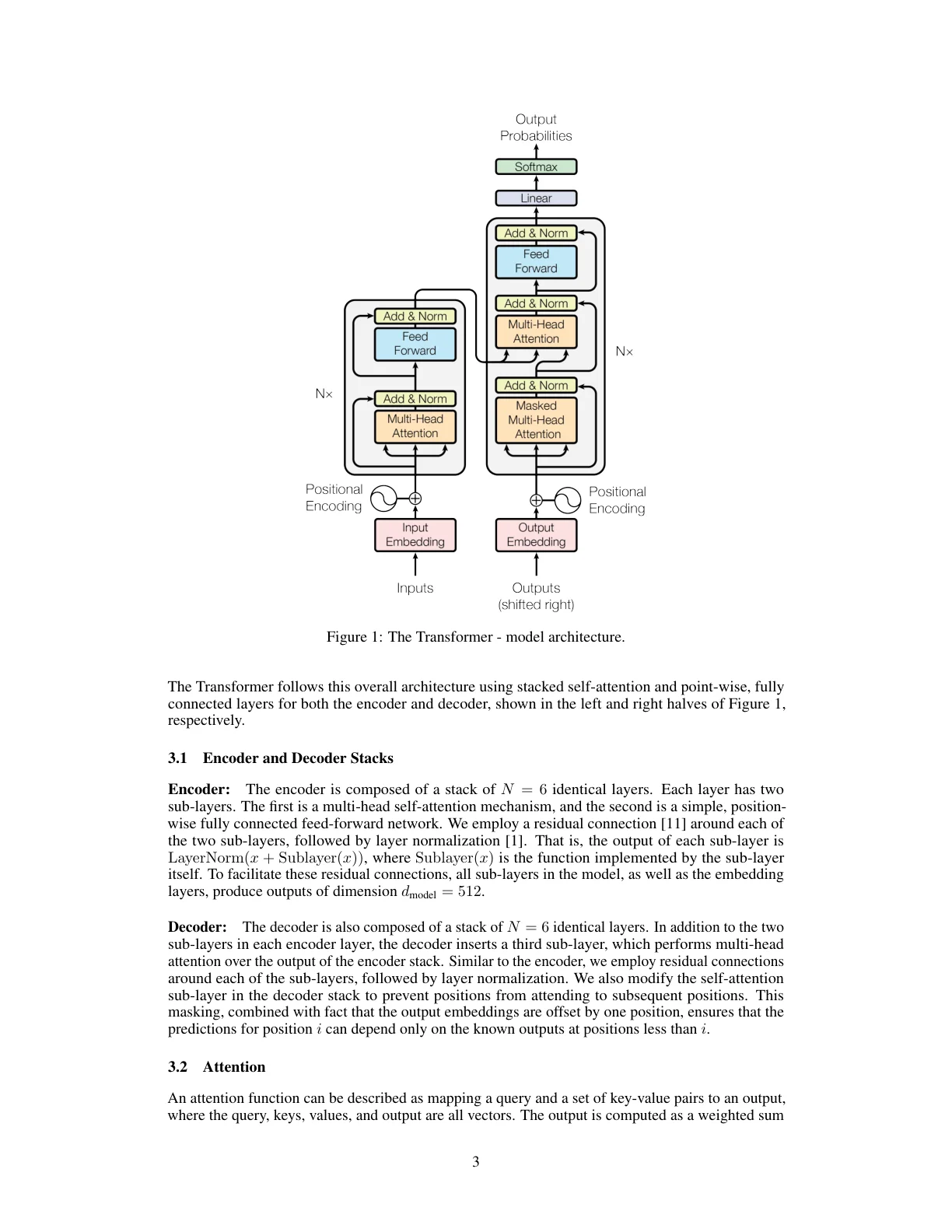
Figure 1, Section 3: Transformer architecture. Source: arXiv PDF Figure 1. Extracted from the NeurIPS 2017 camera-ready PDF; Google grants scholarly reproduction per the arXiv HTML header. This page crop includes surrounding text; use the PDF for fine detail.
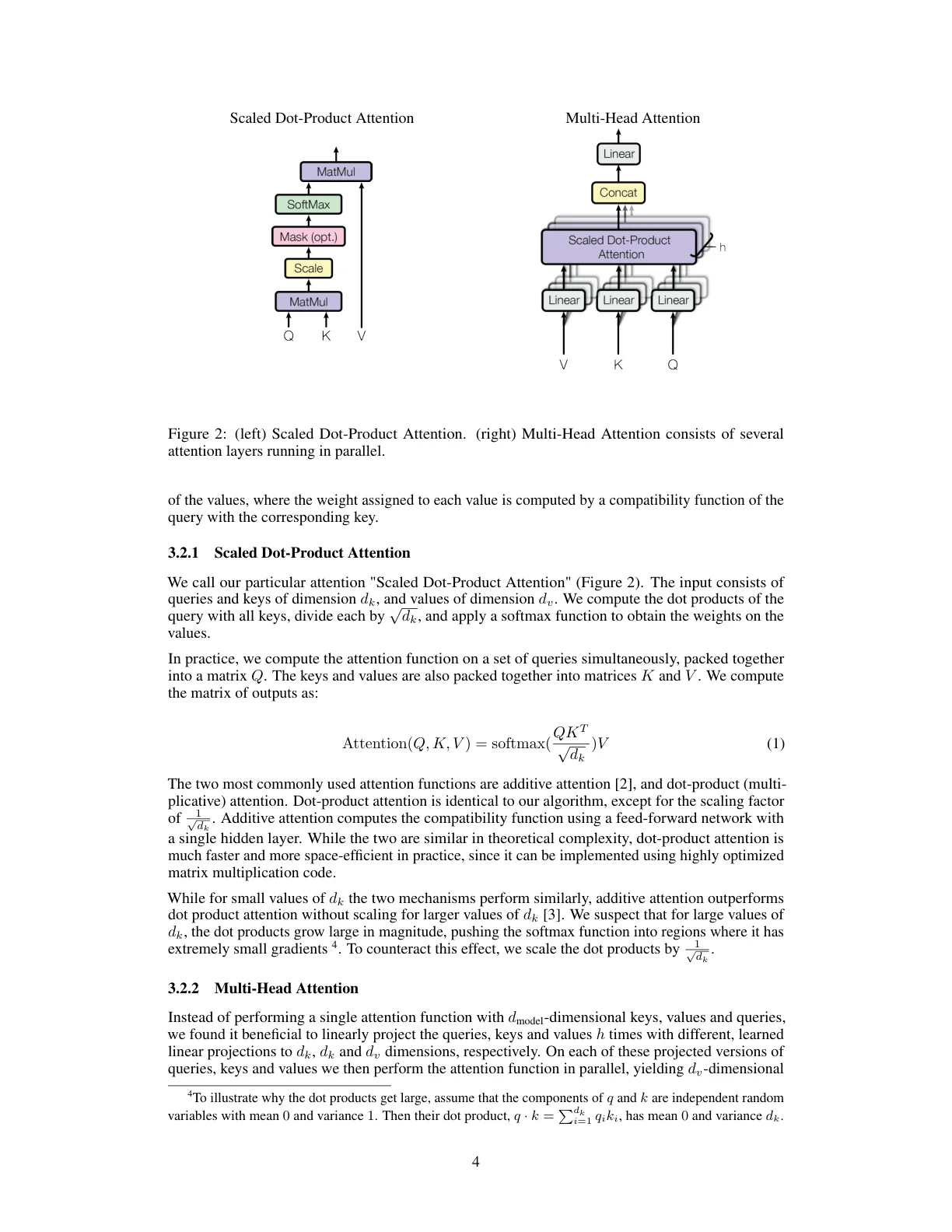
Figure 2, Section 3.2: attention mechanisms. Source: arXiv PDF Figure 2. License note as for Figure 1.
How to read the evidence
Table 2: BLEU and training cost (Section 6.1)
Question: Can Transformer beat GNMT / ConvS2S (including ensembles) at lower training FLOPs? Controls: WMT 2014 newstest2014; beam 4, length penalty 0.6; big model averages the last 20 checkpoints. Observation: Transformer (big) reaches 28.4 EN-DE and 41.8 EN-FR BLEU; big-model EN-DE training FLOPs are , below GNMT+RL ensemble at . Boundary: This is 2014 MT test data, not MMLU or HumanEval; 41.8 comes from the Table 2 EN-FR column (consistent with the abstract).
Table 1: Why recurrence can be removed (Section 4)
Question: What does self-attention trade for parallelism and path length? Observation: Self-attention uses sequential operations per layer and maximum path length; RNN layers need . Boundary: Per-layer cost is —long sequences remain expensive; the paper plans restricted attention for future work (end of Section 4).
Table 3: Ablations (Section 6.2)
Question: Which knobs move BLEU on EN-DE dev? Observation: Base (six layers, eight heads) reaches 25.8 BLEU on newstest2013; a single head drops to 24.9; reaches only 23.7; improves to 26.0. Boundary: All rows are EN-DE dev, not EN-FR test.
Appendix Figures 3-5: Attention visualizations (Section 4, appendix)
Question: Do heads learn interpretable structure? Observation: Encoder layer five shows long-distance links such as making…difficult; some heads track coreference. Boundary: Visuals are qualitative support, not extra BLEU gains.
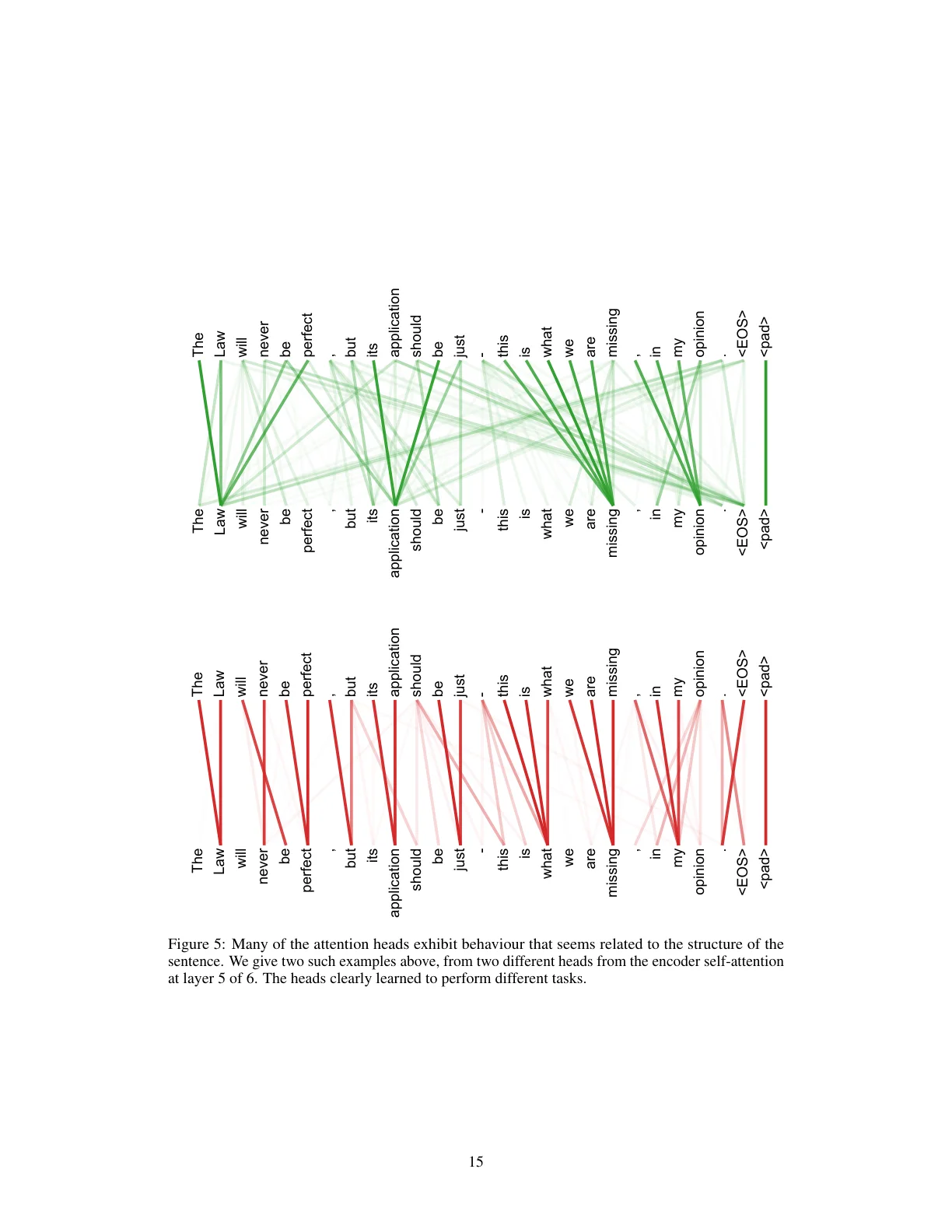
Figure 3, appendix: attention visualization (layer 5 of 6). Source: arXiv PDF appendix. This page crop includes other content; colors distinguish heads—see the PDF. License and reuse note as for Figure 1.
Table 4: Parsing transfer (Section 6.3)
A four-layer Transformer reaches 91.3 F1 on WSJ with WSJ-only training and 92.7 semi-supervised—architecture transfers, but hyperparameters still follow the MT base setup, not a parsing product SOTA claim.
Ablations and design choices
- Head count (Table 3A): eight heads win; too few or too many hurts BLEU.
- Smaller (Table 3B): dot-product compatibility gets harder.
- Depth (Table 3C): six layers beat two or four.
- Dropout / label smoothing (Table 3D): and for base.
- Checkpoint averaging: base averages the last five checkpoints; big averages the last twenty (Section 6.1).
Limitations and threats to validity
- Task boundary: supervised MT; not zero-shot LLM usage or retrieval-augmented generation.
- attention: long documents or high-resolution inputs need approximations (the paper’s stated future work).
- Hardware era: 8xP100 GPUs, 12 hours / 3.5 days—remeasure on your cluster and model size today.
- Do not mix in later results: BERT, GPT-2/3, T5, ViT, LLaMA, and ChatGPT benchmarks are outside this PDF.
- Keep CV foundations separate: ResNet / YOLO ImageNet and VOC numbers must not enter MT evidence tables.
Engineering decision and when not to use it
When to borrow this paper: If your system needs global dependencies between sequence elements and can pay attention cost, the encoder-decoder Transformer remains the textbook starting point. Measure per-layer attention memory and latency before chasing BLEU or downstream scores.
When not to copy it blindly:
- You need bidirectional pretraining (BERT) or decoder-only generative pretraining (GPT)—different objectives.
- You need image patch sequences (ViT)—different modality and inductive bias.
- You write 28.4 EN-DE BLEU into a 2026 chat product SLA.
- You confuse the historical tensor2tensor repository with the 2017 paper’s experimental contract.
Huahua’s judgment
YOLO shows how to report latency beside quality; Transformer demonstrates a new sequential inductive bias. WMT 2017 BLEU supports machine translation, not later LLM product performance.
Artifacts and reproducibility
As of 2026-08-28:
- Paper: arXiv abs, PDF v7, and the NeurIPS 2017 page are readable.
- Code: The paper points to tensorflow/tensor2tensor (Section 7). This environment did not verify one-click reproduction of Table 2; modern PyTorch/JAX ports are downstream implementations.
- Data: WMT 2014 EN-DE (~4.5M sentence pairs) and EN-FR (36M sentences); you must obtain the era-appropriate preprocessing pipeline yourself.
The smallest useful reproduction: run encoder-decoder forward plus one masked-attention step on a tiny parallel corpus and check that attention maps are non-degenerate—mechanism validation, not a 28.4 BLEU replication.
Three things to remember
- Technical idea: seq2seq transduction via stacked self-attention + FFN instead of recurrence; positional encodings restore order; the control point is parallel global attention.
- Evidence: Table 2—Transformer (big) 28.4 EN-DE and 41.8 EN-FR BLEU; base 12 hours / big 3.5 days on 8xP100; training FLOPs below most RNN/CNN SOTA rows.
- Boundary: This is an MT encoder-decoder, not BERT, GPT, or ViT. The sequence from AlexNet through ResNet and YOLO to Transformer moves from trainable CV to residuals, real-time detection, and finally sequence transduction.
Further reading
If you have not read the CV starting points, return to AlexNet part 1, part 2, ResNet, and YOLO. For reading method, see the three-pass approach. This note covers the original Transformer; InstructGPT next addresses post-pretraining human-feedback alignment rather than a new architecture. BERT, GPT, T5, and ViT are intentionally not expanded here.