Computer Vision Foundations
4 reading notes
Build a foundation for reading methods papers through classic vision architectures, training choices, and evaluation evidence.
Reader question
Which design choices and evidence from a classic model still transfer to today’s systems?
Reading library
Read this topic in depth
Every paper reading currently filed under this research topic.
-
ResNet: Residuals Make Depth Trainable, but ImageNet 2015 Is Not a Ready-Made Detection or ViT Contract
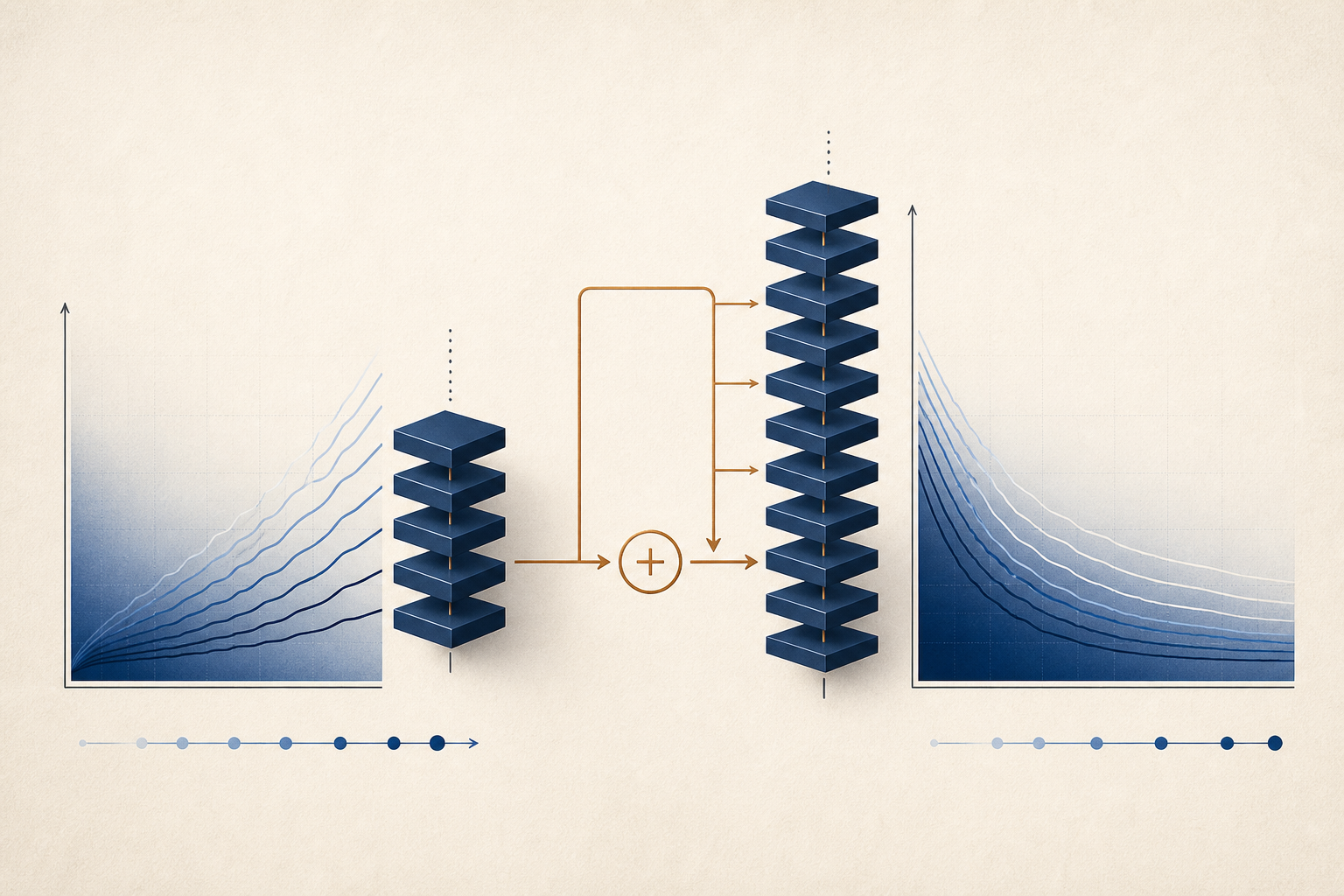
Intermediate Build the foundations firstA source-grounded reading of He et al., CVPR 2016 / arXiv:1512.03385: identity shortcuts let stacked layers learn residual F(x)+x and fix plain-net degradation. ResNet-152 reaches 4.49% top-5 validation error on ImageNet; this is 2015 classification evidence, not a YOLO, ViT, or modern ConvNet leaderboard contract.
Understand it in 90 seconds
- Problem
- After batch normalization and good initialization made tens of layers trainable, stacking more plain conv layers still triggers degradation—deeper models show higher training error (Figure 1, Figure 4 left), which is not ordinary overfitting.
- Core insight
- Recast the target mapping. Instead of asking stacked nonlinear layers to fit $\mathcal{H}(\mathbf{x})$ directly, let them fit $\mathcal{F}(\mathbf{x}):=\mathcal{H}(\mathbf{x})-\mathbf{x}$ and output $\mathbf{y}=\mathcal{F}(\mathbf{x})+\mathbf{x}$ through identity shortcuts (Equation 1). The control point is whether the solver must fit $H(x)$ from scratch or learn a correction $F(x)$ on top of identity.
- Strongest evidence
- On ImageNet with matched parameter counts, plain-34 top-1 error is 28.54% versus plain-18 27.94%, while ResNet-34 is 25.03% and beats ResNet-18 27.88% (Table 2, 10-crop validation). On CIFAR-10, plain-56 training error exceeds 60% and is omitted from Figure 6 left, while ResNet depth scans down to ResNet-110 6.43% (Table 6, Figure 6). ResNet-152 single-model top-5 validation error is 4.49%; a six-model ensemble reaches 3.57% top-5 on test (Tables 4–5).
- Main boundary
- The headline contract is 2012 ImageNet classification plus CIFAR-10 depth diagnostics; PASCAL/COCO detection is a Faster R-CNN backbone transfer table (Tables 7–8), not a YOLO contract, not ViT, and not a modern ConvNet leaderboard.
-
YOLO: Detect From One Full-Image Pass, but VOC 2016 Does Not Represent the Later YOLO Family
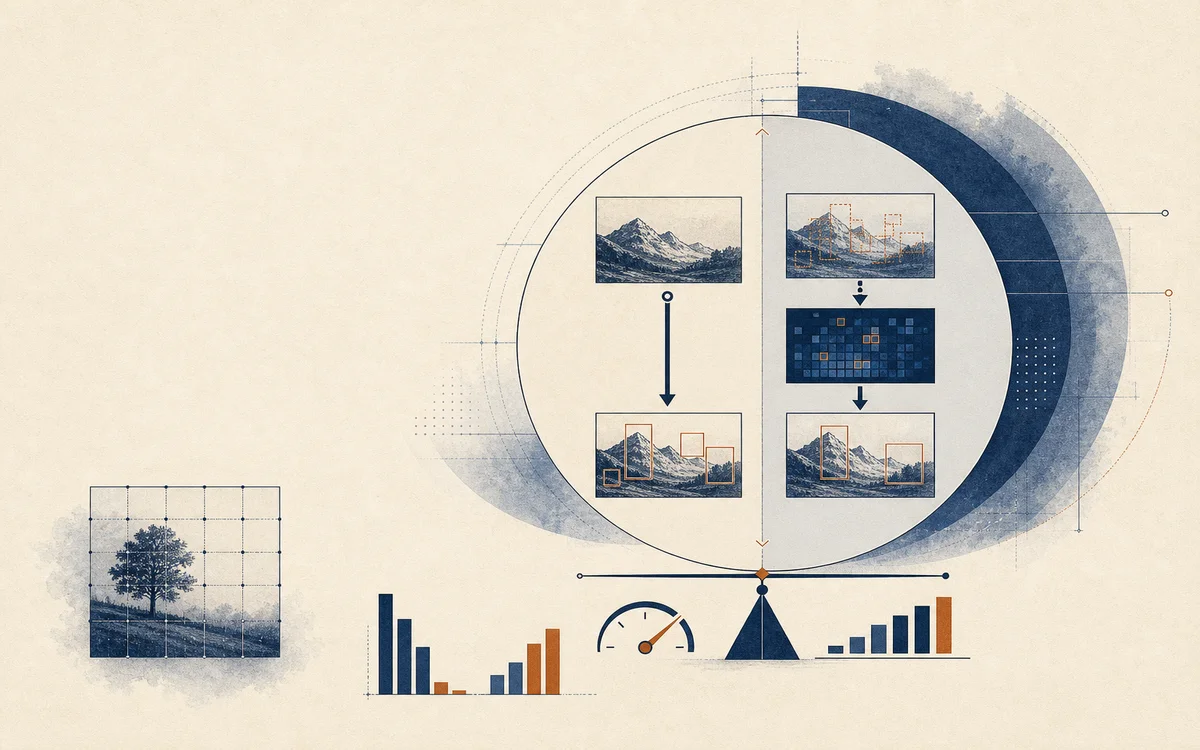
Intermediate Build the foundations firstA source-grounded reading of Redmon et al., CVPR 2016 / arXiv:1506.02640: object detection as a single forward-pass regression—an S×S grid, B boxes, and C class probabilities in one shot. On VOC 2007, YOLO reaches 63.4% mAP at 45 FPS; this is 2016 unified-detection evidence, not YOLOv3 COCO or Ultralytics product numbers.
Understand it in 90 seconds
- Problem
- Pre-2016 detectors (DPM, R-CNN, Fast/Faster R-CNN) split proposals, features, scoring, and post-processing into separate stages that are hard to optimize end-to-end and slow at test time (for example R-CNN over 40 seconds per image; Fast R-CNN about 0.5 FPS).
- Core insight
- Recast detection as single regression: one CNN maps the full image directly to spatially separated bounding boxes and class probabilities. The control point is one-shot global reasoning versus two-stage propose-then-classify; the whole pipeline is one network trained end-to-end on detection loss (Sections 1-2, Figures 1-2).
- Strongest evidence
- PASCAL VOC 2007 (Table 1, train 2007+2012): YOLO 63.4% mAP at 45 FPS (Titan X, no batching); Fast YOLO 52.7% mAP at 155 FPS. Same table: Fast R-CNN 70.0% mAP at 0.5 FPS; Faster R-CNN VGG-16 73.2% mAP at 7 FPS. Figure 4: YOLO's top error bucket is localization at 19.0%; background false positives are 4.75% versus Fast R-CNN 13.6%.
- Main boundary
- Coarse grid (two boxes and one class set per cell), VOC's 20 classes, not instance segmentation; VOC 2012 test 57.9% mAP trails leaderboard leaders. YOLOv2/v3/v8, COCO 2017, and Ultralytics product mAP are not in this PDF; ResNet-152 ImageNet 4.49% is not a detection contract either.
-
AlexNet Part 2: Turning the Training Recipe into Testable Design Choices
Intermediate Build the foundations firstA source-grounded reading of ReLU, multi-GPU splitting, overlapping pooling, augmentation, and dropout in Figure 1–3 and Sections 3–6.
Understand it in 90 seconds
- Problem
- a 60M-parameter CNN can overfit even with 1.2M images, and its training recipe must be separated from the competition result.
- Core insight
- random crop/flip, RGB PCA lighting jitter, and dropout change or regularize the effective training distribution; SGD, momentum, weight decay, and a learning-rate schedule make Part 1's architecture converge.
- Strongest evidence
- color augmentation reduces top-1 error by over 1%, overlapping pooling by 0.4/0.3 points, and the full system reaches 37.5/17.0 on ILSVRC-2010 and 15.3 top-5 in 2012 (Sections 4–6; Table 1).
- Main boundary
- these ablations belong to the era's architecture, data, and compute; they do not show every modern vision model needs ten-crop, LRN, or the same schedule.
-
AlexNet Part 1: Reading the Evidence Behind an ImageNet Turning Point
Introductory Build the foundations firstA source-grounded rereading of AlexNet’s problem, evaluation, historical result, and evidence boundary.
Understand it in 90 seconds
- Problem
- in 2012, training a deep CNN on millions of high-resolution images was constrained by optimization speed, GPU memory, and overfitting.
- Core insight
- AlexNet is not one “big network” trick: convolutional locality, ReLU, a constrained two-GPU split, and an eight-layer architecture form a trainable system.
- Strongest evidence
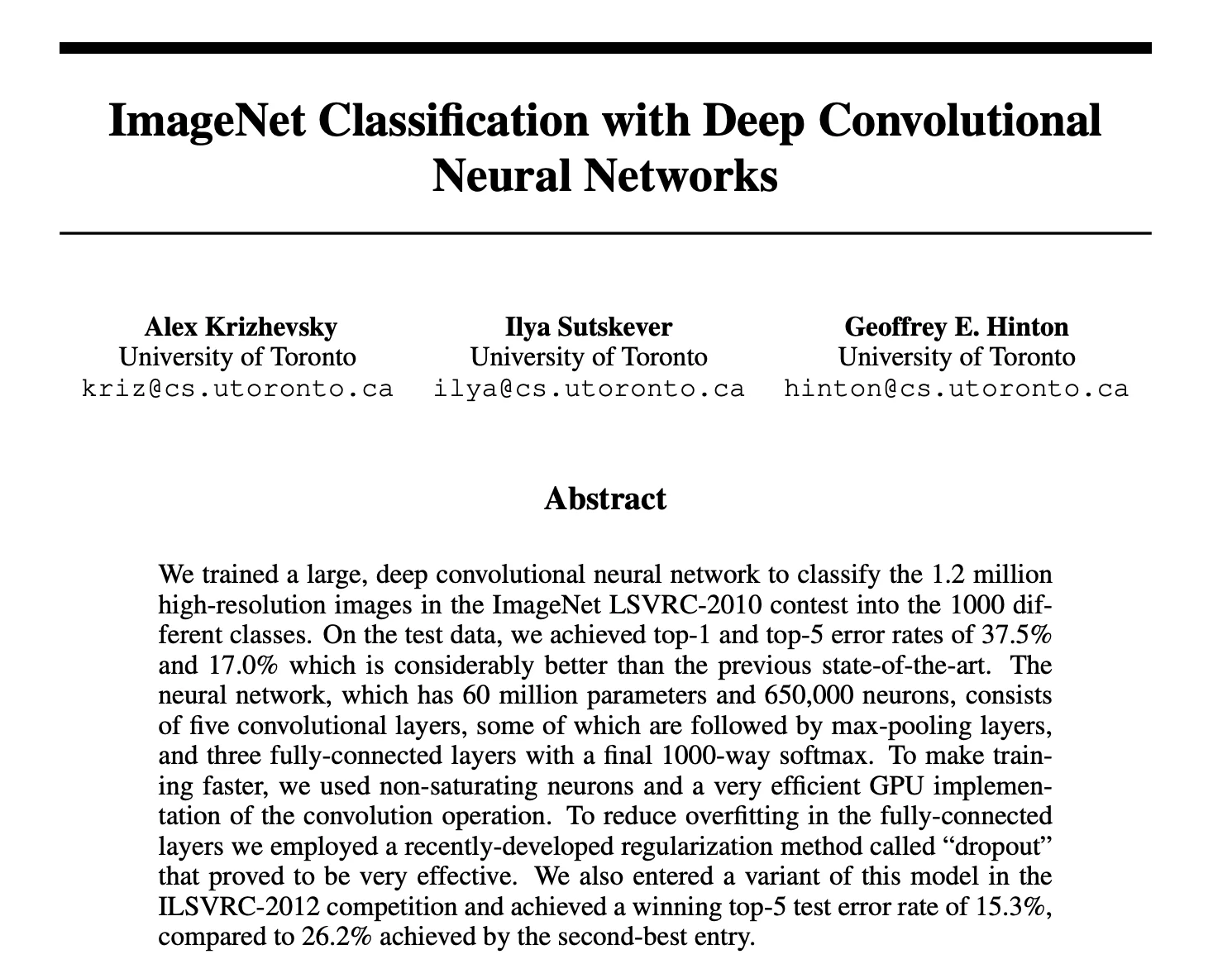
- ILSVRC-2010 top-1/top-5 error is 37.5%/17.0%; the 2012 competition top-5 error is 15.3% versus 26.2% for second place (Section 6; Table 1).
- Main boundary
- LRN, the two-GPU split, and some kernel choices are hardware-era tradeoffs, not claims of modern optimality.
For speaking invitations, internal engineering sessions, or architecture exchange, see the topics and public work I can bring into the conversation.
Speaking & contact