Agent Memory & Adaptation
12 reading notes
Understand memory layers, index updates, durable state, and safe system adaptation for long-horizon tasks.
Reader question
What should a system remember, update, or forget to improve over time without accumulating errors?
Reading library
Read this topic in depth
Every paper reading currently filed under this research topic.
-
Predicting Partial Answer Quality and Utility in Agentic Retrieval-Augmented Generation
AdvancedA deep reading of Predicting Partial Answer Quality and Utility in Agentic Retrieval-Augmented Generation: turning intermediate answer quality, utility, and trajectory signals into an early-stopping controller, then checking the savings and transfer boundary.
Understand it in 90 seconds
- Problem
- An agentic RAG system may execute several query, retrieve, read, and reasoning rounds before it produces a final answer. Running every instance to natural stopping wastes cost after the answer has saturated, while continuing after a failure pattern may only repeat the failure. The paper asks whether each partial answer can provide a prediction of quality and utility.
- Core insight
- Partial quality and incremental utility are different targets. Quality asks how close the current answer is to the gold answer; utility asks how much quality changed from the previous round. Quality is easier to predict, while the sign and magnitude of utility depend more strongly on trajectory, retrieval noise, and task.
- Strongest evidence
- On Search-R1 and R1-Searcher over HotpotQA, 2WikiMultiHopQA, and MuSiQue, the authors compare supervised and unsupervised predictors. Search-R1 reaches about 0.438 at the best quality Pearson correlation and about 0.321 for utility; with thetaP=0.3 and thetaU=0.2, the controller reduces average iterations from 3.21 to 2.86 and preserves 97.60% of natural-stopping quality.
- Main boundary
- Partial answer quality is probed with F1 against a gold answer. That is not open-ended answer quality, and it does not show that a threshold transfers to a new retriever, model, corpus, answer format, or controller. Probing itself has generation cost.
-
EvoOntology: Turning a Static Data-Agent Semantic Layer into a Verifiable, Self-Evolving Interface
AdvancedA deep reading of EvoOntology: an MCP ontology layer built by evidence-grounded probing, then refined through attribution-guided typed edits and a backbone-conditional paired gate.
Understand it in 90 seconds
- Problem
- A data agent working over tables, files, and databases does not merely lack column names. It may not know which field, join, filter, or value constraint grounds a domain concept. Raw querying makes every trajectory rediscover the schema; a static semantic layer can be too large, stale, and expensive to maintain. This agent–data gap becomes wrong queries, longer trajectories, and ungrounded answers.
- Core insight
- Treat the ontology as a versioned MCP service with Content, Schema, and Tool layers rather than as a fixed prompt document. The builder agent probes the raw data to ground semantics. The evolution agent finds gaps in failed trajectories, proposes a typed, evidence-grounded patch at one layer, and accepts it only through a paired validation gate on the same backbone.
- Strongest evidence
- Figure 2 shows the three-layer architecture; Figure 4 shows four backbones improving across accepted rounds; Tables 5–7 isolate the contributions of the gate, attribution, diagnosis, editable levels, and content object families; Appendix B Table 8 shows that per-turn context grows while average turns per task fall from 14.6 to 8.4 and total tokens per task fall from 52.6K to 42.0K.
- Main boundary
- The headline gain must be read with scope labels: four-backbone analysis subset, six-backbone main tables, benchmark-specific metrics, and round-wise evolution are not interchangeable. The repository contains inspectable framework code and a demo, but benchmark raw data, prebuilt ontologies, model weights, and complete provider credentials are not delivered as one reproducible bundle.
-
VikingRAG: Fewer Retrieval Rounds, Less Context Waste for Structured-Document RAG
AdvancedA deep reading of VikingRAG: hierarchy-preserving URI-addressable storage, Search/List/Grep/Read tools, reusable experience edges, and adaptive escalation for reducing repeated retrieval tokens and latency.
Understand it in 90 seconds
- Problem
- Enterprise manuals, syllabi, papers, contracts, and financial reports are not bags of unrelated chunks. An answer may require finding the right document, then following chapter, section, or subsection structure to collect facts that are far apart. Serializing every directory into the prompt makes structural context expensive; doing only one flat top-k retrieval can miss cross-section dependencies on the first pass.
- Core insight
- Move the hierarchy from the prompt into queryable external semantic storage. Every directory node, chunk, and multi-level abstract receives a URI whose prefix preserves ancestor–descendant relations. A vector result is therefore not only text; it is a navigation handle that can drive scoped List, Grep, and Read operations (Sections 2.2 and 3.1).
- Strongest evidence
- The evaluation covers six structured-document datasets and eight baselines, with default settings K=10, L=1,000, and B=15. End-to-end accuracy, latency, LLM tokens, ingestion, and deletion are measured. Figure 3 and Table 3 report 11.6%–51.9% token ratios for VikingRAG and 5.1%–32.5% for VikingRAG-E+; Figure 7 repeats the central comparison with GPT-5.5, Seed-2.0, and GLM-4.7 on VersionQA.
- Main boundary
- Accuracy is an LLM-as-a-judge semantic-consistency proxy with expert verification, not a direct retrieval-recall or independently replicated correctness proof. Experience edges are warmed with 1,000 synthetic historical questions generated from the same document corpus; false-no-escalation is still 14.4% on QASPER and 6.7% on FinanceBench (Table 7).
-
Generative Agents: Observe–Reflect–Plan in a Multi-Agent Sandbox — Do Not Mistake Sandbox Memory for MemGPT OS Paging
Intermediate Agent runtime, safety, and evaluationA deep read of Park et al., UIST 2023 / arXiv:2304.03442 v2: 25 agents in Smallville use a memory stream, periodic reflection, and retrieval-based planning. Interview ablations hit TrueSkill μ 29.89 vs 21.21 fully ablated; two-day sandbox diffusion and party coordination are qualitative evidence, not production runtime.
Understand it in 90 seconds
- Problem
- Large language models can mimic human behavior at a single time point, but believable agents over long horizons need growing memories, multi-agent social dynamics, and planning grounded in past experience—neither a longer prompt nor one-shot generation is enough.
- Core insight
- Store each agent's full experience in natural language in a memory stream, run periodic reflection to synthesize higher-level inferences, and retrieve with relevance, recency, and importance to plan and react. Twenty-five agents interact in the Smallville sandbox; the memory control plane is social-simulacra observe-reflect-plan, not MemGPT OS-style context paging for one agent.
- Strongest evidence
- Interview ablations (Figure 8): full architecture TrueSkill μ 29.89 (σ=0.72), beating no reflection (26.88), no reflection or planning (25.64), crowdworker baseline (22.95), and full ablation (21.21). Two-day open simulation (Section 7.1): mayor info holders 4%→32%, party info 4%→52%; relationship network density 0.167→0.74; party 12 invited, 5 attended.
- Main boundary
- Sandbox plus ChatGPT; the authors report thousands of dollars in token cost and multi-day runs for 25 agents over two game days (Section 8.2). Common failures are missed retrieval, fabricated embellishments, and overly formal speech from instruction tuning. This is not production ACL memory, not Reflexion across-trial verbal credit assignment, and not later Letta or xMemory product metrics.
-
Reflexion: Write Verbal Reflections into Memory — Do Not Mistake Retries for Weight Learning
Intermediate Agent runtime, safety, and evaluationA deep read of Shinn et al., NeurIPS 2023: frozen weights plus linguistic feedback stored in episodic memory for across-trial verbal credit assignment. HumanEval pass@1 91.0 vs GPT-4 80.1 is a programming setup with self-tests and retries; WebShop and MBPP mark the boundary.
Understand it in 90 seconds
- Problem
- Language agents can already act in external environments, but learning from trial-and-error usually means expensive sample-heavy RL with weight updates, while few-shot in-context teaching barely stores interpretable experience across episodes.
- Core insight
- Keep weights frozen. Amplify binary or scalar feedback into a verbal reflection, append it to an episodic memory buffer, and condition the next trial on that text. The changed control point is across-trial verbal credit assignment, not a parameter gradient.
- Strongest evidence
- HumanEval (PY) Reflexion pass@1 91.0 versus GPT-4 single-sample 80.1 (Table 1); ALFWorld heuristic setting solves 130/134 (Section 4.1); HotPotQA reports about +20% over strong baselines (Section 4 lead-in). Rust ablation: full Reflexion 0.68; omitting reflection or tests falls to 0.60 / 0.52 (Table 3).
- Main boundary
- Needs a usable evaluation signal; reflections can be wrong; extra trials cost compute; memory is a sliding window (typically 1–3), not enterprise governance. WebShop barely improves (Figure 6); MBPP (PY) drops to 77.1. This is not weight learning and not a deployable runtime.
-
MemGPT: Treat Context as Paged Memory — Do Not Mistake the OS Metaphor for Enterprise Memory
Intermediate Agent runtime, safety, and evaluationA deep read of Packer et al., arXiv:2310.08560 v2: finite context as RAM, OS-like tiers, and function-mediated paging. DMR moves GPT-4 from 32.1% to 92.5%; nested KV shows multi-hop lookup—not ACL memory governance.
Understand it in 90 seconds
- Problem
- Fixed-length context windows break long conversations and long-document analysis; naively lengthening transformer context raises quadratic cost, and long windows still may use middle tokens poorly.
- Core insight
- Do not start by buying a bigger RAM stick. Treat the LLM’s prompt tokens as main context (RAM), keep chat history and document stores in external context (disk), and let function calls decide what to write out, retrieve, and evict—like OS virtual-memory paging.
- Strongest evidence
- On Deep Memory Retrieval (Table 2), GPT-4 fixed-context accuracy is 32.1% versus 92.5% with MemGPT; GPT-4 Turbo moves 35.3% → 93.4%. On Nested KV (Figure 7), fixed-context models fall to 0% at deeper nesting while MemGPT+GPT-4 keeps multi-hop lookup alive.
- Main boundary
- The system depends on tool/function-call fidelity; the paging policy is itself an agent decision that can store or drop the wrong facts; the evidence is dialogue consistency plus sampled/synthetic document tasks—not ACL, audit, or rollback memory governance. Later Letta productization is not this paper’s experiment artifact.
-
ADIAS: Turning Agent Self-Improvement into Traceable Issue Repair
Advanced Agent runtime, safety, and evaluationA deep reading of ADIAS: persistent issue state organizes failure evidence across optimization rounds so a full-code agent designer can remember what was tried, what regressed, and when a repair is actually confirmed.
Understand it in 90 seconds
- Problem
- Automated agent design is usually candidate-centric. Each round re-reads candidate code, scores, and trajectories, but it does not explicitly remember whether the same failure has already been repaired, which intervention worked, or which change caused a regression.
- Core insight
- Make the issue being repaired, rather than the candidate agent, the persistent control state. Each issue has a stable identity, priority, supporting evidence, lifecycle status, and intervention-outcome history.
- Strongest evidence
- ADIAS is evaluated on Tau-Bench, ALFWorld, TextCraft, WebShop, and ScienceWorld against five baselines. Table 1 reports an average score of 78.4 versus 62.6 for DGM-H, with shared wrappers, splits, action interfaces, scoring scripts, a ten-iteration optimization budget, and 15 training episodes per iteration (paper Section 4 and Table 1).
- Main boundary
- The paper holds trajectory diagnosis and issue association fixed rather than measuring their accuracy separately, and evaluates only text-based interactive benchmarks. The GitHub repository still says Coming Soon as of 2026-08-12, so this article does not treat a paper-level code claim as a currently reproducible artifact.
-
DocMemo: Letting Long-Document RAG Recover from a Bad First Retrieval
Advanced Retrieval, memory, and production RAGA deep reading of DocMemo: document schema, page belief, and question episodic memory preserve retrieval state across rounds, while Bayesian updates, Thompson sampling, and adaptive granularity recover missed evidence.
Understand it in 90 seconds
- Problem
- Evidence in long documents can be spread across dozens of pages, tables, figures, and cross-page clues. Static retrieval fixes a top-k page pool at the start; if the first pass misses evidence, the reasoner has no state that explains which pages may still help, which were ruled out, or what remains missing.
- Core insight
- Turn retrieval into dynamic evidence exploration. Document Schema Memory stores document structure, Page Belief Memory updates page relevance beliefs, and Question Episodic Memory records discoveries and query refinement for the current question.
- Strongest evidence
- On MMLongBench-Doc, LongDocURL, and PaperTab, DocMemo reports accuracy of 71.3, 81.1, and 80.4, for a 77.6 average. Table 4 also shows MMLongBench-Doc accuracy falling from 71.3 to 68.5 or 68.8 when memory or Bayesian updating is removed.
- Main boundary
- Evaluation depends on a GPT-4.1 binary judge, PDF rendering, Qwen3.5-VL-9B, ColQwen2.5, MinerU, and annotations from three benchmarks. It does not establish citation faithfulness, access-control correctness, freshness, or total cost on arbitrary enterprise corpora.
-
ContextWeave Deep Read: Does Memory Actually Make Agents Better at Work?
Advanced Agent runtime, safety, and evaluationA close reading of how ContextWeave reconstructs multi-month workflows into an executable benchmark and measures memory's effect on workspace outcomes, preference adherence, continuity, and misleading recall.
Understand it in 90 seconds
- Problem
- memory benchmarks often count whether history is retrieved, not whether it makes the next executable task better.
- Core insight
- reconstruct multi-month workflows as fixed executable task streams, then change only access to prior trajectories for the same target task. Measure workspace quality and preference adherence, not a retrieval hit alone.
- Strongest evidence
- with 14 participants and 1,005 reconstructed tasks (568 core evaluation tasks), the strongest component raises Workspace Score from 68.08 to 78.20 and Preference Score from 41.50 to 70.60 (Section 5.2, Table 2).
- Main boundary
- Docker reconstruction, mock APIs, and LLM-based rubrics make the comparison controlled; they do not establish the uplift of every memory implementation on live enterprise data or drifting tools.
-
PAST-Bench: What Did a Persistent Agent Actually Learn from the Past?
Advanced Agent runtime, safety, and evaluationA deep read of how PAST-Bench uses fresh-session task families, matched persistence controls, and trace-level mechanism evidence to separate genuine retained-experience gains from higher scores with unrelated causes.
Understand it in 90 seconds
- Problem
- a persistent agent's later score can improve because of model, prompt, task difficulty, or residual context—not because it used prior experience correctly.
- Core insight
- PAST-Bench uses fresh-session task families, holds prompt, grader, and tool stack fixed, and switches persistence on/off while reporting task-score gap and write/read/artifact mechanism evidence.
- Strongest evidence
- 26 scenarios, 204 episodes, four capabilities, seven models, and four frameworks; Hermes+ reports its overall gap from +0.13 to +0.15 and Mech from 0.64 to 0.73 (Table 2; Section 4.3).
- Main boundary
- the gap difference is smaller than run-to-run variation, tasks are authored by the proposing team, and matched ablation is a strong control rather than complete causal proof.
-
Beyond RAG for Agent Memory: Detailed Notes on xMemory
Intermediate Retrieval, memory, and production RAGAn interpretation of arXiv:2602.02007 covering xMemory's four-tier hierarchy, sparsity–semantics objective, two-stage top-down retrieval, and empirical results on LoCoMo/PerLTQA.
Understand it in 90 seconds
- Problem
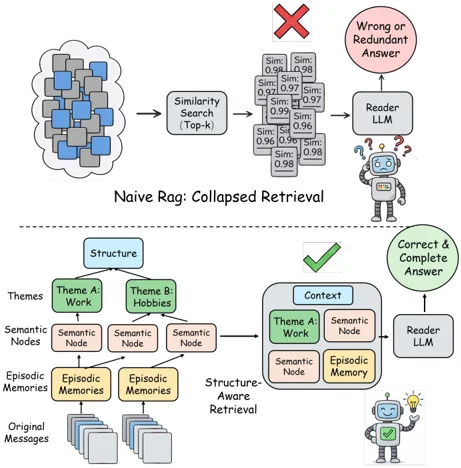
- agent memory is a temporally connected, near-duplicate, highly relevant interaction stream; fixed top-k chunks can crowd into one local region, while pruning can sever dependencies.
- Core insight
- xMemory decouples and aggregates raw messages into message, episode, semantic, and theme levels, uses a sparsity–semantics objective for split/merge, and retrieves top-down to spend detail only when needed.
- Strongest evidence
- LoCoMo, PerLTQA, and long-dialogue comparisons use Table 1, Figure 2, Figure 3, and appendix ablations to support hierarchy, retrieval, and efficiency claims.
- Main boundary
- hierarchy quality depends on segmentation, embeddings, and budget; benchmark QA does not establish safe production updates or governance of long-term memory.
-
RAG without Forgetting: Writing Successful Query Expansion Back into the Index
Intermediate Retrieval, memory, and production RAGA source-grounded assessment of ERM's correctness gate, selective attribution, bounded key updates, BEIR/BRIGHT results, and missing artifacts.
Understand it in 90 seconds
- Problem
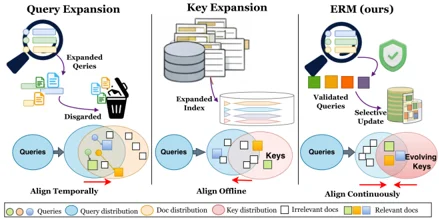
- query expansion can bridge query–document mismatch but regenerates work on every request; persistent key expansion can write bad feedback into the index.
- Core insight
- ERM accepts an expansion unit only through a correctness gate, attributes it to document keys whose similarity it improves, and applies a bounded update. It updates keys, not retriever parameters.
- Strongest evidence
- the paper reports retrieval and generation results across 13 BEIR/BRIGHT domains, with Table 1, Table 2, Figure 3, and Appendix B.9 separating quality, latency, budget, and transfer.
- Main boundary
- there is no public implementation, live A/B, attack/privacy, or rollback study; a bad gate can turn a wrong association into persistent index state.






For speaking invitations, internal engineering sessions, or architecture exchange, see the topics and public work I can bring into the conversation.
Speaking & contact