Paper reading
EvoOntology: Turning a Static Data-Agent Semantic Layer into a Verifiable, Self-Evolving Interface
The paper in 90 seconds
- Problem: A data agent working over tables, files, and databases does not merely lack column names. It may not know which field, join, filter, or value constraint grounds a domain concept. Raw querying makes every trajectory rediscover the schema; a static semantic layer can be too large, stale, and expensive to maintain. This agent–data gap becomes wrong queries, longer trajectories, and ungrounded answers.
- Core insight: Treat the ontology as a versioned MCP service with Content, Schema, and Tool layers rather than as a fixed prompt document. The builder agent probes the raw data to ground semantics. The evolution agent finds gaps in failed trajectories, proposes a typed, evidence-grounded patch at one layer, and accepts it only through a paired validation gate on the same backbone.
- Strongest evidence: Figure 2 shows the three-layer architecture; Figure 4 shows four backbones improving across accepted rounds; Tables 5–7 isolate the contributions of the gate, attribution, diagnosis, editable levels, and content object families; Appendix B Table 8 shows that per-turn context grows while average turns per task fall from 14.6 to 8.4 and total tokens per task fall from 52.6K to 42.0K.
- Main boundary: The headline gain must be read with scope labels: four-backbone analysis subset, six-backbone main tables, benchmark-specific metrics, and round-wise evolution are not interchangeable. The repository contains inspectable framework code and a demo, but benchmark raw data, prebuilt ontologies, model weights, and complete provider credentials are not delivered as one reproducible bundle.
My bounded verdict is: the most reusable idea is the combination of a queryable semantic control plane, typed local edits, and a same-backbone gate—not the claim that adding an ontology automatically improves every data agent. It is a good fit for recurring schema and domain gaps that can become auditable shared assets. If names, permissions, or data relationships change rapidly, resolve freshness, provenance, and transfer before copying the score headline.
Version, sources, and the reader question
This article reads EvoOntology v1, submitted to arXiv on 2026-09-14 by Meiduo Chong, Shaolei Zhang, Ju Fan, and Xiaoyong Du. It is an arXiv preprint, not a peer-reviewed result. I treat the reported benchmark scores as paper evidence, not as gains independently replicated outside the paper. I checked the full arXiv HTML, the PDF, all Figures 1–8, Tables 1–8, Appendices A–D, the builder and evolution method, and the authors’ EvoOntology repository and usage material.
The reader question is: How can a data agent avoid rediscovering schema and domain semantics on every task without permanently injecting a giant, static metadata layer into its context? This follows VikingRAG’s structured evidence navigation, DocMemo’s dynamic evidence discovery, and MidTool’s tool-use control: EvoOntology joins exploration traces, semantic structure, and the tool interface into an evolving intermediate layer.
Evidence map: Paper, Evidence, and Bloss0m judgment
| Layer | What this reading says |
|---|---|
| Directly supported by the Paper | The Content, Schema, and Tool layers; four Content node families and two edge families; builder probe-and-verify initialization; trajectory analysis, attribution, typed patch, and backbone-conditional paired gating; three benchmarks, six backbones, four-backbone analyses; main tables, ablations, cost, transfer, and case study. |
| Author claims | An interactive ontology layer lets an agent query heterogeneous data semantically; self-evolution can find gaps in execution trajectories and improve benchmark performance round by round; typed gating is safer than an uncontrolled rewrite against static semantic-layer baselines. |
| Not established by the Evidence | Domain transfer across all enterprise data sources; the best strategy for sharing an evolved ontology across models; safety under production freshness or ACL changes; total cost without provider billing; independent external replication; or reproduction of every paper number from a repository clone alone. |
| Bloss0m engineering judgment | Treat the ontology as a versioned data-agent control plane. Keep accepted and rejected patches, evidence, benchmark splits, and serving backbones in one lineage, and make gate failures observable signals rather than discarded attempts. |
Paper Essence Contract
- What problem does it solve? It addresses the agent–data gap: one business concept can be spread across fields, tables, files, and reference paths, and a data agent needs an actionable semantic bridge.
- Why are previous approaches insufficient? Raw querying pushes schema-discovery cost into every trajectory. A static semantic layer can fill the context, require manual maintenance, and lack a feedback loop that identifies gaps from real agent failures.
- What is the core technical idea? Use a three-layer ontology state, MCP browse/resolve tools, evidence-grounded initialization, and an attribution-guided typed edit plus paired gate to turn semantic exploration into queryable, evolvable, rollback-friendly objects.
- How does one input flow? User question → agent browses Terms and Mappings → resolves linked records, Constraints, and Evidence → produces a query or analysis → trajectory is diagnosed → candidate patch is compared with its parent on held-out validation → candidate is accepted or rejected → later inputs use the new ontology version.
- What evidence supports the headline claim? Figure 2’s architecture and Figure 8’s card-legality case; Tables 1–4’s benchmark results; Figures 3–5 and Tables 5–7’s evolution, ablation, and transfer evidence; and Appendix B Table 8’s token and turn accounting.
- Where does the claim stop? The main tables include six backbones, while deeper evolution, transfer, and cost analyses focus on four. Models evolve separate stores. The results support the paper’s comparisons, not long-term production operations across providers and enterprise domains.
Core intuition: an ontology is a verified semantic control plane
First imagine the ontology as a translator between an agent and raw data. The source data keeps its tables, files, columns, records, and references. The ontology adds four semantic object types that the agent can query:
- Term: a domain concept such as “Legality Status Code” or a business metric;
- Mapping: the field, join path, or record relation that grounds the Term;
- Constraint: the conditions under which the Term is valid and which values or filters must be coupled;
- Evidence: a value distribution, schema observation, query result, or other support for the semantic claim.
The Schema layer specifies fields, allowed relations, and reference patterns. The Tool layer exposes only the semantic material needed for the current step. This mental model matters because semantics are not decorative prompt prose. They are typed objects with mappings, constraints, and evidence. When a trajectory reveals a gap, the system proposes a patch to one editable level and tests that candidate as a new version rather than rewriting the whole store.
Why prior approaches are insufficient
A raw-querying agent can read schemas, execute SQL, inspect spreadsheets, or browse files, but it must guess concepts and locations again for each task. Cross-source questions add more than tool rounds: the agent may choose a wrong field, miss a reference, or treat two same-named columns as the same concept. A traditional semantic layer provides metadata, entities, metrics, and schema, but has two bottlenecks. A full layer cannot grow indefinitely inside context, and a manually or once-built layer does not automatically locate gaps from the agent’s actual trajectories.
EvoOntology is not merely metadata renamed as a graph. It packages the layer as an MCP server so the agent can selectively browse and resolve it, then treats agent behavior as evolution evidence. Previous methods mostly treat semantics as fixed input; this paper treats semantics as a runtime dependency and a testable versioned state.
End-to-end worked example: from raw data to an accepted ontology patch
1. State and the three-layer architecture
At evolution round t, the paper writes the ontology state as : Content is , Schema is , and Tool is . Separating them has two benefits. The deployed agent can retrieve only the semantics relevant to its current step, while the evolution agent can distinguish a missing Term from a schema rule that disallows a relation or a tool manifest that fails to expose existing content.
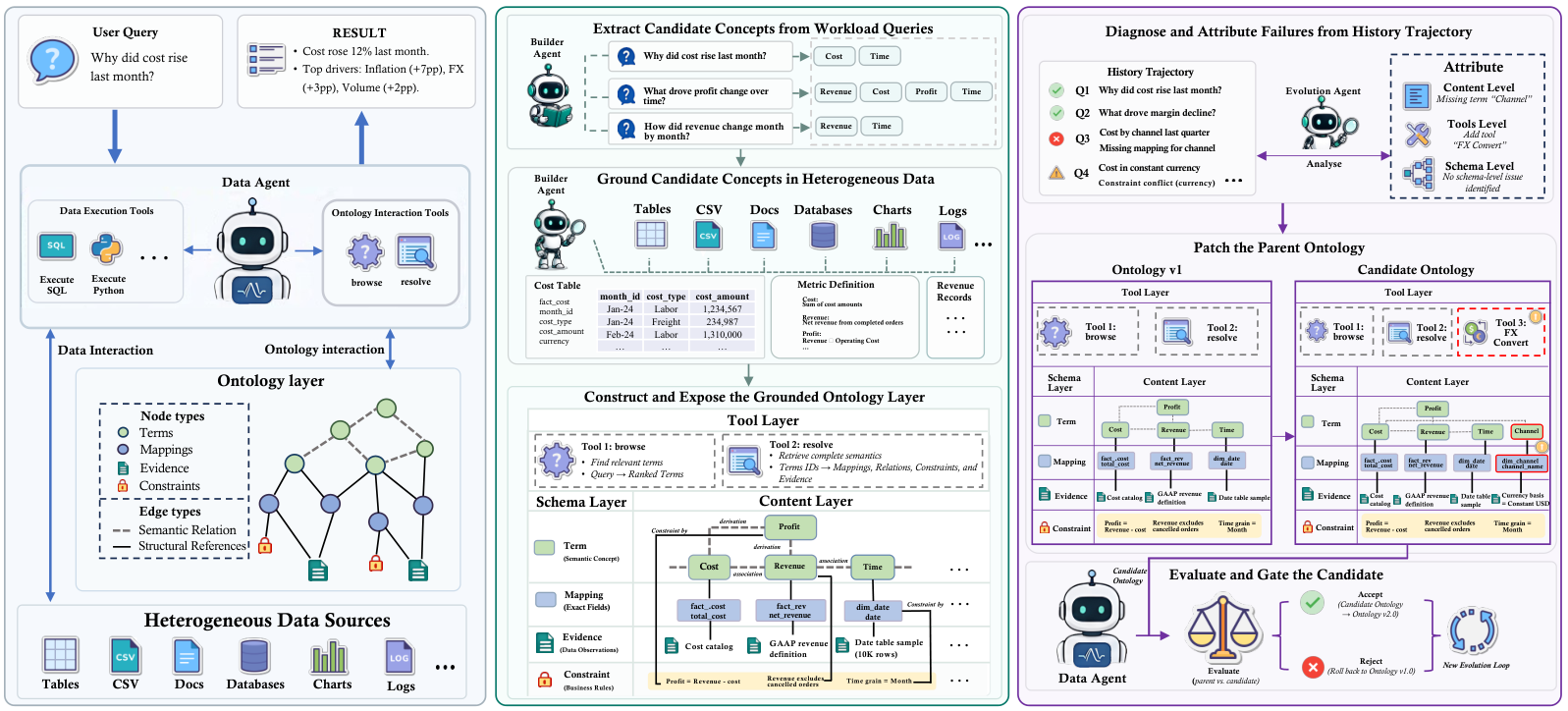
Figure 2 (Section 3, anchor Sx3.F2): the original paper’s overview of the typed Content graph, object Schema, runtime Tool interface, and builder/evolution roles. Original source: arXiv HTML Figure 2. License/reuse restriction: the source states an arXiv.org perpetual non-exclusive license; this article retains the unmodified figure with attribution for research reading, and any redistribution should be checked against the original terms.
2. Builder: grounding semantics with probes
Initialization is not a free-form request for the builder to imagine an ontology. Given workload W and raw data D, the builder proposes concepts C, runs probe(c,D), and verifies types, filters, value distributions, or references in the data. Only concepts satisfying verify(probe(c,D))=1 enter C+. The initial state is then S0=construct(C+,D;Γ0), yielding L0=(S0,Γ0,R0).
The point is to keep evidence adjacent to an ontology entry. A Term that sounds plausible but has no queryable column, value pattern, or structural reference should not become ground truth merely because the language model described it fluently. The builder can still miss a difficult concept, but it distinguishes “grounded” from “guessed.”
3. Runtime: browse and resolve as selective semantic access
The Tool layer mainly exposes two interfaces:
- browse(q,k,n) returns the top-n semantic matches for query q, so the agent can find relevant Terms or concepts;
- resolve(I,c) uses identifiers and context c to return linked records and a compact manifest, with detailed records fetched on demand.
This avoids injecting the entire ontology into the prompt. An agent can browse “banned card format,” resolve the Term’s Mapping, Constraint, and Evidence, and then return to the raw data for a query. The Tool layer is not just search; it is the exposure contract that determines which fields, relations, and evidence are available to the agent.
4. Evolution: diagnose, attribute, patch, gate
Each evolution round consumes a trajectory set T_t:
- Diagnose: Analyze interaction trajectories to find repeated failures, wrong mappings, missing constraints, or tool-exposure gaps.
- Attribute: Assign the failure to the Content, Tool, or Schema level as a checkable hypothesis.
- Patch: Produce a typed candidate L’_t=patch(L_t,σ,α(σ)) for one level instead of rewriting the whole ontology.
- Gate: For the same backbone m, compare candidate and parent on held-out validation V. Accept only when φ(L’,V;m)−φ(L,V;m)≥τ; otherwise keep the parent and log the rejection.
The gate is backbone-conditional. Different backbones use the same ontology differently, so the paper evolves a separate store for each backbone. This improves in-backbone scores but introduces a cross-backbone transfer problem, which Figure 5 makes visible.
Original-paper evidence: the architecture and its provenance
The four body figures below are reused original-paper assets, not newly generated diagrams. Each caption identifies the figure number, paper section or anchor, original source, and license/reuse restriction.
Evaluation setup: three benchmarks, six backbones, two analysis scopes
The paper evaluates three data-agent benchmarks:
- DDR-Bench 10-K: Message-Wise, Trajectory-Wise, and Overall, with emphasis on multi-turn data-agent workflows;
- InsightBench: Insight, Summary, and Overall, measuring data exploration and summarization;
- BIRD with Oracle Knowledge: EX and VES, focusing on text-to-SQL execution and semantic scoring under the oracle-knowledge setting.
The main tables report six backbones: GPT-5.5, GPT-5.6-sol, Claude-Sonnet-5, Claude-Opus-4.8, DeepSeek-V4-Flash, and Qwen3.5-Flash. Deeper analyses in Figures 3–7 and most appendix summaries fix four: GPT-5.5, GPT-5.6-sol, Claude-Sonnet-5, and Claude-Opus-4.8. These scopes must not be merged into “everything used four” or “every analysis used six.”
The baseline is ReAct, with Baseline + SL as a static semantic-layer comparison and ReAct + Memory on DDR. The evaluation uses a reciprocal two-fold protocol, A→B and B→A. Roughly 70% is used for ontology construction, trajectories, and candidates; the remaining 30% is paired validation. The selected ontology is frozen before test. The paper states that gold answers and evaluator feedback from held-out validation are not used to construct the ontology.
Result one: total gain first, then its source
The four-backbone analysis subset can be summarized as follows. These are the paper’s Figure 3 and appendix summary means, not a newly recomputed average that mixes the six-backbone tables.
| Benchmark / primary metric | Baseline | Initial | Evolved | Reading |
|---|---|---|---|---|
| DDR-Bench / Traj-Wise | 69.5 | 81.8 | 89.5 | Initial grounding reduces exploration gaps; evolution repairs recurring failures. |
| InsightBench / Insight | 53.2 | 54.0 | 54.2 | The margin is small, so its bottleneck differs from DDR. |
| BIRD / EX | 63.6 | 68.7 | 72.4 | Mappings, constraints, and tool exposure help SQL execution, but metrics do not rise equally. |
In the full six-backbone DDR Table 1, EvoOntology’s Overall relative to ReAct also varies by backbone: GPT-5.5 reaches 82.5 (+20.1), GPT-5.6-sol 85.9 (+19.6), Claude-Sonnet-5 79.9 (+6.5), Claude-Opus-4.8 85.2 (+11.7), DeepSeek-V4-Flash 44.9 (+16.7), and Qwen3.5-Flash 20.1 (+4.8). This does not prove that smaller models never benefit or that every model benefits equally; it says to read absolute score and relative gain together.
Table 2 puts DDR’s four-backbone mean beside ReAct + Memory: Baseline 69.5, ReAct + Memory 75.8, and EvoOntology 89.5. Memory can preserve episodic history, whereas the ontology supplies queryable, structured semantic state supported by mappings, constraints, and evidence. They are not the same kind of memory.
The interpreted evidence from Figure 3 is that DDR rises 12.3 points from Baseline to Initial and another 7.7 from Initial to Evolved; Insight rises roughly 0.8 and then 0.2; BIRD EX rises roughly 5.1 and then 3.7. This supports roles for both initial grounding and failure-driven refinement, while showing that different benchmarks do not share one ontology bottleneck.
Result two: does evolution converge round by round
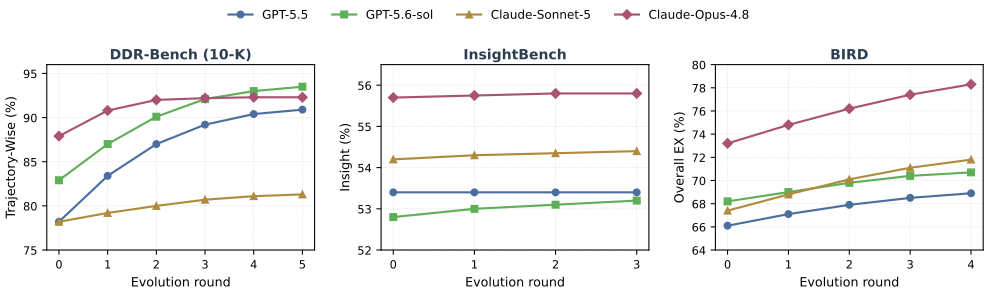
Figure 4 (Section 5, anchor Sx5.F4): the original paper plots DDR Traj-Wise, InsightBench Insight, and BIRD EX across accepted evolution rounds. GPT-5.6-sol reaches 93.5 Traj-Wise after five rounds and Claude-Opus-4.8 reaches 92.3 after four; late curves flatten. Original source: arXiv HTML Figure 4. License/reuse restriction: the source states an arXiv.org perpetual non-exclusive license; this article uses the unmodified original figure with attribution, and other uses should be checked against the source terms.
The point of Figure 4 is not that more rounds are always better. The gain appears to accumulate from accepted patches, with smaller marginal improvement in late rounds. That makes self-evolution more auditable than a one-shot prompt rewrite: for each round, one can ask which gap, which level, which parent score, and which held-out gate admitted it.
It also raises an operational question. A round is an accepted candidate, not necessarily a fixed time interval. If production trajectories drift, the rate and quality of accepted edits will change. Reciprocal folds and a frozen test reduce leakage risk, but the paper does not turn long-term concept drift into a measured guarantee.
Result three: is the evolved ontology portable across backbones
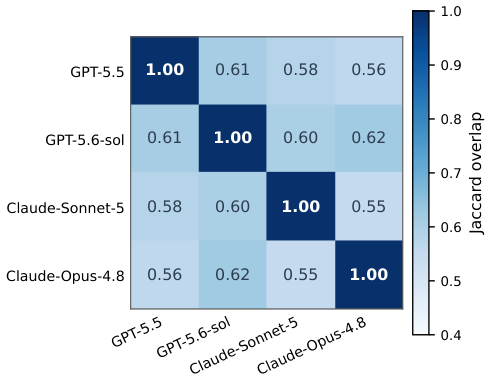
Figure 5(a) (Section 5, anchor Sx5.F5.sf1): the original paper compares pairwise Jaccard overlap of accepted Term identifiers across four evolved stores. The maximum is about 0.62; GPT-5.5/GPT-5.6 is about 0.61, while the two Claude backbones are about 0.55. Original source: arXiv HTML Figure 5. License/reuse restriction: the source states an arXiv.org perpetual non-exclusive license; this article keeps the original panel and numbering with attribution, and reuse should follow the source terms.
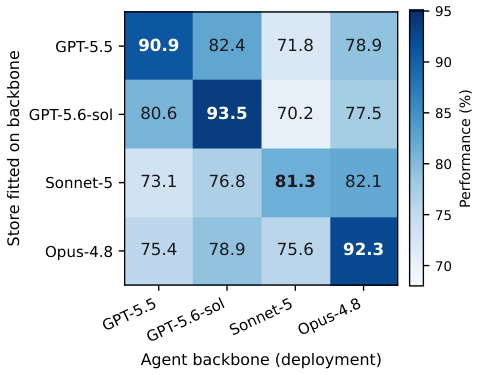
Figure 5(b) (Section 5, anchor Sx5.F5.sf2): the original paper serves each backbone’s evolved store to all four backbones. The diagonal is highest in every column; off-diagonal performance drops at least 6.6 points relative to the same-backbone store, with average column drops from about −6.6 to −10.9. Original source: arXiv HTML Figure 5. License/reuse restriction: the source states an arXiv.org perpetual non-exclusive license; this article uses the unmodified original panel and does not create a derivative graphic; check the original terms before redistribution.
Figure 5 is a diagnostic that the headline gain cannot hide. With the same raw data and initial ontology, different backbones select different Term identifiers, manifest details, SQL-fragment evidence, and tool exposure. Identifier overlap is not semantic-equivalence proof, but the diagonal transfer pattern shows that the serving backbone affects the usefulness of the evolved state.
There are two reasonable engineering paths. First, accept a model-specific artifact and bind serving model, ontology version, and accepted rounds together. Second, build a backbone-agnostic contract and add cross-model regression gates to every patch, trading local optimization for portability. The paper mainly supports the first path; it does not finish the second.
Ablations, failure modes, cost, and transfer
Evolution-loop ablation: the gate is the load-bearing regression barrier
Table 5 reports the four-backbone DDR average:
| Variant | Traj-Wise | Relative to Full |
|---|---|---|
| Full evolution loop | 89.5 | — |
| w/o Gate | 78.3 | −11.2 |
| w/o Attribution | 83.2 | −6.3 |
| w/o Diagnose | 84.7 | −4.8 |
| w/o typed patch, using a free-form rewrite | 87.8 | −1.7 |
The largest drop without the gate supports paired acceptance as a real protection against candidate regressions, not a ceremonial step. Attribution also matters: when the level tag and hypothesis disappear, content edits can be applied to a manifest problem and vice versa. This is a single benchmark and four-backbone ablation; it does not show that every gate threshold works equally well.
Editable-level ablation: Tool, Content, and Schema are complementary
Table 6 reports Baseline 69.5, Content-only 78.2 (+8.7), Tool-only 82.7 (+13.2), Schema-only 73.1 (+3.6), and Full 89.5 (+20.0). Tool-only being strong suggests that the agent lacks not only content but also a way to expose content. Schema-only being weaker suggests that representational rules alone cannot fill a missing concept. The Full score should not be treated as the sum of the three single-level gains, but it supports complementarity.
Table 7 removes Content object families one at a time: Full 89.5; without Mappings 76.1 (−13.4); without Evidence 80.8 (−8.7); without Constraints 86.0 (−3.5); without Relations 87.4 (−2.1). This failure analysis separates “the ontology has Terms” from “the Terms land on the right data.” Mappings are the largest single-removal drop, followed by Evidence. Constraints and Relations still matter, but their marginal effect is smaller in this setup.
Cost: fatter turns can still mean a cheaper trajectory
Appendix B Table 8 reports the four-backbone DDR average:
| Metric | Baseline | Initial | Evolved |
|---|---|---|---|
| Input tokens / turn (K) | 3.2 | 4.1 | 4.6 |
| Output tokens / turn (K) | 0.4 | 0.4 | 0.4 |
| Turns / task | 14.6 | 11.2 | 8.4 |
| Total tokens / task (K) | 52.6 | 50.4 | 42.0 |
| Traj-Wise | 69.5 | 81.8 | 89.5 |
The evolved ontology raises input context per turn from 3.2K to 4.6K, but turns per task fall from 14.6 to 8.4 and total tokens per task become about 20% lower than baseline. This supports the claim that semantic context can replace repeated exploration. It is not a promise of 20% lower provider billing: ontology build and evolution, tool latency, caching, prompt serialization, parallelism, and human review are additional costs.
Content growth and attribution
Appendix A Figure 6 shows GPT-5.6-sol’s Terms growing from 61 initially to 80 after five rounds. Per-round growth for tracked elements falls below 5% after round 3, and content curves flatten with Traj-Wise. Appendix C Figure 7 assigns cumulative gain to Tool edits at 57% over six accepted rounds, Content edits at 34% over eleven rounds, and Schema edits at 9% over three rounds. Tool edits need not be the most numerous to produce the largest accumulated gain; Schema edits are rarer but address representation gaps that instantiated content cannot fix.
End-to-end case study: turning card legality into a verified constraint
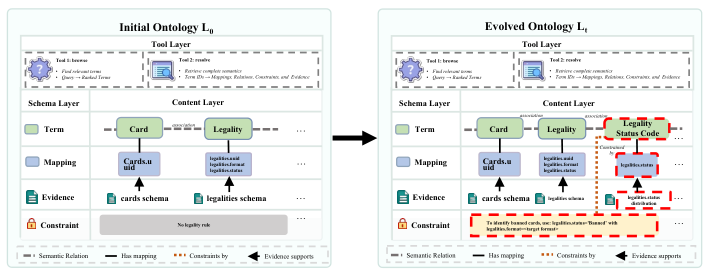
Figure 8 (Appendix C, anchor A3.F8): the original paper’s case study begins with general Card and Legality semantics but no interpretation of legality status. The accepted content patch adds a Legality Status Code Term, a Mapping to legalities.status, Evidence, and a Constraint tying status to the requested format. Original source: arXiv HTML Figure 8. License/reuse restriction: the source states an arXiv.org perpetual non-exclusive license; this article retains the unmodified figure and appendix provenance with attribution, and later reuse should follow the source terms.
Walk through the example:
- The agent asks whether a card is legal in a target format. The Initial ontology can find Card and Legality, but the browse/resolve result does not connect status-code semantics to the format condition.
- The trajectory shows that the agent found data but lacked interpretation, or produced a query without the status/format filter. This is a Content gap, not necessarily a need to replace the Tool or Schema layer.
- The candidate adds a “Legality Status Code” Term, maps it to legalities.status, attaches distribution and evidence, and adds a constraint: a Banned status must be judged together with the target format.
- Paired validation compares parent and candidate. After acceptance, browse finds the new concept, resolve returns its mapping, evidence, and constraint, and the final SQL execution still verifies the raw data.
The teaching point is that the ontology does not replace query execution and a natural-language explanation is not automatically truth. It supplies an intermediate representation for “which field, which value, and which filter must be coupled,” followed by a data-level check.
Artifact audit: code, data, model, and demo are different answers
As of 2026-09-16, I directly inspected the authors’ EvoOntology GitHub repository. It is public, MIT licensed, and not archived. The main branch was available at commit ace8ff695f6b1752240cb0e0322f65667d7016eb when checked.
- Code: available. The repository contains the core framework, Content/Schema/Tool layers, builder and evolution loop, plugin integration, benchmark adapters, configs, documentation, and usage/test material. The README and USAGE describe Claude/Codex client integration through a marketplace and a default .evoontology workspace.
- Data: incomplete. Raw BIRD, DDR-Bench, and InsightBench data are not shipped with the repository; the benchmark instructions expect the user to prepare data paths. A complete prebuilt ontology is not published as a ready-to-run artifact either.
- Model/checkpoint: not provided. The paper uses multiple model/provider backbones, but the repository contains no author-trained checkpoint. Reproduction requires model access, API credentials, prompts/configuration, data, and a cost budget.
- Demo: viewable but not a reproduction. The repository includes evoontology-demo.mp4 and a corresponding GitHub user-attachment video endpoint. That can verify the interaction shape, but it cannot replace benchmark data, model credentials, or a prebuilt ontology.
The artifact verdict is therefore “code readable, demo viewable, benchmark data and model environment still required.” A minimal smoke test can follow each benchmark README after preparing the data and API key. Reproducing Tables 1–8 also requires locking the split, backbone, ontology workspace version, evolution rounds, paired-gate threshold, token accounting, and provider behavior. A public repository is not the same as end-to-end reproducibility.
Limitations, failure boundaries, and when not to use it
Paper limitations:
- Although the main tables include six backbones, deep evolution, transfer, and cost analyses focus on four; the paper cannot establish that every new model benefits the same way.
- Evolved stores are visibly backbone-specific; Jaccard identifier overlap is not semantic-equivalence evidence.
- Three benchmarks and reciprocal two-fold reduce some leakage risks, but they do not establish freshness under long-running data updates, schema migration, ACL changes, or a new domain.
- The gate depends on the same backbone and held-out validation; threshold τ, trajectory quality, and diagnosis correctness are system choices.
- The repository does not include complete benchmark data, a prebuilt ontology, or a checkpoint, so external reproduction needs additional providers and data.
- The cost table measures tokens, turns, and tasks; it is not full monetary TCO, wall-clock latency, or maintenance cost.
When not to use EvoOntology as the default solution: If schemas are rewritten hourly, permissions change per user or session, cross-tenant evidence cannot be stored safely, or a task is one-off with no recurring schema gap, build, review, and invalidation costs may exceed the benefit. If the product requires one identical semantic contract across backbones and providers, establish portability gates and schema standards first; do not treat a local evolved store as universal knowledge.
Bloss0m engineering decision: Start with a narrow workload and a versioned ontology. Record each Term’s mapping, constraint, evidence, source freshness, and owner. Put accepted and rejected patches in an audit log. Use frozen validation, shadow traffic, and cross-backbone regression as a canary. Only then decide whether an evolution agent may auto-accept. If the team cannot explain which failure mode a patch reduced, keep human review.
Next reading
Next read VikingRAG’s URI-based structured evidence navigation to compare hierarchy-preserving storage with ontology-mediated data access; DocMemo for finding evidence from historical traces; and MidTool for connecting MCP exposure with tool-use diagnosis.
Three takeaways to remember
- An ontology is a queryable control plane, not a prompt appendix: Content, Schema, and Tool separate semantic state from its shape and exposure.
- The safety core is typed edit plus paired gate: Diagnose, attribute, patch, and gate work together; removing the gate drops the DDR four-backbone average by 11.2 points.
- Local gain is not cross-model portability: Same-backbone diagonal transfer is strongest; production governance must bind model, ontology version, evidence, freshness, and regression gates.