Paper reading
ContextWeave Deep Read: Does Memory Actually Make Agents Better at Work?
The paper in 90 seconds
- Problem: Existing agent memory evaluations treat retrieving past text snippets as success, without verifying whether recalled memories actually help an agent execute downstream tasks correctly in real workspace environments.
- Core insight: Reconstruct multi-month real workflows into a controlled, executable task stream. Holding the target task, underlying model, and workspace fixed, change only whether prior trajectory memory is provided; measure the net causal intervention gain on post-task workspace state and user preference adherence rather than retrieval hit rate.
- Strongest evidence: Across 14 participants and 1,005 reconstructed tasks (including 568 core evaluation tasks), the strongest memory component (A-Mem) raised Workspace Score from 68.08 without recall to 78.20 with recall, and Preference Score from 41.50 to 70.60 (Section 5.2, Table 1).
- Main boundary: Environments are reconstructed in Docker sandboxes with mock APIs, and evaluation relies heavily on GPT-5.5 as a rubric judge. Crucially, the strongest component introduces a 7.39% memory-induced error rate. High recall is not an unconditional production win; without provenance tracking, staleness detection, and verification guardrails, benchmark gains do not translate directly to enterprise reliability.
This reading is based on the arXiv v1 preprint (2026-08-05, arXiv:2608.04830); there is no separate peer-reviewed journal or conference record. The paper is authored by researchers from Fudan University and collaborating institutions, with an accompanying open-source repository.
What to know first
When evaluating memory architectures for autonomous, long-running agents, engineering teams routinely encounter a frustrating paradox: a vector database retrieves highly relevant dialogue history, yet the agent subsequently executes the wrong action in the repository. Understanding ContextWeave’s contribution requires examining why previous approaches fail and why traditional evaluation methodology is insufficient:
- The insufficiency of long-history question answering (QA): Traditional memory benchmarks (such as LoCoMo) reduce memory to plain text extraction. Questions ask for factual recall—such as “what server port did the user mention three weeks ago?”—evaluated via Recall@K or ROUGE/BLEU scores. However, enterprise agents are not conversational chatbots; they are autonomous actors expected to perform state mutations across filesystems, git repositories, and external APIs. Extracting a correct string is fundamentally disconnected from executing valid mutations in an active workspace.
- The disconnect in single-turn agent benchmarks: Standard agent benchmarks (such as SWE-bench and WebArena) initialize each task from scratch in a freshly provisioned container. They test an agent’s on-the-spot reasoning and tool use, but deliberately eliminate cross-episode history. Consequently, they cannot measure how agents accumulate, retrieve, and reconcile user habits and project conventions over extended time horizons.
- Environment drift in full-trajectory replays: Simply letting an agent run continuously across months of tasks causes early errors to compound exponentially. When a later task fails, it becomes impossible to determine whether the root cause was memory failure, underlying model hallucination, or cumulative workspace corruption from earlier steps.
Prior evaluation methodology thus suffered from a foundational gap: the lack of an executable evaluation framework capable of preserving authentic multi-month dependency structures while isolating the causal contribution of memory representations.
Core intuition
ContextWeave’s core intuition is straightforward: Memory is not a database caching utility; it is an active causal intervention on an agent’s downstream actions.
In decision rules, previous intuition prioritized recall maximization: if the top-k retrieved chunks closely match the query vector, the memory system is deemed effective. ContextWeave shifts the decision rule to workspace net gain: memory is valuable only when it tangibly improves downstream completion and preference alignment.
The authors formalize this evaluation framework: Suppose a multi-month workflow is partitioned into an executable task stream . For any target task , let denote the workspace outcome achieved by an agent operating under the baseline condition of zero recall. Let denote the outcome achieved when a memory module supplies representations extracted from earlier trajectories. The net intervention effect of memory is defined as:
Under this protocol, the target task specification, underlying LLM, tool permissions, initial Docker environment, and evaluation rubrics remain strictly frozen. The only active variable is the historical context representation supplied to the agent.
- If , the memory successfully injected necessary antecedent context or conventions;
- If , memory provided no actionable benefit, merely consuming context tokens;
- If , the intervention exposes the most dangerous failure mode in agentic systems: memory-induced error. When memory retrieves obsolete configurations, deprecated dependencies, or conventions from an unrelated project, the agent falsely assumes it understands the context. It skips necessary exploratory verification and writes incorrect modifications into the workspace.
Walk one example through the method
To understand how ContextWeave evaluates an agent in practice, consider a representative software maintenance workflow through five concrete stages:
- Input and task context: In earlier workflow tasks (such as and ), a software team established a convention: all CI endpoint test summaries must be exported as JSON files into
/opt/workspace/reports/ci/, and filenames must include both the git commit hash and execution timestamp. Weeks later, target task is triggered: “Implement unit tests for the authentication module and produce the execution report.” - Intermediate representation (memory extraction and prompt injection): In the baseline No-recall condition, the agent receives only the isolated task prompt and an empty history buffer, unaware of earlier conventions. In the With-recall experimental condition, the memory module (such as A-Mem or MemoryBank) indexes past trajectories and retrieves the reporting convention, injecting the schema and directory requirement into the agent’s context window.
- Decision, action, and transformation: Without memory, the agent must expend multiple Bash commands exploring the filesystem to guess where reports belong, or it may invent a non-standard location (such as writing to
./test-output.txt). With memory enabled, the agent skips redundant filesystem exploration, writes the unit tests, runs the test runner, and outputs the resulting JSON directly to/opt/workspace/reports/ci/auth_test_[hash]_[timestamp].json. - Output and workspace verification: Upon task completion, the evaluation harness executes automated assertions within the Docker container across two explicit dimensions: Workspace Score assesses functional state—whether test files were added, unit tests passed, and the output JSON file exists with valid syntax; Preference Score assesses adherence to user conventions—whether the report was saved in the designated directory and whether the filename strictly follows the required hash and timestamp pattern.
- Likely failure point and misleading recall: If the memory module exhibits low precision and retrieves an obsolete convention from a deprecated project branch (such as requiring XML format via an uninstalled plugin), the agent confidently attempts to execute invalid commands. The task fails due to memory poisoning. In the No-recall setting, the agent would have inspected the current repository files and discovered the correct convention. This failure is explicitly categorized and measured as a memory-induced task failure.
Technical mechanism
ContextWeave establishes an end-to-end framework spanning privacy-preserving workflow capture, executable environment synthesis, and multi-dimensional scoring protocols.
Benchmark Construction Pipeline
Paper Figure 1 illustrates the full benchmark construction lifecycle:

Figure 1 — ContextWeave benchmark construction. Paper Section 4. Source: Wang et al., ContextWeave Figure 1, used under the paper’s CC BY-NC-SA 4.0 license.
The pipeline operates across four structured phases:
- Privacy-preserving workflow collection: The authors recorded multi-month desktop and development workflows from 14 real participants across domains including academic research, software engineering, data analysis, and IT administration. All traces underwent de-identification and sensitive entity redaction;
- Task decomposition and mock environment synthesis: Continuous workflows were segmented into discrete, semantically self-contained tasks accompanied by input instructions, local filesystem snapshots, and simulated control APIs;
- Docker containerization: Each task was packaged into an isolated Docker container, ensuring identical starting filesystem states, environment variables, and network mocks;
- Human validation and rubric alignment: Domain experts reviewed each task’s initial state and dependency chains, authoring deterministic programmatic rubrics for post-task verification.
Dataset Scale and Temporal Characteristics
The resulting ContextWeave benchmark comprises 1,005 executable tasks, including 568 core evaluation tasks subjected to rigorous human labeling. Among these 568 core tasks, 541 tasks (95.2%) exhibit genuine causal dependencies on predecessor tasks, yielding 8,084 relevant links. Dialogue and command history spans an average of 36.3K tokens, with peak histories reaching 212.3K tokens.
Paper Figure 2 analyzes task domain diversity and temporal relevance:

Figure 2 — Task diversity and temporal relevance. Paper Section 4. Source: Wang et al., ContextWeave Figure 2, used under CC BY-NC-SA 4.0.
As Figure 2 reveals, temporal proximity does not equal semantic relevance. Critical dependencies—such as database schemas configured weeks earlier—remain vital despite their temporal distance, while events from moments prior may be entirely irrelevant. This delivers a key engineering lesson: memory retrieval systems relying strictly on recency weighting or sliding windows will consistently miss long-horizon architectural dependencies.
Evaluation Protocol and Metric Suite
The primary experimental harness uses a standardized Codex agent framework powered by GPT-5.5 xhigh as the baseline reasoning engine. Holding tools, permissions, and environments constant, the authors compare No-recall against six prominent memory components:
- mem0: Lightweight key-value pairing with vector-based retrieval;
- memos: Session-oriented conversational summarization;
- Supermemory: External cache designed for notes and web resources;
- MemoryBank: Hierarchical memory management incorporating Ebbinghaus forgetting curves;
- LangMem: Structured semantic memory extraction designed for LangChain ecosystems;
- A-Mem: Agentic memory architecture utilizing dynamic organization and adaptive indexing.
The evaluation evaluates five explicit metrics:
- Workspace Score: Post-task environment correctness against rubric-defined state invariants (0–100);
- Preference Score: Adherence to implicit or explicit user conventions and formatting habits (0–100);
- Relevance / Continuity: Semantic alignment of retrieved memories and continuity with ongoing work;
- Solvability: Whether memory injection preserves task solvability or induces reasoning deadlocks;
- Memory-induced task rate: Proportion of tasks where recalled memories directly triggered an avoidable failure.
How to read the evidence
Reading ContextWeave evidence requires scrutinizing behavioral shifts and error trade-offs alongside headline gains.
Comparative Performance: Table 1 Analysis
Paper Table 1 presents primary benchmark outcomes on GPT-5.5 xhigh across the six memory components:
| Setting | Workspace Score | Preference Score | Win rate (vs No recall) | Memory-induced task rate |
|---|---|---|---|---|
| No recall | 68.08 | 41.50 | — | — |
| mem0 | 72.48 | 49.73 | 50.70% | 0.35% |
| memos | 70.01 | 46.38 | 53.30% | 0.35% |
| Supermemory | 70.57 | 48.04 | 55.60% | 0.70% |
| MemoryBank | 73.24 | 55.40 | 65.08% | 1.23% |
| LangMem | 75.29 | 57.37 | 62.79% | 5.11% |
| A-Mem | 78.20 | 70.60 | 72.70% | 7.39% |
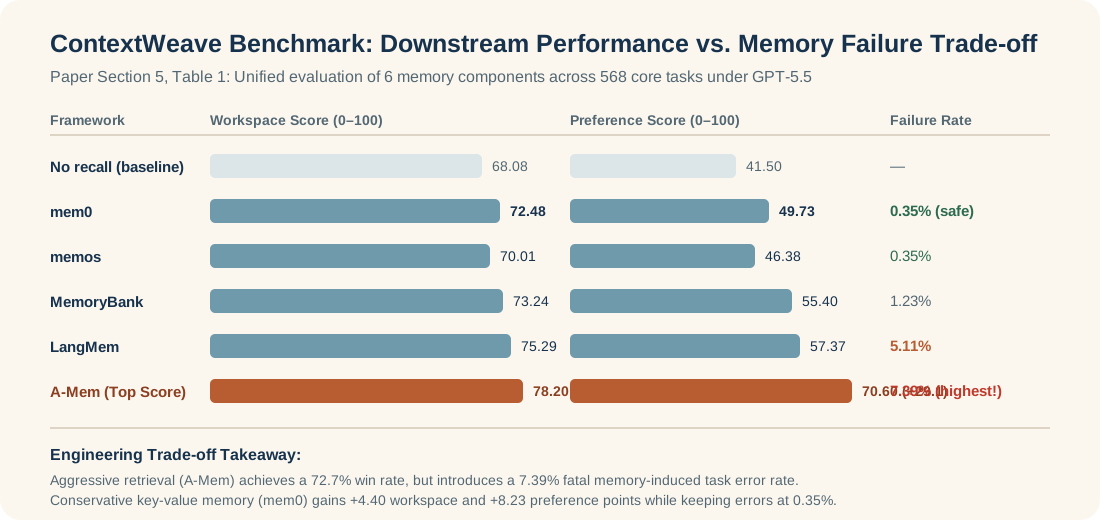
Figure 3, based on Section 5, Table 1 of the paper and Bloss0m’s synthesis: compares downstream Workspace and Preference scores across No-recall, mem0, memos, MemoryBank, LangMem, and A-Mem, highlighting the trade-off where top-scoring A-Mem (78.20 workspace, 72.7% win rate) introduces a severe 7.39% memory-induced failure rate. See original Table 1 anchor. Reused under CC BY-NC-SA 4.0.
Three critical observations emerge from Table 1:
- Significant outcome gains: Compared to the No-recall baseline (68.08 Workspace, 41.50 Preference), all memory components improved performance. A-Mem achieved the highest scores (78.20 Workspace, 70.60 Preference, 72.70% win rate), demonstrating that cross-session memory substantially enhances agent execution quality in sequential workflows.
- The hidden cost of aggressive recall: A-Mem’s performance comes with a severe vulnerability: a 7.39% memory-induced task rate. In contrast, conservative architectures like mem0 and memos caused errors in only 0.35% of tasks, and MemoryBank in 1.23%. LangMem recorded 5.11%. In more than 7 out of every 100 tasks, A-Mem’s memory directly derailed tasks that the agent would have solved correctly from scratch.
- Behavioral trajectory trade-offs: Behavioral trajectory logging reveals that A-Mem reduced agent exploration by 7.06 percentage points while increasing direct execution by 6.63 percentage points. When recalled context is accurate, skipping exploratory steps saves time and tokens. But when memories are stale or misaligned, reduced exploration turns into lack of verification, and the agent executes flawed actions with false confidence.
Cross-Model Transfer: Table 2 Analysis
To test whether memory benefits transfer across model architectures, the authors evaluated mem0 across five foundational LLMs (Table 2):
- DeepSeek-V4-Pro: Workspace Score +5.61, Preference Score +9.61;
- GPT-5.5: Workspace Score +4.95, Preference Score +7.66;
- GLM-5.1: Workspace Score +2.19, Preference Score +5.83;
- Kimi-K2.6: Workspace Score +2.99, Preference Score +8.37;
- Qwen3.7-Max: Workspace Score +3.06, Preference Score +5.55.
The results demonstrate consistent positive gains across all five backbones, confirming the general utility of memory layers. However, the magnitude of improvement varied considerably (DeepSeek and GPT-5.5 captured significantly higher gains than GLM or Qwen). This underscores that memory layers do not operate in a vacuum; their effectiveness is bounded by the host model’s native instruction-following, context reasoning, and self-correction capabilities.
Evidence map
To maintain analytical rigor, we separate ContextWeave’s findings into four distinct evidential tiers:
Direct paper evidence
- Benchmark scale and coverage: The benchmark provides 1,005 executable tasks across 14 real participants, with 568 core evaluation tasks featuring 541 validated predecessor dependencies and 8,084 relevant links;
- Measured downstream improvement: In controlled evaluations, memory components consistently improved Workspace Scores (up to +10.12 points for A-Mem) and Preference Scores (up to +29.10 points);
- Quantified misleading recall: Components that aggressively inject historical trajectories (A-Mem and LangMem) exhibit substantial memory-induced error rates (7.39% and 5.11%), directly causing avoidable task failures;
- Cross-model transferability: Memory augmentation reliably improved performance across five distinct foundation models, yielding Workspace Score improvements ranging from +2.19 to +5.61 points.
Author causal claims
- Intervention delta as causal attribution: The authors claim that isolates the true causal contribution of memory by holding environments, prompts, and harnesses constant;
- In-context trajectories beat summaries: The authors argue that fine-grained experience memory outperforms high-level summarization because trajectory fragments preserve executable syntax and specific filesystem paths;
- Exploration reduction signifies efficiency: The authors interpret the drop in exploration steps and increase in execution steps as a direct indicator of operational efficiency.
Unsupported claims
- A-Mem is not proven to be enterprise-optimal: In production environments where faulty operations incur severe remediation costs, MemoryBank’s 1.23% error rate may be vastly preferable to A-Mem’s 7.39% failure rate, despite lower average benchmark scores;
- Robustness in live, drifting enterprise infrastructure is unproven: Because tasks run inside static Docker containers with mock APIs, the benchmark does not establish how components behave when live external APIs experience schema drift or credential revocation;
- Model grading bias cannot be excluded: Because scoring relies primarily on GPT-5.5 rubrics, evaluation may harbor inherent alignment bias toward GPT-generated response styles;
- Statistical significance across subgroups is incomplete: The paper reports aggregate averages without comprehensive confidence intervals or per-domain statistical hypothesis testing;
- Full ablation matrix is constrained by cost: With an estimated evaluation cost of $200 per full benchmark run, the authors could not execute a complete cross-product ablation across all memory systems and LLM combinations.
Bloss0m engineering synthesis
- Paradigm shift in memory evaluation: ContextWeave successfully reframes agent memory from retrieval metrics (Recall@K) to an active intervention measured on downstream workspace mutations;
- Defensive memory architecture requirements: Production memory components require four explicit security layers: granular provenance tracking, staleness detection with automated TTL invalidation, conflict detection, and rollback safety;
- The exploration-verification frontier: Engineering teams must recognize that reduced exploration is dangerous in critical tasks. For destructive or sensitive actions, systems must enforce deterministic ground-truth verification regardless of memory confidence.
Artifacts and reproducibility
This reading evaluates the arXiv v1 preprint (2026-08-05, arXiv:2608.04830). The authors host code and materials on the public ContextWeave GitHub repository.
As of 2026-08-09, the repository exposes benchmark execution runners, Docker configuration manifests, memory interface adapters, metric scoring scripts, and archived task data.
For teams planning reproduction or local evaluation, key operational constraints apply:
- Scope of verification: All metrics discussed in this reading represent author-reported experimental findings. The full 568-task suite was not independently rerun for this article;
- Reproduction cost barrier: Executing a full benchmark run requires approximately $200 in commercial API credits, alongside high-performance servers configured for concurrent Docker sandboxing;
- External API dependency: Heavy reliance on closed-source model APIs creates reproducibility friction over time, as model updates and alignment adjustments may alter exact baseline scores.
Recommended minimal reproduction path: Teams seeking to adopt ContextWeave’s methodology should not attempt to rerun the entire 568-task benchmark immediately. Instead, select a single participant’s workflow containing 3–5 sequential tasks with explicit dependencies. Run the subset under No-recall versus one open-source memory component (such as mem0 or MemoryBank), measuring workspace diffs, preference compliance, and the occurrence of misleading recall. If this compact matrix does not expose meaningful differentiation, full-scale benchmarking should be deferred.
Bloss0m engineering judgment and when not to use it
Drawing on practical engineering experience with autonomous agent architectures, we offer concrete guidance on applying ContextWeave’s principles:
When ContextWeave methodology is worth adopting
- Building regression test harnesses for memory subsystems: When refactoring retrieval-augmented generation pipelines, vector indexing schemas, or hierarchical memory graphs, ContextWeave provides a gold-standard framework for detecting downstream behavioral regressions;
- Evaluating long-horizon coding and workspace agents: For agents operating across complex software repositories over multiple weeks, adopting the dual Workspace Score and Preference Score structure provides vital visibility into user convention adherence;
- Quantifying misleading recall risk: Incorporating the Memory-induced task rate as a mandatory deployment gating metric ensures that memory updates do not quietly introduce dangerous hallucinations.
When NOT to use or copy directly
- Do not treat benchmark scores as a deployment guarantee: A high score like A-Mem’s 78.20 does not imply production readiness. A 7.39% failure induction rate is unacceptable in automated billing, production infrastructure, or security tooling;
- Never centralize raw multi-tenant memories without isolation: Aggregating uncurated long-term histories into a monolithic vector index introduces severe data leakage, privilege escalation, and prompt injection vulnerabilities;
- Do not bypass ground-truth workspace validation: Never permit recalled memories to overwrite existing filesystem states or skip prerequisite checks before executing irreversible actions.
Recommended four-slice enterprise evaluation matrix
For teams implementing enterprise agent memory, we recommend structuring evaluation across four balanced slices:
- Outcome verification: Measure physical workspace diffs, unit test pass rates, and schema validity across No-recall, text summarization, structured memory, and full trajectory replay;
- Continuity and lineage: Check whether the agent needlessly re-executes completed work, and whether it preserves naming conventions, file paths, and architectural decisions established in prior sessions;
- Staleness and robustness: Actively inject contradictory, expired, or synthetic misleading memories into the datastore to verify whether the agent validates against ground truth or blindly acts on stale prompts;
- Holistic operational cost: Calculate aggregate token consumption, tool latency, and the estimated human cost of diagnosing and recovering from memory-induced errors, rather than measuring API latency alone.
Three things to remember
- Technical idea: Agent memory must be evaluated as a causal intervention () on downstream workspace state and user preference adherence, not as a static retrieval hit rate.
- Core evidence: Across 568 core workflow tasks, memory components elevated Workspace Scores from 68.08 to 78.20, but the strongest component introduced a 7.39% memory-induced failure rate; reduced exploration can easily disguise a failure to verify ground truth.
- Engineering boundary: Headline benchmark gains never justify unrestricted memory recall; production systems require strict provenance tracking, staleness detection, error-rate gating, and mandatory ground-truth verification before action execution.
Primary sources
- ContextWeave arXiv preprint: Metadata, author list, and formal abstract.
- ContextWeave full paper HTML: Figures 1–2, Section 4 system pipeline, Section 5 experimental results, Tables 1–2, and limitations.
- ContextWeave official repository: Evaluation runners, Docker environments, component adapters, and task archives.
- CC BY-NC-SA 4.0 License: Open licensing terms governing the academic reproduction of paper figures (Figure 1 and Figure 2).
- OSReward deep read on agent evaluation: Complementary reading on agent benchmark design, reward modeling, and non-deterministic evaluation risks.