Paper reading
InstructGPT: Align Instructions with Human Feedback, but 2022 Preference Win Rates Do Not Represent Later ChatGPT
Pair this with the three-pass approach. In this site’s foundations sequence, the note follows Transformer. Transformer covers sequence-transduction architecture; InstructGPT keeps the GPT-3 architecture and moves the focus to post-pretraining human-feedback alignment (SFT → RM → PPO), with labeler preference win rates as its core evidence.
The paper in 90 seconds
- Problem: Bigger LMs do not automatically follow user intent better. GPT-3-class models under a next-token pretraining objective often produce untruthful, toxic, or unhelpful outputs (Section 1). Language modeling is misaligned with responding helpfully and safely to instructions.
- Core insight: On a frozen GPT-3 architecture, run three stages: (1) SFT—fine-tune on demonstrations from about 40 contractors; (2) RM—train a 6B reward model on human rankings; (3) PPO—optimize the policy against RM scores with a per-token KL penalty toward SFT; the default PPO-ptx mixes pretraining gradients to reduce public NLP regressions (Figure 2, Equation 2, Section 3.5). The control point is human-preference alignment, not a new attention stack.
- Strongest evidence: Labeler preference evals on the API prompt distribution (Figure 1, Section 4.1): 175B InstructGPT is preferred to 175B GPT-3 85±3% of the time; to few-shot GPT-3 71±4%; 1.3B InstructGPT still beats 175B GPT-3 (>100× parameter gap). Versus the 175B SFT baseline, InstructGPT wins 73.4±2%, beating FLAN/T0 fine-tunes (26.8±2%, 29.8±2%).
- Main boundary: Closed 2022 GPT-3 family models; preferences come from a specific labeler pool and API Playground distribution (Sections 5.2–5.3). ChatGPT product metrics, GPT-4, DPO, Llama-2-chat, and Constitutional AI are outside this PDF; YOLO mAP and Transformer WMT BLEU are not alignment contracts.
My conclusion: Keep the 2022 engineering lesson of post-pretraining SFT, RM, and PPO. The 85±3% preference win rate applies to that evaluation and cannot serve as a 2026 chat product SLA.
Huahua’s one-liner
The architecture is still GPT-3; the pipeline changes—copy labeler demos, score with a reward model, then PPO-chase the score. Figure 1 win rates are 2022 labeler preferences, not a ChatGPT MAU contract.
Version and reading scope
This reading follows Ouyang et al., NeurIPS 2022 as arXiv:2203.02155 v1 (2022-03-04). The PDF carries the arXiv.org perpetual non-exclusive license. Author order follows v1 (* marks equal contribution): Long Ouyang, Jeff Wu, Xu Jiang, Diogo Almeida, Carroll L. Wainwright, Pamela Mishkin, Chong Zhang, Sandhini Agarwal, Katarina Slama, Alex Ray, John Schulman, Jacob Hilton, Fraser Kelton, Luke Miller, Maddie Simens, Amanda Askell, Peter Welinder, Paul Christiano, Jan Leike, and Ryan Lowe.
Beyond the abstract, this note checks Section 3 (Figure 2, Equations 1–2), Section 4 results (Figures 1, 3–7), Section 5 discussion and limits, and the openai/following-instructions-human-feedback link as of 2026-08-28. ChatGPT, GPT-4, DPO, and Llama-2-chat numbers remain outside this paper’s evidence.
The reader question
Given a pretrained GPT-3-class LM, should you rely on scale and prompt engineering, or add SFT, a reward model, and PPO on a frozen architecture to follow natural-language instructions on open-ended tasks? Ouyang et al. choose the latter and report labeler preference win rates alongside TruthfulQA, toxicity, and hallucination slices.
The precise question is not whether InstructGPT is the strongest 2026 chat system. It is how the three-stage RLHF pipeline rewrites post-pretraining data flow, what preference win rates actually contract for, and which later product numbers must not be imported.
Evidence map
| Layer | How this article uses it |
|---|---|
| Paper directly supports | Figure 1 preference eval; Figure 2 three-stage pipeline; Figure 3 held-out labeler win rates; Figure 4 metadata; Equation (1) RM loss and Equation (2) PPO-ptx objective; Table 1 API use-case mix; Section 3.2 dataset sizes (SFT ~13k, RM ~33k, PPO ~31k prompts). |
| Author claims | Human-feedback fine-tuning aligns broad instruction tasks; preference win rates beat GPT-3 and SFT-only; PPO-ptx reduces alignment tax; alignment cost is far below retraining GPT-3. |
| Not established | ChatGPT product performance; GPT-4 / Claude-class systems; DPO-style RL-free preference optimization; universal cross-user preference; fully open reproduction of the 175B pipeline. |
| Bloss0m engineering judgment | Place this note in the instruction-alignment section of the foundations sequence, after Transformer. BERT GLUE, YOLO VOC, and WMT BLEU do not belong in RLHF tables; 85±3% is not a ChatGPT SLA. |
Why the previous approach is insufficient
Sections 1–2 set the context. Pure pretrained LMs optimize next-token prediction, which misaligns with helpful, honest, harmless use. Prompt engineering / few-shot prefixes (GPT-3 prompted) help modestly but stay far below SFT and PPO in Figure 1. SFT alone imitates demonstrations but lacks ranked preference signal. FLAN / T0 fine-tunes on public NLP tasks; on the API distribution they trail SFT and InstructGPT (Section 4.1, Figure 5).
Transformer addresses encoder–decoder transduction and WMT BLEU; YOLO addresses unified detection—neither tackles post-pretraining human-preference alignment.
Core intuition
Skip the PPO notation for a moment. Picture a pretrained 175B GPT-3 asked to “list five ideas to regain enthusiasm for my career.” It may ramble in web-page style, miss the instruction, or hallucinate.SFT shows tens of thousands of labeler-written ideal answers to imitate.The RM learns which of several candidates humans prefer.PPO lets the model generate freely, scores with the RM, and pulls each token back with a KL penalty so it does not drift too far from SFT.
Three easy-to-confuse next steps:
- GPT-3 base + prompt: no weight change; cheap but capped (Figure 1).
- InstructGPT (this paper): SFT → 6B RM → PPO (default PPO-ptx); still GPT-3 architecture.
- Later methods and products: ChatGPT, GPT-4, DPO, Constitutional AI—numbers and system boundaries are outside the 2022 PDF.
Walk one example through the method
A simplified API prompt through inference and training (Bloss0m teaching example, not a paper table row).
- Input: “Explain gradient vanishing in at most two paragraphs.” (Generation/QA mix common in Table 1.)
- Intermediate representation: tokenized input through the same GPT-3 transformer stack; SFT already saw similar demos; the RM ranked concise vs verbose vs wrong answers.
- Model or system decision: the PPO policy autoregresses; RM reward accumulates per token minus KL (Equation 2); PPO-ptx also mixes pretraining gradients ( in Appendix C is 27.8).
- Output: a two-paragraph, instruction-following explanation (in the ideal case).
- Likely failure point: false premises—the model may accept bad assumptions (Figure 9); over-hedging on simple questions; reward hacking if the RM has blind spots; closed labeler distribution—preferences may not match your end users (Section 5.2).
Technical mechanism
Three-stage pipeline (Figure 2, Section 3.1)
- Step 1 SFT: labeler demonstrations on API / labeler-written prompts; fine-tune GPT-3. ~13k training prompts; 16 epochs (Section 3.5).
- Step 2 RM: labelers rank – candidates; train a 6B reward model (175B RM unstable per Appendix C). ~33k training prompts.
- Step 3 PPO: optimize SFT against RM reward with per-token KL toward SFT; default PPO-ptx mixes pretraining gradients. ~31k PPO prompts (inputs only, no human labels).
Model sizes: 1.3B, 6B, 175B, all GPT-3 architecture (Section 3.5).
Reward model loss (Equation 1, Section 3.5)
is the scalar reward for prompt and completion ; is the human-preferred side. Larger lowers loss and better matches rankings.
PPO-ptx objective (Equation 2, Section 3.5)
controls KL penalty strength; controls pretraining mix (zero for plain PPO). Unless stated otherwise, InstructGPT means PPO-ptx in this paper.
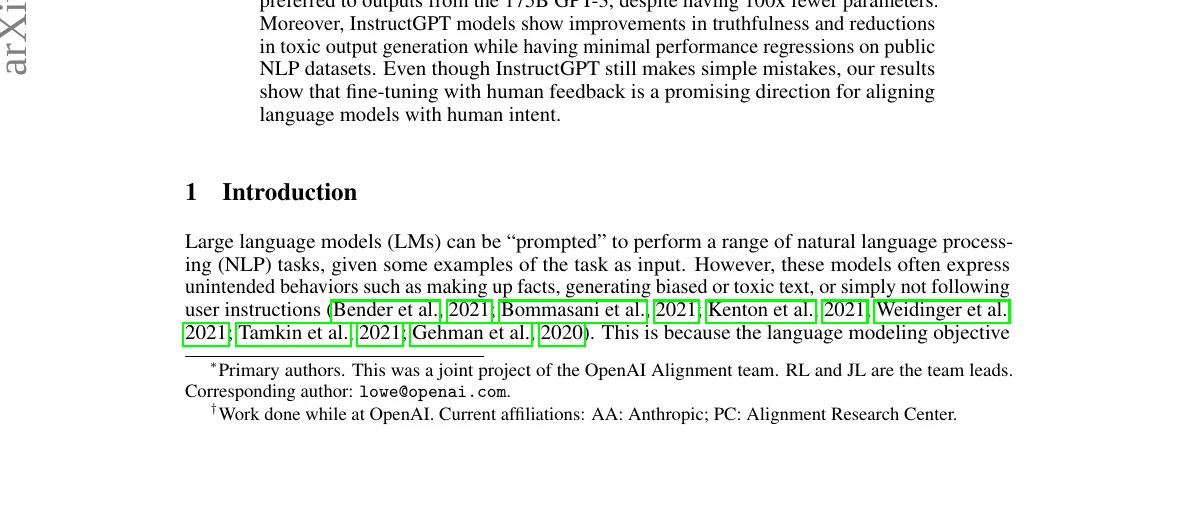
Figure 1, paper Section 1 / 4.1: human preference evals on the API prompt distribution; 1.3B PPO-ptx beats 175B GPT-3. Original at arXiv PDF Figure 1. Cropped from the NeurIPS 2022 camera-ready PDF; arXiv.org perpetual non-exclusive license. This crop includes surrounding text; see the PDF for full detail.
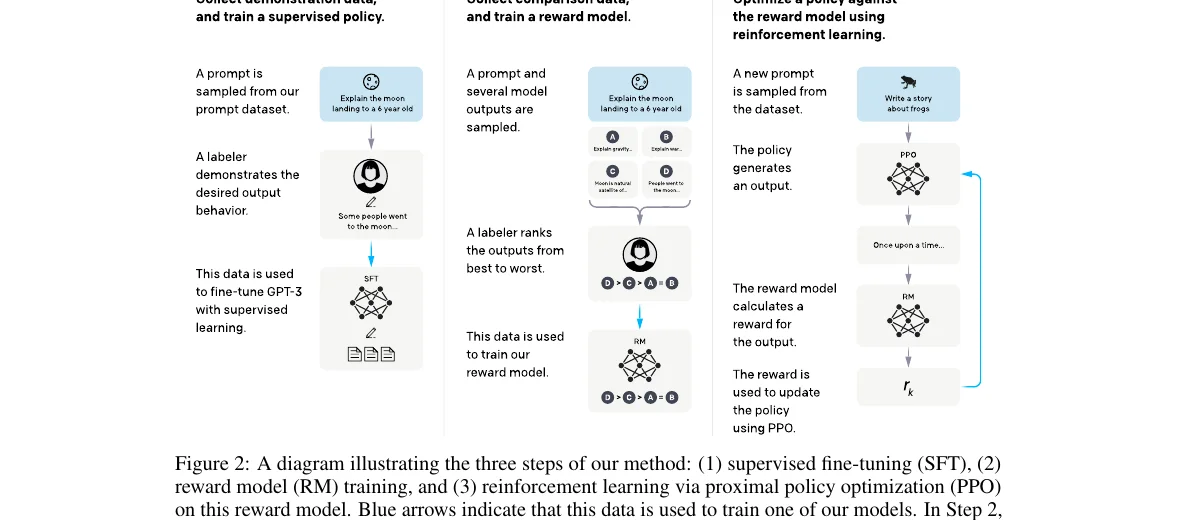
Figure 2, paper Section 3.1: three-step method—demonstration data trains SFT, ranking data trains the RM, PPO optimizes the policy. Original at arXiv PDF Figure 2. License note same as Figure 1.
How to read the evidence
Figure 1 / Section 4.1: preference win rates (headline)
Question: How much do labelers prefer InstructGPT over 175B GPT-3 and over SFT alone? Controls: held-out API test prompts; three labelers; 95% CIs. Observation: ladder GPT-3 < GPT-3 prompted < SFT < PPO < PPO-ptx; direct 175B vs GPT-3 comparison 85±3%; vs few-shot GPT-3 71±4%; 1.3B PPO-ptx still beats 175B GPT-3. Boundary: 2022 contractor preferences, not product NPS; Playground-skewed prompts.
Figure 3: held-out labelers and GPT-3 API prompts
Question: Overfit to training labelers? Still true on prompts submitted to GPT-3? Observation: held-out labelers rank similarly; conclusions largely hold on GPT-3 prompts (Section 4.1). Boundary: still English-majority, specific contractor pool.
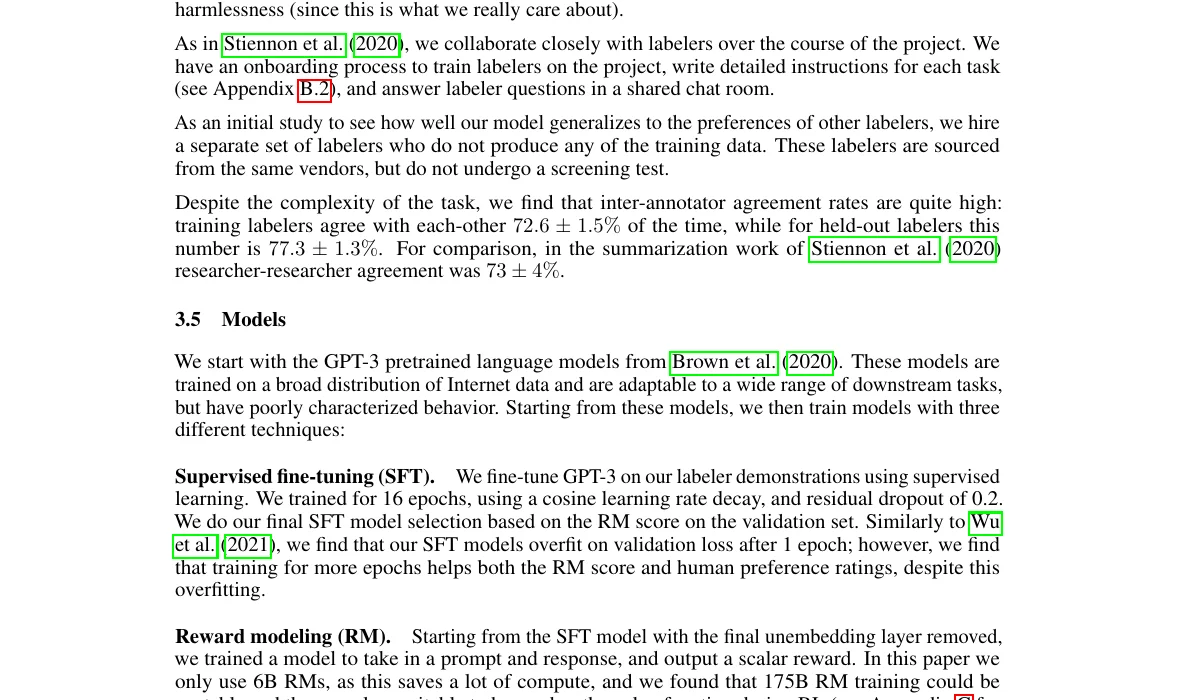
Figure 3, paper Section 4.1: win rate vs 175B SFT; left GPT API prompts, right InstructGPT API prompts; top held-out labelers, bottom training labelers. Original at arXiv PDF Figure 3. Crop includes other page content; PDF is authoritative. License note same as Figure 1.
Figure 4 / supporting metrics: TruthfulQA, toxicity, hallucination
Question: Beyond preferences, do truthfulness / toxicity / hallucination improve? Observation: on TruthfulQA, truthful and informative answers about twice as often as GPT-3 (Figure 6, Section 4.2); closed-domain hallucination 21% vs 41% (Section 1); with a respectful prompt, ~25% fewer toxic outputs (Section 4.2). Boundary: bias (Winogender, CrowS-Pairs) does not clearly improve; public NLP (SQuAD, DROP, etc.) shows alignment tax, partially mitigated by PPO-ptx (Section 4.2).
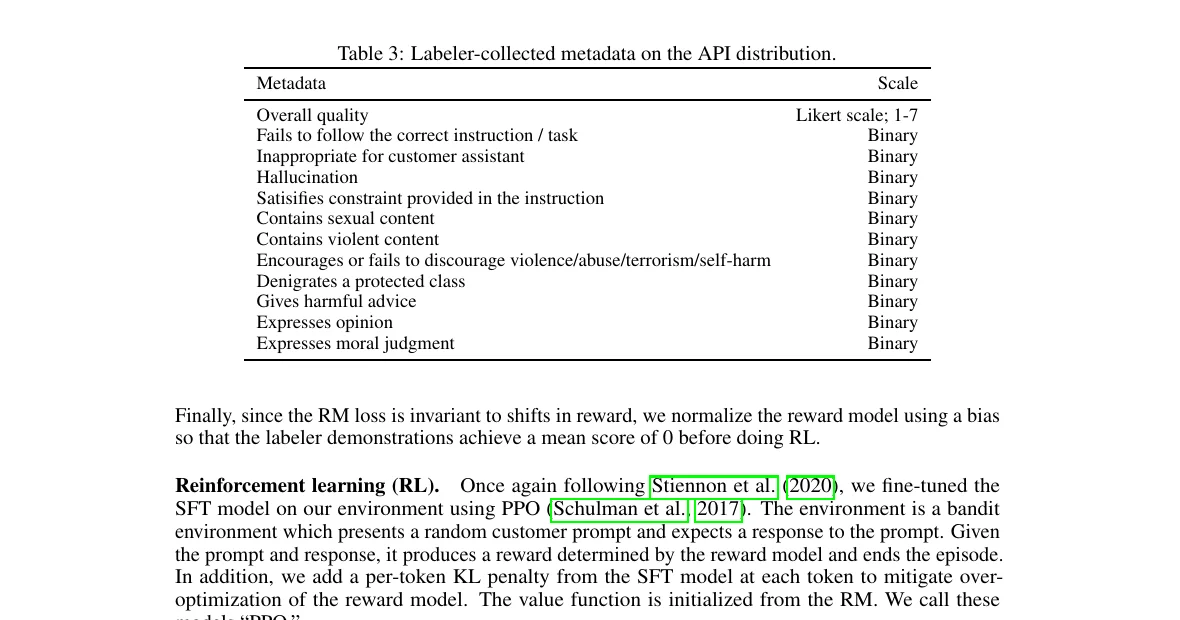
Figure 4, paper Section 4.1: PPO models score better than GPT-3 on customer-assistant appropriateness, constraint following, and reduced hallucination. Original at arXiv PDF Figure 4. License note same as Figure 1.
Cost (Section 5.1)
175B SFT ~4.9 petaflops/s-days; 175B PPO-ptx ~60; versus GPT-3 pretraining 3640 (Brown et al., 2020). Authors argue alignment spend is much smaller than pretraining, and aligned 1.3B can beat 175B base.
Ablations and design choices
- SFT-only vs +PPO (Figure 1): SFT is a big jump; PPO adds another—read both stages.
- PPO vs PPO-ptx: similar preference scores; PPO-ptx cuts public NLP regression (Section 4.2, Figure 29).
- KL vs pretraining mix (Figures 33–34): larger KL hurts validation reward; ptx mixing recovers SQuAD/DROP better.
- RM size: 6B RM in practice, not 175B (unstable).
- FLAN / T0 baselines (Figure 5): public instruction tuning trails API-preference RLHF; head-to-head 78±4% (vs FLAN), 79±4% (vs T0).
Limitations and threats to validity
- Alignment target: ~40 contractors, ~73% agreement (Sections 3.4, 5.2)—not universal human values.
- Task boundary: API Playground prompts; 96%+ English; not full production API traffic.
- Safety gaps: still toxic, biased, or fabricated; can be more toxic when instructed to be toxic (Sections 4.2, 5.3).
- Do not mix in later results: ChatGPT launch stats, GPT-4, Claude, DPO, Llama-2-chat, o1.
- Keep other foundations nodes separate: WMT BLEU, YOLO mAP, ImageNet top-5 must not enter RLHF evidence tables.
Engineering decision and when not to use it
When to borrow this paper? You already have a large base LM, pain is instruction following / style / preference mismatch, and you can fund demos + rankings + RL training—three-stage RLHF remains the textbook starting point. Measure labeler agreement and RM calibration before citing win rates.
When not to copy blindly?
- You need fully open 175B reproduction—checkpoints and data are not fully released.
- You have little SFT data but expect ChatGPT-class behavior—RM+PPO still has cost and data-quality floors.
- You write 85±3% into a 2026 product SLA or conflate the InstructGPT paper with ChatGPT the product.
- You assume DPO / RL-free preference optimization is proven here—that is later work.
Huahua’s judgment
From Transformer, keep “match the control point to the era’s evidence.” From InstructGPT, add: alignment is a post-pretraining training procedure; 2022 preference win rates are a research contract, not a chat product warranty.
Artifacts and reproducibility
Artifact status as of 2026-08-28:
- Paper: arXiv abs and PDF v1 are readable.
- Samples: openai/following-instructions-human-feedback releases sampled outputs on some NLP tasks; not a full 175B retraining recipe.
- Weights: 175B InstructGPT checkpoints are not public; reproduction needs your own base LM and labeling budget.
Minimal useful reproduction: run SFT → RM → PPO on a small model and log KL and reward curves—validate mechanism, not 85±3%.
Three things to remember
- Technical idea: frozen GPT-3 architecture; SFT demos → 6B RM rankings → PPO (+KL, default PPO-ptx); control point is human-preference alignment, not a new Transformer.
- Evidence: Figure 1—175B InstructGPT vs GPT-3 85±3%, vs few-shot 71±4%; 1.3B beats 175B GPT-3; supported by TruthfulQA / toxicity / hallucination slices.
- Boundary: The evidence is closed 2022 API labeler preference, not ChatGPT, GPT-4, or DPO. In the foundations sequence, this note’s specific topic is instruction alignment.
Further reading
If you have not read the sequence starting point, return to Transformer. For reading method, see the three-pass approach. Speculative Decoding next covers lossless inference acceleration on frozen weights, not a new architecture.
To contrast in-prompt reasoning and browser-assisted QA, see CoT and WebGPT. They do not change the post-training preference pipeline and complement this note. BERT, GPT-2/3 pretraining, ChatGPT, and DPO remain outside this paper’s scope.