論文精讀
FinRank 論文精讀:金融文件檢索與重排序評測
原文:FinRank: A Financial Document Retrieval Benchmark for Evaluating Embedding and Reranking Models
90 秒掌握論文 / The paper in 90 seconds
- 問題: 金融文件問答的錯誤不只來自「找不到相似文字」。同一個詞可能出現在不同公司、不同申報年度、不同 Note,metadata filter 也可能把真正的 supporting passage 一起裁掉。FinRank 要測的是:檢索器能否在這些近似但不正確的段落中保住正確證據。
- 核心想法: 建立 1,185 筆人工撰寫的金融 QA、5,230 段 pooled corpus 與 6,021 個 curated hard negatives,再用多種資料切分測試跨年份、跨公司與查詢改寫的泛化。
- 最重要證據: 在 pooled corpus 的 Recall@10 表中,e5-mistral-7b-instruct 為 44.8、BM25 為 32.1;metadata-filtered BM25 為 55.0,但 Section 7.1 說明 filter 可能因 first-occurrence metadata 把 gold passage 排除。Section 7.3 的 hard-negative 對比又讓 pairwise accuracy 比 random negatives 低 13.0–20.5 個百分點。
- 主要邊界: 論文沒有測 answer generation、citation correctness 或 faithfulness;資料主要來自 2024–2025 的美國 10-K/10-Q,且標註與資料分布仍有版本不一致。因此它是 retrieval evaluation 的好起點,不是金融 RAG 上線安全證明。
先知道什麼 / What to know first
這篇論文把「retrieval」與「generation」切開。對每個問題,先有一個 supporting passage,再從候選池中召回段落;Recall@10 問的是 gold 是否出現在前十名,而不是模型最後是否寫出了正確答案。Pairwise accuracy 則比較模型能否把 supporting passage 排在 hard negative 前面。
你也需要區分三種資料:
- In-record candidates: 同一份申報文件內的候選段落,較接近「在一份文件內找答案」。
- Pooled corpus: 把不同公司與文件的段落放進同一個候選池,測跨文件候選發現與 entity/year 邊界。
- Hard negatives: 與問題表面上高度相關、但不是 supporting passage 的段落;它們比隨機負例更接近生產環境的錯誤。
這和 Bloss0m 既有的 BM25 scaling 精讀 與 RubricRanker 精讀 可以接起來:前者問 access layer 如何隨 corpus scale 變化,後者問 reranker 的 rubric 如何改變文件排序;FinRank 則把「錯證據為什麼難」變成可重跑的資料與切分問題。
既有方法為什麼不夠 / Why the previous retrieval approach is insufficient
只用隨機負例或單一小型文件集,會讓 retriever 看起來已經學會 relevance,卻沒有測到跨公司、跨年度與跨 Note 的近似錯證據。只報一個 pooled score,也會把 candidate recall、metadata exclusion 與 hard-negative discrimination 混成同一個數字。FinRank 的前置限制正是這個 evaluation gap;它沒有宣稱解決 generation 或 safety 的全部問題。
核心直覺 / Core intuition
一般相似度檢索的直覺是:問題與段落越像,段落越可能是答案。FinRank 的挑戰是把這個直覺推到它會失效的地方:
- 公司邊界: 「operating segments」可能在多家公司的 10-K 中都出現,但問的是 JNJ,不是 LLY。
- 時間邊界: 同一家公司不同年度的財務數字都合理,卻不一定回答當年的問題。
- 披露邊界: 財報 Note、風險因素與管理層討論可能共享詞彙,只有其中一段真正承載答案。
- 查詢邊界: 69% 的資料帶有 query rewrite;改寫可以補足口語問題,也可能改變 entity、年度或欄位語意。
因此工程上的決策規則不是「dense 一定勝 BM25」,而是:先問候選池是否包含正確證據,再問排序器是否能把正確證據推到前面,最後才問生成器能否忠實使用它。FinRank 主要覆蓋前兩問。
走一個例子 / Worked example
論文 Appendix E 提供一個已去識別化的 JNJ 範例。問題詢問 J&J 在 FY2024 的 segments;supporting passage 來自 JNJ 的公司概覽,而 hard negative 來自 LLY 的 Note 19。這不是要我們背出財報內容,而是看一次完整的判斷流程:
- Input: 將問題、公司與年度意圖送入檢索器;若 query rewrite 改寫問題,仍要保留 JNJ 與 FY2024 這些約束。
- Candidate pool: 在 pooled corpus 中同時出現 JNJ 段落與 LLY 段落。兩者可能共享 segments、year 或 business vocabulary。
- Ranking decision: 模型不只要看語意相似度,也要讓 entity、period 與 disclosure provenance 形成排序訊號。若 metadata filter 先刪除不符合 first-occurrence 的候選,正確 JNJ passage 可能在 ranking 前就消失。
- Output: 前十名應包含 supporting passage,且最好把它排在 LLY hard negative 之前;這才是 Recall@10 與 pairwise accuracy 分別在測的兩層能力。
- Failure point: 若模型只認得「segments」這個詞,它可能選中 LLY。若 filter 只信段落先出現的 metadata,則可能得到更乾淨卻錯誤的候選池。
這個例子也解釋為什麼本文不把 FinRank 當成 answer benchmark:文章可以先回答「找到了哪段證據」,但還沒有驗證生成器是否引用正確段落、保留數字、處理衝突或拒答。
技術機制 / Technical mechanism
FinRank 的資料與評測流程可以拆成四步:
- Question and passage construction: 作者從 2024–2025 年、22 家美國公司的 10-K/10-Q 建立 1,185 筆 QA,涵蓋 pharmaceuticals、oil/gas 與 automotive;資料有 6,021 個 curated hard negatives,並提供 supporting passage。
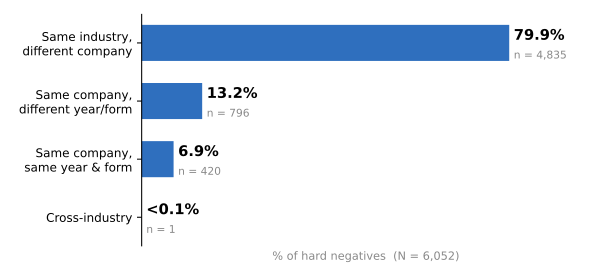
Figure 1,論文 Section 3.3 的 Hard Negatives 分類法:依據負例來源段落與原問題實體、申報年度及披露主題的語義關係劃分,呈現跨公司、跨年度與同文檔不同 Note 的混淆維度。原始 Figure 1 anchor;圖片取自 arXiv HTML figure endpoint。原論文標示為 CC BY-NC-SA 4.0 授權。

- Corpus pooling: 先保留每筆資料的 in-record candidates,再形成 5,230 個 unique passages 的 pooled corpus。這讓「在正確文件內找」與「在跨公司候選中找」成為兩種不同難度。
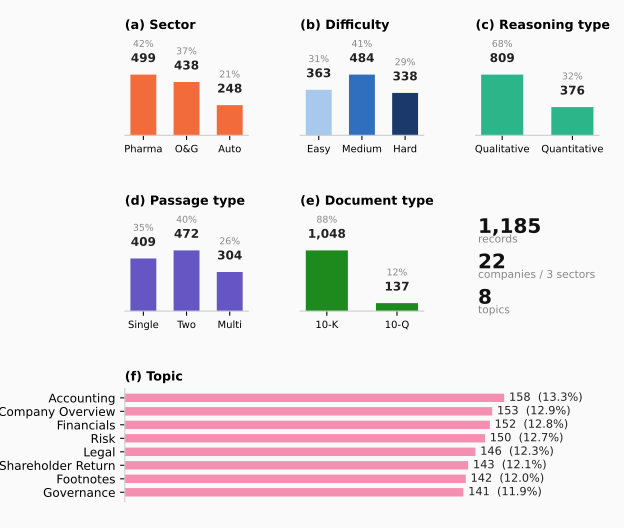
Figure 2,論文 Section 4 的資料集構成分析:展示 1,185 筆金融檢索任務在 (a) 產業領域(醫療、能源、汽車等)、(b) 難度等級、(c) 推理類型(數值計算、事實對比、條款引用等)的完整分佈。原始 Figure 2 anchor;圖片取自 arXiv HTML figure endpoint。原論文標示為 CC BY-NC-SA 4.0 授權。

- Retriever comparison: Section 6.1 比較 TF-IDF、BM25、all-mpnet-base-v2、cross-encoder、bge-large、finance-adapted embedder 與 e5-mistral-7b-instruct 等基線;文中也固定 512-token truncation,避免不同模型看見不同長度的輸入。
- Split and contrast: 五種 generalization splits、query-rewrite 對比、metadata-filtered BM25,以及 hard-versus-random negative 對比,分別檢查跨資料分布、規則過濾與負例難度。
這裡沒有需要神秘化的新 loss。論文的可取之處在於把錯誤來源拆開:資料如何構成、候選如何混合、負例是否真的困難,以及 metadata policy 是否在檢索前改變了任務。
如何讀證據 / How to read the evidence
Pooled retrieval:Recall@10 到底回答什麼
問題與控制: Section 3.6 的 pooled corpus 把不同記錄的段落放在同一候選池;同一批問題、supporting passage 與候選集合讓模型之間可比較。觀察: Section 7 / Figure 3 / Table 4 報告 e5-mistral-7b-instruct 的 Recall@10 為 44.8,BM25 為 32.1。解釋: 在這個 pool 與截斷設定下,較強的語意模型能把更多 gold passage 帶進前十名。邊界: 這不代表它會生成正確答案,也不代表在另一個公司分布、語言或長文件切法仍維持同一差距。
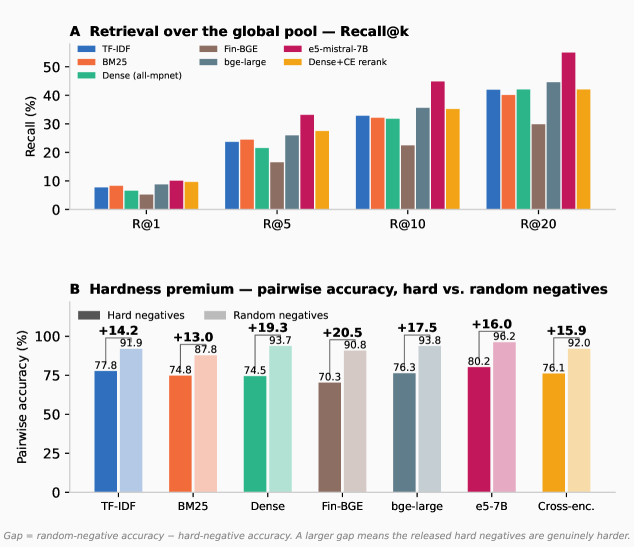
圖|原文 Figure 3(Section 7):上半部是 pooled retrieval 的 Recall@k,下半部是 curated hard negatives 與 random negatives 的 pairwise accuracy。來源:FinRank v1 Figure 3;原論文標示為 CC BY-NC-SA 4.0。
Metadata filter:高分是否可能是風險訊號
問題與控制: Section 7.1 比較普通 BM25 與 metadata-filtered BM25。觀察: filter 版 Recall@10 報告為 55.0。解釋: 如果 metadata 事先把大量不可能的候選排除,排序器面對的問題變簡單。邊界: 論文指出 first-occurrence metadata 可能排除 gold passage;所以 55.0 不是免費的準確率,必須與 metadata coverage、false exclusion rate 一起看。這是一個典型的「offline score 上升、任務邊界改變」問題。
Hard negatives:接近生產錯誤的壓力測試
問題與控制: Section 7.3 / Table 5 把 curated hard negatives 與 random negatives 對比。觀察: hard-negative 條件使 pairwise accuracy 比 random 條件低 13.0–20.5 個百分點。解釋: 模型可能在一般語料上學會「有關鍵詞就相似」,但還不會可靠處理 entity、year 與 disclosure provenance。邊界: 這個差距不能直接轉成 production failure rate;它只說明負例設計會顯著改變難度。
Generalization 與資料品質
Appendix A 的 Sections 3.2–3.5 描述資料構造與 annotation。論文主文與 artifact summary 對資料分布有約 87% / 88% 為 10-K 的差異;我把它保留為版本待釐清,而不選一個數字假裝精確。資料約 75% 來自 2025 年、質性問題約佔四分之三,且是 single-annotator,沒有正式 inter-annotator agreement。另有 442 個 hard negatives(約 7.3%)與別筆紀錄的 supporting passage byte-equal;這些都會影響你對 split leakage、難度與獨立性的判讀。
證據地圖 / Evidence map
- 論文直接支持: FinRank 的資料規模、pooled corpus、baseline 清單、Recall@10、pairwise accuracy、五種 split 與 hard-negative 對比;定位點是 Sections 3.6、6.1、7、7.1、7.3,以及 Appendix A。
- 作者的解讀: hard negatives 比 random negatives 更能暴露金融檢索器的 ranking weakness;metadata-aware retrieval 可以改善召回,但不是沒有 exclusion risk。
- 尚未建立: 沒有 answer generation、citation correctness、faithfulness、human preference、在線延遲或金融決策風險結果;也不能從這些 retrieval numbers 推出某個模型在生產環境最安全。
- Bloss0m 工程判斷: 最值得帶走的是 evaluation contract:每次報 Recall 時,同時保存 entity/year/document provenance、候選池版本、hard-negative taxonomy 與 filter 的 false-exclusion audit。這是工程推論,不是論文實驗結果。
Limitations 與 unsupported interpretations
這些 limitations 不是腳註,而是結論的一部分:FinRank 的 preprint 結果不能支持「某個 retriever 在所有金融資料都更好」、不能支持「metadata filter 不會漏掉答案」,也不能支持 generation faithfulness 或金融決策安全。資料的 10-K 比例、single-annotator 品質、hard-negative byte equality 與沒有正式 IAA,都應在採用前重新核對。
Artifact 與可重現性 / Artifacts and reproducibility
截至 2026-08-11(as of 2026-08-11),作者的 FinRank repository 可直接連線,包含 FinRank.jsonl、baselines/、splits、validation script、repair log、hard-negative taxonomy 與 summary。README 說明資料集以 CC BY-NC 4.0 提供,完整 SEC filing 原文不隨 repo 重新散布;因此 artifact repository 可用於檢查 schema、跑 smoke-level validation 與理解 reported results,但不是拿到所有外部文件後就能無條件重現論文。
重跑至少要固定:repo commit、FinRank.jsonl 版本、五種 split、模型 checkpoint、512-token truncation、query-rewrite 狀態、metadata filter 規則,以及 raw filing 的取得方式。若缺少 SEC 原始文件、模型權重或相同 preprocessing,應報告「partial reproduction」而不是「reproduced」。
Bloss0m 工程判斷與不適用條件
值得使用的情境:
- 你正在做企業財報、法務或合規 RAG,需要把「候選召回」和「回答正確」拆成兩個 gate。
- 你有多個公司、年度與文件版本,想測 metadata policy 是否誤刪 gold evidence。
- 你希望用 hard negatives 建立 retriever/reranker regression set,而不是只用隨機負例。
不要直接套用的情境:
- 你要驗證生成答案、數字計算、引用範圍或拒答;FinRank 沒有這些結果。
- 你的資料是多語、即時市場資料、表格與圖形密集文件;本文只把表格與圖形文字化,不能假設視覺證據已被涵蓋。
- 你的系統只允許嚴格 metadata filter,卻沒有 false-exclusion audit;55.0 的 filter 結果反而應該先觸發風險檢查。
- 你要比較 production latency、API cost 或金融決策安全;這篇 preprint 沒有提供完整 operational study。
一個實務 rollout 可以先把 FinRank schema 改成自己的 document provenance,再加入公司/年度/文件型別的 hard-negative matrix,最後把 top-k evidence 送進 answer-and-citation audit。不要跳過候選池覆蓋率,就直接用最終答案分數調參。
三個要記住的點 / Three things to remember
- 技術想法: 金融檢索的難點不是相似文字,而是相似文字跨越了錯誤的公司、年度與披露邊界。
- 證據: pooled corpus 的 Recall@10 與 hard-negative drop 說明候選池與負例設計會顯著改變排序結論;metadata filter 的高分必須搭配 exclusion audit。
- 邊界: FinRank 是 retrieval benchmark,不是 generation、faithfulness、latency 或金融安全的完整驗證;artifact 可查驗,但完整重現仍有外部文件與版本條件。