Engineering note
AWS Bedrock AgentCore Consent Portal: Agent OAuth Is More Than a Connect Button

When an AI agent is expected to read GitHub issues, search Slack, or operate another SaaS on a user’s behalf, the hard part is rarely drawing the OAuth button. The hard part is proving that one user, in one agent session, granted one Gateway access to one set of scopes. AWS Machine Learning Blog’s AgentCore Consent Portal walkthrough from September 14, 2026 moves this repeatedly rebuilt flow into Amazon Bedrock AgentCore Identity and Gateway.
Its value is not another Connect page. It puts end-user consent, portal session binding, Gateway resources, and outbound-provider token custody into one observable flow. But it remains an AWS reference walkthrough: it demonstrates how AWS documents the components together; it is not an independent security review and does not prove that every IdP, scope, session, IAM, or provider-compatibility choice is safe.
The responsibility chain
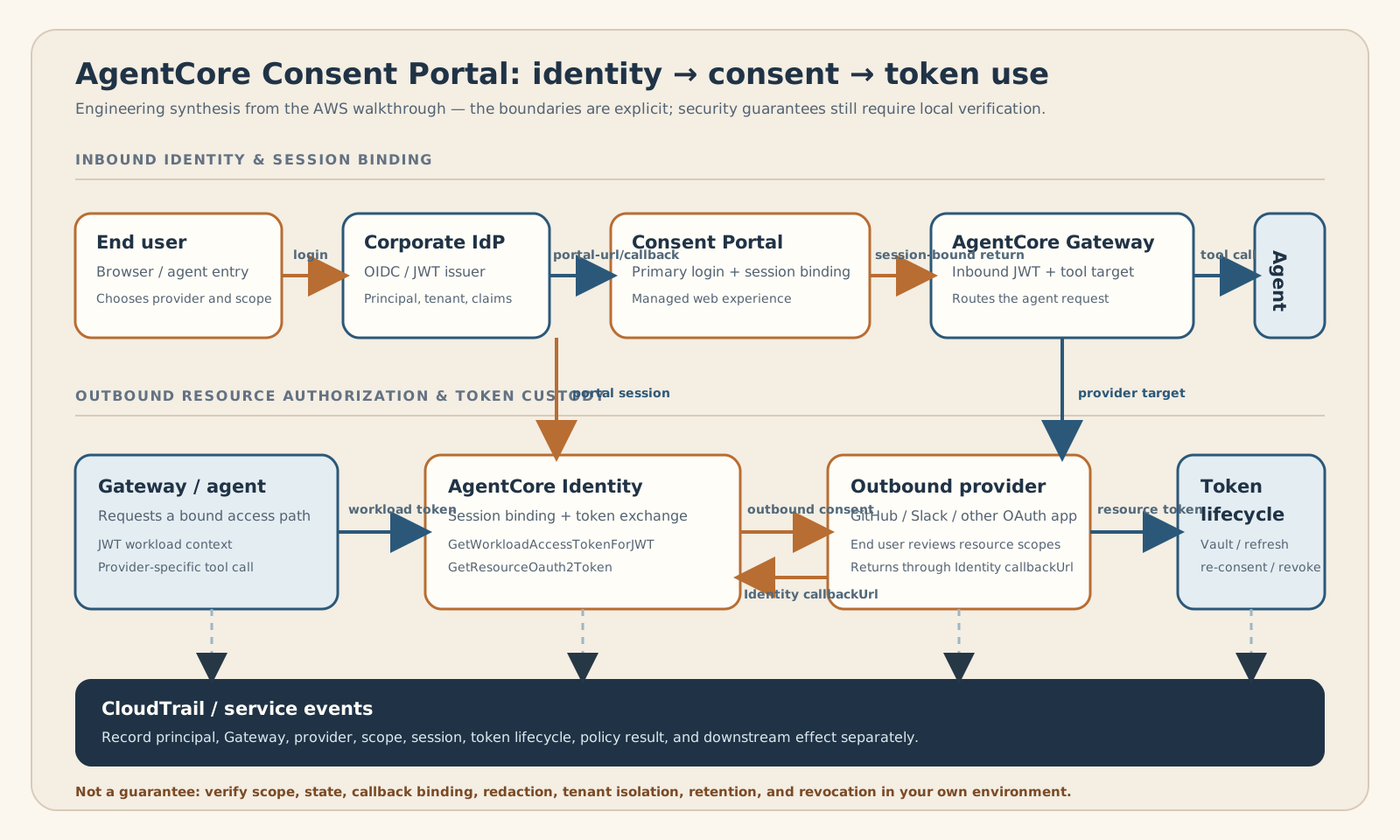
Figure: a Bloss0m engineering synthesis that separates the AWS walkthrough’s identity login, portal-session binding, outbound-provider consent, token lifecycle, and CloudTrail evidence. This is not an AWS original figure and does not represent a completed security guarantee.
The smallest useful mental model for Consent Portal has five roles: The smallest useful mental model has five actors:
| Actor | Responsibility in the flow | What it must not be confused with |
|---|---|---|
| End user | Completes corporate-IdP login and separately consents to GitHub, Slack, or another target provider | A super-user that grants every provider scope to the agent |
| Corporate IdP | Proves the user and organization identity and returns an OIDC or JWT result to the portal | GitHub or Slack as an outbound resource provider |
| AgentCore Gateway | Exposes agent tools or resources, handles inbound JWT authorization, and owns target return context | The application that automatically stores every user’s third-party refresh token |
| AgentCore Identity | Manages portal session binding, obtains workload access tokens, and completes resource-token exchange | An authorization engine that grants every Gateway request provider scope |
| Outbound provider | Owns GitHub, Slack, or another OAuth app’s consent, access token, and refresh-token lifecycle | The Consent Portal’s primary corporate IdP |
This separation matters because teams often treat “the user signed into the agent” and “the user delegated GitHub access to the agent” as one OAuth event. The AWS documentation describes two different delegations: first establish the principal with the corporate IdP, then let that principal consent to an outbound resource provider. If scopes, subjects, audiences, or callbacks are mixed, even CloudTrail becomes difficult to interpret: which authorization produced which token?
Three callbacks: the easiest place to be wrong
The AWS Consent Portal configuration guide and prerequisites distinguish callback roles. A compact routing table is:
| Callback | Who calls it | Where it returns | What it completes |
|---|---|---|---|
| portal-url/callback | Corporate IdP | AgentCore Consent Portal | Primary identity login and portal-session binding |
| portal-url/connect/callback | Gateway target or default return flow | The portal’s connection experience | Return the Gateway request to the user’s target connection flow |
| AgentCore Identity callbackUrl | GitHub, Slack, or another outbound OAuth app | AgentCore Identity’s resource-token exchange | Provider-token binding and later resource-token acquisition |
The authority for each URL is different. The first is not a GitHub callback; the second is not a generic provider redirect URI; and the third is not an arbitrary application-front-end callback. At implementation time, put every URL, client ID, secret, state, redirect URI, issuer, audience, and token owner into a configuration contract. After deployment, verify each one against an actual browser trace and the corresponding CloudTrail events.
The AWS prerequisites also make the primary-IdP constraint explicit: the portal’s primary IdP must provide OIDC or JWT identity and use the openid scope. In the walkthrough, GitHub and Slack are outbound resource providers, not the primary corporate IdP. That does not mean GitHub or Slack cannot have their own OAuth flow; it means their role in this AgentCore architecture is different.
The administrator flow: establish the trust boundary first
The administrator workflow is more than creating a portal. Based on the AWS walkthrough and supporting documentation, deployment should at least cover:
- Prepare the corporate IdP: confirm issuer, discovery endpoint, client ID, client secret, redirect URI, and openid scope. Decide which claims identify tenant, user, group, and policy context.
- Prepare outbound provider apps: configure GitHub, Slack, or another resource provider with OAuth app credentials, allowed scopes, and the AgentCore Identity callbackUrl. Each provider needs its own scope review and revoke or re-consent policy.
- Configure Gateway inbound authorization: Gateway validates inbound JWT authorization. Do not treat the inbound corporate identity and an outbound provider token as the same credential.
- Create the Consent Portal: use the managed portal URL and Gateway relationship described by AgentCore Identity. The documentation describes one portal per Gateway; do not assume one global portal automatically provides isolation for every Gateway.
- Store secrets and configure IAM: keep client secrets in Secrets Manager and give Gateway or Identity a least-privilege execution role. Review the trust policy, resource policy, KMS access, and secret-read permission together.
- Register redirect URLs and allow-lists: record the primary-IdP callback, connect callback, and outbound-provider callback separately. Do not replace explicit environment or tenant mapping with wildcard redirects.
These steps show what the managed portal does and does not do. It removes common plumbing; it does not outsource the responsibility for principal, audience, scope, token owner, or audit-event design. Adding a provider, changing an IdP, adding a scope, enabling a multi-tenant Gateway, or changing a callback domain should trigger a new review.
The end-user flow: two grants, two token meanings
The user flow can be represented as a state machine:
- The user enters Consent Portal from an agent or Gateway target.
- The portal redirects to the corporate IdP; the user signs in.
- The portal binds the returned principal to the current portal session.
- The user sees available resource providers, such as GitHub or Slack, and chooses a connection.
- The provider presents its own OAuth consent screen; the user reviews scopes and approves.
- The provider redirects to AgentCore Identity’s callbackUrl, where Identity completes resource-token authentication.
- The Gateway or agent later calls GetResourceOauth2Token, or uses GetWorkloadAccessTokenForJWT to obtain the workload access path that corresponds to the session.
- If the provider requires refresh, Identity follows its token lifecycle. If a refresh token expires, scopes change, or the user revokes access, the flow returns to re-consent instead of silently expanding authority.
This is where access tokens and workload access tokens must remain distinct. The first represents a resource authorization at an outbound provider; the second is an access path for the workload inside the AgentCore boundary. Even if both look like bearer tokens, they should not be interchangeable in logs, caches, or API contracts.
The AWS walkthrough also includes operations such as GetResourceOauth2Token and CompleteResourceTokenAuth, alongside token-refresh caveats. A production implementation should not stop at wiring the API calls. It should retain a correlation ID, portal session, provider, user subject, scope hash, token expiry, refresh result, and revocation reason. The token material itself must not enter application logs; debugging should use hashes, metadata, and event references.
CloudTrail and session binding: visible does not mean proven
One benefit of the flow is that AWS documents session binding, token acquisition, and identity operations through observable CloudTrail or service-event surfaces. An enterprise can use these records to ask:
- Which Gateway initiated consent?
- Which principal and tenant did the corporate IdP return?
- Which outbound provider and scopes did the user approve?
- Was token acquisition first consent, refresh, re-consent, or error recovery?
- Which workload used which session-bound token?
- After provider revocation or token failure, was the old Gateway session marked unusable?
But a CloudTrail event does not prove that session swapping is impossible or that token isolation passed an independent audit. The AWS post does not provide independent tests for CSRF, login CSRF, authorization-code interception, session fixation, tenant mix-up, callback confusion, or token replay. Those are security-verification tasks for the adopting enterprise.
Scope and token custody: managed does not mean least privilege
Consent Portal can show the user a provider consent screen, but scope review remains a platform and product responsibility. Keep at least three scope layers separate:
| Scope layer | Examples | Review question |
|---|---|---|
| Identity | openid, subject, tenant or group claims | Are these claims used only for identity, or accidentally treated as resource authorization? |
| Resource read | Read issues, read channels, repository metadata | Does the agent need all of this scope? Can it be restricted to a repository, channel, or project? |
| Resource write | Create issues, send messages, modify files, call an external action | Does it require human approval, a second confirmation, a write policy, and rollback? |
Putting refresh tokens in a token vault does not mean the risk has been automatically removed by the AWS product name. Verify who can read the vault, who can call GetResourceOauth2Token, whether cross-tenant lookup is possible, how caches are handled, how quickly revocation takes effect, and whether provider revocation propagates. Documentation describes a service capability; it is not an independent isolation certificate for an enterprise environment.
A practical design keeps provider authorization and tool capability separate. A user may consent to read Slack while agent policy permits search only in selected channels. A user may consent to read a GitHub repository while the tool schema forbids writes. If writes are enabled, the policy event should record who, why, when, and which approval rule allowed them.
Failure modes: an OAuth happy path can still be incomplete
The most important implementation failures are outside the happy path:
- IdP callback succeeds but provider consent fails: the principal exists, but the resource token does not; the UI must not display “GitHub connected.”
- Provider callback succeeds but binding differs: if state, tenant, Gateway, or browser session does not match, fail closed rather than guessing from the most recent token.
- Refresh token expires: enter a re-consent or reauthorization state; do not retry forever or turn a recoverable refresh error into an opaque 500.
- Scopes change: treat newly requested scope as new consent instead of reusing the old success state.
- A Gateway is copied across environments: callbacks, secrets, execution roles, and tenant mappings must be environment-bound; staging tokens must not be readable by production workloads.
- The user revokes access: be able to trace and disable the provider, AgentCore Identity state, Gateway session, cache, and downstream audit trail.
- CloudTrail is incomplete: event delay, cross-account queries, retention, and redaction affect the incident timeline; a record visible in today’s console is not automatically a permanent record.
These cases explain why a managed callback does not mean callback design has disappeared. The platform writes less custom web-server code, but the identity and Gateway contract must become more precise.
Where it fits in the Bloss0m archive
If you are building an agent-governance baseline, start with the enterprise AI agent security overview, which puts identity, tools, memory, and human control on one architecture map. GitHub MCP enterprise controls is useful for comparing resource scopes, audit, and write capability. Forge MCP Auth Runtime pushes auth state closer to runtime policy. If you are evaluating an AgentCore workflow, follow it with AWS Step Functions and AgentCore validation boundaries.
What AWS documents, and what an enterprise still has to prove
| Area | Explicitly documented in the AWS post or docs | What it does not establish by itself |
|---|---|---|
| Flow | Managed portal, primary IdP, outbound provider, callbacks, and token APIs | Compatibility with every OAuth provider or IdP |
| Identity | OIDC or JWT, openid scope, Gateway and Identity integration | Tenant isolation, session-swap resistance, or independently verified claim mapping |
| Tokens | Token vault, GetResourceOauth2Token, CompleteResourceTokenAuth, workload access token | That token material can never appear in logs, caches, or support surfaces |
| Audit | CloudTrail or service events for parts of the operation | Complete, immediate, immutable events sufficient to reconstruct every downstream effect |
| Operations | Prerequisites, execution role, Secrets Manager, and cleanup order | Availability, cost, latency, revocation SLA, or production adoption |
That distinction is the main judgment of this article. Vendor documentation is a strong source for an implementation checklist. A security conclusion still needs a threat model, penetration testing, negative tests, IAM review, multi-tenant tests, a provider-compatibility matrix, and an incident drill.
Primary sources and verification scope
- AWS Machine Learning Blog: Manage end-user OAuth consent for AI agents with Amazon Bedrock AgentCore
- AgentCore Consent Portal configuration
- AgentCore Consent Portal prerequisites
- Amazon Bedrock AgentCore release notes
I checked the AWS post, Consent Portal configuration, prerequisites, and relevant release-note sections as of 2026-09-17. This article preserves the AWS product terminology and documented flow, while treating security guarantees, token isolation, availability, cost, and compatibility as claims not established by those vendor sources.
Related engineering notes
- Enterprise AI GitSpawn: When Repository Git Config Runs Before a Coding Agent's Trust Boundary A technical analysis of how repository-local core.fsmonitor can trigger background commands before coding-agent workspace trust and approvals, with the archive delivery condition, patch matrix, safe lab boundary, and enterprise controls.

- Enterprise AI Model Hardware Standard: an MCP-shaped interface for physical devices An evidence-led look at Anthropic's Model Hardware Standard research preview: standardized drivers, discovery, and device control for agents, while identity, authorization, approvals, and physical safety remain platform responsibilities.

- Enterprise AI New Enterprise Governance Challenges in the AI Agent Era: The Dual-Platform Path of FinOps × Agent Governance (OmiFin & MAIAH) A source-checked reading of eCloudvalley's FinOps and agent-governance talk, grounded in public FOCUS, FinOps Framework, AWS, and MAIAH material.