Field guide
Financial-Grade Enterprise Agentic AI Architecture Design: From Demo to Agentic Operating System
After the platform runs — governance, responsibility breakdown, auditability, and a reusable Agentic Operating System
If you have read Financial AI Engineering Platform Engineering, that article discussed how Agentic AI operates stably—Cloud Native Runtime, deployment, scaling, monitoring, and the trusted RAG workflow verified at the IT portal.
This article is written for platform architects, technical leads, and risk governance stakeholders facing cross-department AI deployment and enterprise control mechanisms. The core problem it solves is: how to move beyond point chatbots to establish an Enterprise Control Plane (Agentic Operating System) that unifies identity, tools, policies, evaluation, and audit trails.
This article explicitly does not repeat container runtime networking or vector index tuning from post 38, does not offer legal compliance warranties, and does not discuss fully autonomous unsupervised systems.
My core viewpoint is: The next phase of AI in the financial industry lies not in model competition, but in operating system competition.
The Agentic Operating System here refers to a Control Plane where the enterprise manages how AI verifies evidence, calls tools, is bound by policies, undergoes quality evaluation, and leaves audit trails—it is not a traditional OS, nor does it intend to replace existing IT systems.
Recommended reading order for the series: first read the Platform Engineering Chapter (Runtime and Operations), then read this chapter (Governance and OS-ification).
Slides PDF
Wealth Manager Site: This Is Not a Chatbot Test Question
Please imagine a scenario closer to the actual financial business site.
The wealth manager is at the client site, and the client has just finished discussing risk tolerance. The wealth manager further confirms: “This client is RR3, can we recommend this high-yield bond fund?”
This is not a chatbot test question. AI should not give investment advice directly, but should check the product risk rating, suitability rules, and internal regulations; if information is insufficient, it should ask follow-up questions or refuse to answer; if it involves sales suitability, it should escalate for human review.
AI’s answers cannot just stop at looking reasonable, they must be trusted.
At the IT portal, we have already verified that the platform can run; what we are going to talk about today is how the same set of governance capabilities can enter the wealth manager, compliance, and internal control sites.
Being trusted is not about relying on larger models, but on governance capabilities that are verifiable, able to refuse answers, and trackable.
From PoC to Production: Asking One Level Up
The Platform Engineering Chapter has already discussed from an operations perspective: PoC only needs to make people believe the system “can answer”; formal production must simultaneously satisfy real users, enterprise workflows, permissions, and audits. Common breakpoints are system silos, linear RAG, and black-box AI.
This chapter will no longer reiterate how the runtime is built, but will ask one level up:
After the platform can run, how does the enterprise govern this set of capabilities into a reusable, auditable hub across scenarios?
The answer lies in the design of the architecture control plane.
Enterprise Agentic AI Control Plane
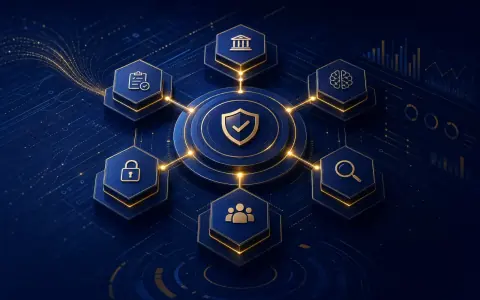
Enterprise-grade Agentic AI is not just about writing good prompts and connecting a few functions. For financial-grade AI to truly go into production, it needs a governable control plane—bringing reasoning, tools, knowledge, policies, evaluation, and trails all under the same governance scope.
In the middle is the runtime: it uses state machines to manage workflows, paired with conditional branching, retries, and failure handling, to keep reasoning controllable and prevent unbounded divergence.
The outer six modules can be understood in three groups:
Group 1: Roles and Tools
| Module | Responsibility |
|---|---|
| Agent Registry | Defines each agent’s responsibility—what to do, can be replaced, can be tested |
| Tool Registry | Uses permission and trail requirements to regulate how enterprise tools are called |
Group 2: Evidence and Policies
| Module | Responsibility |
|---|---|
| Knowledge Layer | Provides reliable, citable evidence within permissions |
| Policy Engine | Gatekeeps role permissions, PII filtering, answer refusals, and human review |
Group 3: Quality and Trails
| Module | Responsibility |
|---|---|
| Evaluation | Quality scoring and regression testing |
| Trace Store | Every answer can be replayed and audited |
Summarized in one sentence: runtime, combined with tools, knowledge, policies, evaluation, and trails—all are indispensable. Missing one piece might still allow for a demo, but makes it very difficult to become a formally deployed financial-grade system.
From Point Assistants to Reusable Enterprise Patterns
The same control plane can map to different scenarios:
| Scenario | Task Breakdown Pattern |
|---|---|
| Information Summarization | Multi-source crawling → Understanding → Organizing |
| Deep Research | Deconstruct query → Search → Verify if evidence is sufficient → Search again if insufficient → Answer only at the end |
| Wealth Manager Support | Check product terms and suitability rules → Policy gatekeeping → Refuse answer or escalate to human → Full trail tracking |
Though the surface functions differ, underneath they all involve breaking down problems into nodes, tools, and governance boundaries.
What is truly worth reusing is not any single chatbot, but the task breakdown method from “problem to architecture, and then to product”. What the financial industry needs is to precipitate these practices into capabilities the enterprise can repeatedly apply.
15+ Agents: Governing the Responsibility Map, Not Agent Quantity
More than fifteen Agents doesn’t mean fifteen microservices, nor is it just to make the architecture diagram look good. We break down a single AI request into over a dozen independently checkable responsibilities—for each item, we can clearly state: what the input is, what the output is, and what constitutes failure.
Why Not Cram Everything Into One Large Model?
If everything is crammed into one large model—understanding the problem, finding documents, calling systems, determining if it can answer, keeping records—it’s all mixed together. Once it answers incorrectly, you can only say “the model is inaccurate,” and there is no way to fix it.
Once broken apart, it’s different:
| Responsibility | Sole Concern |
|---|---|
| Intent Classification | What category is this question |
| Query Routing | Which data source to go to |
| Evidence Verification | Are documents sufficient to support the answer |
| Policy Gatekeeping | Can this question be answered, should it be handed over to a human |
Each step can be individually tested, replaced, observed, and replayed.
These responsibilities don’t have to equate to fifteen independent programs—they can be platform components or workflow nodes, the form can be flexible, but the boundaries must be clear.
Why Does the Financial Industry Need to Break It Down This Way?
Audit and debugging cannot just record “model answered incorrectly.” If an answer about fund suitability for a client is wrong, we need to be able to judge: was the wrong document found, did the rules fail to block it, did it answer despite insufficient evidence, or did the quality scoring miss the problem? Only when responsibilities are clearly broken down can we fix the right places.
The core point is simply: We govern the responsibility map, not the quantity of agents.
How a Wealth Manager Request Traverses the Agentic Runtime
The wealth manager asks at the client site: “This client’s risk profile is RR3, can we recommend this high-yield bond fund?”
After this request comes in, what actually happens? I will explain it in four stages:
Stage 1: Understanding the Problem
It judges that this is a sales suitability problem, not a general product introduction—it has to check the client’s risk profile, the product’s risk rating, and internal rules, and cannot just answer using the model’s common knowledge. With the wealth manager in front of the client, the system must instantly understand and plan the next steps—here, Realtime GPT is responsible for understanding and orchestrating.
Stage 2: Finding Evidence and Verifying Sufficiency
It goes to the knowledge base to check product descriptions and suitability rules, and if necessary, calls product systems or CRM to confirm the risk rating of this fund. Once documents are gathered, the evidence verification module checks: is the data sufficient, and can it support the judgment of “can it be recommended”?
Stage 3: Generating the Answer and Gatekeeping
AI does not give investment advice directly, but explains constraints based on evidence; policy gatekeeping checks sales suitability rules, whether the wealth manager is querying beyond their authorization, whether this question can be answered automatically, and whether to escalate for human review; quality scoring further confirms if the answer meets production standards.
Stage 4: Full Trail Tracking
Allows for replay audits afterward.
Instant understanding and orchestration go to Realtime GPT; verification, gatekeeping, scoring, and trails go to the platform—it is not one model doing it all.
Every answer is a path that can be replayed, debugged, and continuously improved.
Knowledge Layer: Evidence Governance, Not Search Cloud & Platform
The Platform Engineering Chapter has thoroughly discussed hybrid search and data engineering; this chapter only addresses the evidence governance perspective.
If parsing is wrong, chunking is wrong, or retrieval is wrong, no matter how strong the subsequent model is, it is just reasoning on wrong data.
The knowledge layer is responsible for three things:
- Correctly parsing documents
- Chunking while preserving sufficient semantics
- Ensuring every piece of evidence carries a source ID, permission scope, and reliability
This is the foundation for subsequent policies, scoring, and trail tracking to function. The first step of financial-grade RAG is not generation, but letting Agents obtain evidence that is within permissions, citable, and verifiable.
Agentic RAG: Self-Correcting Workflows
Traditional RAG: Retrieve first, then generate.
Financial scenarios cannot rely solely on this mode—for that wealth manager’s request, if it’s just “answer when data is found,” it’s completely inadequate.
The difference in Agentic RAG lies in turning the aforementioned four-stage workflow into a self-correcting workflow; each step can revert to re-check, refuse to answer, or escalate to human review.
Remember one concept (echoing the Platform chapter):
Accuracy is not a function of the model, but a property of the entire workflow.
Three Layers of Security Boundaries: Not Every Question is Answered
The financial industry cannot design an AI that always answers. A truly production-ready AI must determine when to answer, when to re-check, when to refuse, and when to hand over to manual processing.
| Level | What to Check |
|---|---|
| Evidence Boundary | Is the evidence sufficient? Are the sources consistent? If insufficient, rewrite query or refuse to answer |
| Policy Boundary | Is it allowed to answer? Can it call tools? Role permissions, PII filtering, refusal policies, tool risk levels |
| Human Boundary | High-risk scenarios like compliance, credit, internal control, customer complaints—AI can assist in organizing evidence, but does not replace the final decision-maker |
Rewriting, refusing to answer, and escalating to humans—represent the value of financial-grade Agentic AI: it lies not in being fully autonomous, but in operating autonomously within controllable boundaries.
LLM-as-a-Judge: Making Quality Measurable and Regressible
Quality is not something tested once and forgotten, every new version must be measurable, verifiable, and able to undergo regression testing.
Evaluation is based on the 100 low-risk IT and process tasks described in the Platform Chapter—the numbers represent the runtime’s credibility, not that high-risk wealth management decisions can be fully automated yet. Question types cover FAQs, synonymous rewrites, mandatory refusals, and edge cases.
The Agent goes through the full workflow to generate an answer, which is then graded on a fixed four-level standard by the Quality Scoring Module:
| Metric | Result |
|---|---|
| Weighted Accuracy | 98% |
| Strict Correctness | 96% |
| Incorrect or Unsafe Answers | 0 |
| Full Workflow P95 Latency | 6.19 seconds |
Why Is Scoring Not a Black Box?
All 100 questions were manually cross-calibrated—human standards were established first, then the scoring module was calibrated. The accuracy reported earlier is the result aligned with human standards, not an uncalibrated black-box score.
What Do Ablation Studies Tell Us?
| Setup | Accuracy |
|---|---|
| Simple RAG | 87% |
| Hybrid Search Only | 83.5% |
| Full Agentic RAG | 98% |
Quality improvements come from verification, refusal, boundary routing, and scoring—not the retriever itself.
Quality improvements come from verification, refusal, boundary routing, and scoring—not the retriever itself.
The core point is not the numbers themselves, but the engineering attitude: question banks, scoring methods, manual calibration, and component contributions must all be clearly explained, so that quality can be governed. This mechanism directly builds upon the practical experience from our Agentic RAG Engineering Case. Furthermore, in terms of multi-modular tool orchestration, we leverage architectural patterns from the LINE / n8n Agent Platform, which coordinates 19 modular subflows and maintains isolated boundaries for Tool Gateway authorization and failure handling.
Concrete Trade-offs and Engineering Costs of Control Planes
Deploying an Enterprise Control Plane effectively mitigates compliance and reasoning risks, but engineering teams must absorb three concrete costs:
- Architectural and Collaboration Overhead: Decomposing monolithic chatbot logic into six modules—Agent Registry, Tool Registry, Policy Engine, Knowledge Layer, Evaluation, and Trace Store—means application teams can no longer simply “call an API, write a prompt, and ship.” They must adhere to the platform’s E·P·J·T integration contract, lengthening initial cross-team coordination and architectural review cycles.
- Latency and Storage Expenditure: Every request requires pre-execution intent classification and policy checks, mid-execution context validation and tool authorization, post-execution evaluation sampling, and comprehensive trace logging (prompts, tool parameters, policy interception decisions). This adds seconds to P95 latency and generates rapidly accumulating audit log storage volumes during large-scale operations.
- Maintenance and Calibration Burden: LLM-as-a-Judge is not a “set-and-forget” utility. Whenever internal policies change, domain rules update, or underlying models are swapped, teams must sample fresh human control sets and recalibrate the judge; otherwise, judge drift silently corrupts automated quality metrics.
Production Observability: No Observability Means No Financial-Grade AI
In the financial industry, observability itself is a governance tool, not just for engineers to debug.
Every answer cannot merely store the final response; it must also record:
- User Intent
- Agent Execution Path
- Cited Evidence
- Tool Calls
- Policy Judgments
- Quality Scores
- Response Latency and Refusal Reasons
When queried by managers, auditors, or compliance units, the system must be able to answer: Why did it answer this way? Which tools were used? What documents were consulted? Did policies intercept it? What was the quality score result?
Monitoring metrics fall into four categories:
| Category | Examples |
|---|---|
| Quality | Score passing rate, unsafe answers count |
| Performance | P50, P95 latency |
| Governance | Refusal rate, human escalation rate |
| Cost | Token usage, tool calling costs |
Retrieval controls the recall count; tool calls have timeout and circuit breaker mechanisms. After AI goes live, the real challenge is whether it can be continuously operated, debugged, and improved.
E·P·J·T: A Reusable Governance Foundation Across Scenarios
Returning to the opening RR3 fund suitability question—what does the enterprise truly want to reuse?
It’s not about making a wealth manager chatbot, but four reusable governance capabilities. I remember them with E·P·J·T:
| Letter | Capability | Correspondence in Wealth Manager Requests |
|---|---|---|
| E — Evidence | Evidence | Check product terms and suitability rules |
| P — Policy | Policy | Sales suitability gatekeeping, unauthorized access checks |
| J — Judge | Judge | Pre-release quality scoring |
| T — Trace | Trace | Replayable for compliance |
The four stages that request just went through correspond exactly to these four items.
These four capabilities completed validation in the IT scenario; what we see today is how they enter wealth management, KYC, compliance, and internal controls—the exact same governance architecture, just with a change in business scenario.
The point is not building one bot per scenario, but taking this foundation everywhere.
Known Limitations and When NOT to Adopt
This governance architecture has strict engineering applicability boundaries:
- Known Limitations: The 98% weighted accuracy and 0 unsafe responses are validated only on low-risk IT and internal workflow question banks. They must never be conflated with certifying high-risk wealth management advice, credit decisions, or compliance sign-offs for fully autonomous operation. High-risk domains require strict human-in-the-loop boundaries, with AI constrained to structuring constraints and regulatory citations.
- When NOT to Adopt (Anti-Patterns): For internal concept explorations (1 engineer, 1-week timeline), low-frequency non-PII internal utilities, or small teams (1–2 engineers) with a single domain scope, enforcing 6 control plane modules and 15+ agent responsibilities is classic over-architecture. Direct script execution with native API wrappers is far more pragmatic.
Conclusion: From AI Demo to Agentic Operating System
| Layer | Platform Chapter (Runtime) | This Chapter (Control Plane) |
|---|---|---|
| Core Question | How does Agentic AI operate stably? | How does the enterprise govern, reuse, and audit? |
| Validated Scenarios | Field IT, Voice Support | Wealth management, KYC, Compliance, Internal Controls |
| Deliverables | Operational AI Capability | Agentic Operating System |
A demo showcases model capabilities; formal production demands platform capabilities—able to integrate, sufficiently accurate, controllable, and visible.
- Fast is an experience issue.
- Accurate is a trust issue.
- Able to refuse, trackable, and auditable are the real issues for financial AI production deployment.
The next phase of AI competition in the financial industry will not stop at who uses larger models, but will center on who can engineer AI into an operable, governable, reusable Agentic Operating System.
FAQ
Why validate with IT scenarios instead of going straight to compliance or credit?
IT scenarios are low-risk, high-frequency, and have clear workflows, making them suitable for validating whether the runtime can go live stably first. Although the main theme of this chapter is wealth management and compliance, the evaluation numbers still come from the IT validation foundation—proving the credibility of the runtime, not that high-risk wealth management decisions can be fully automated yet. What is truly reused are the four E·P·J·T capabilities; once these are stable, they will be extended to KYC, compliance, internal control, and high-risk business decisions.
Are 15+ Agents too complex?
More than 15 Agents do not mean 15 microservices, but over 15 governable responsibility roles. The focus is not on the quantity, but on having clear responsibility boundaries that can be tested, observed, replaced, and governed.
Does Realtime GPT replace the entire workflow?
Not at all. Realtime GPT is the core for instant interaction and orchestration, responsible for understanding, planning, and connecting workflows; retrieval, tools, policies, scoring, and tracking are still completed collaboratively by platform components. Only in this way can both instant interaction and enterprise governance be achieved.
Is the LLM Judge also a black box?
Therefore, we do not solely rely on the scoring module, but validate it with fixed scoring standards, four-level grading, full-question manual cross-calibration, regression dashboards, and controlled experiments. The scoring result is the output aligned with human standards.
Does “0 unsafe” mean completely safe?
It does not. It indicates that in the current 100 low-risk IT and process tasks, there were no incorrect or unsafe answers. The next phase should incorporate high-risk financial question types, more edge cases, consistency evaluations for human review, and policy tests across different business contexts.
Next Steps and Related Projects
Three focused paths connecting runtime, contract, and engineering implementation:
- Foundational Runtime: Financial GenAI Platform Engineering — Understand the underlying Cloud Native Runtime, MCP tool bus, and Hybrid Search implementation.
- Production Review Contract: Agentic AI Platform Contract: The Control Plane You Must Wire Before Production — Turn the control plane and E·P·J·T into checkable release criteria and seven non-bypass rules.
- Featured Platform Project: Agentic AI Platform Case — Inspect modular subflows, Tool Registry, and operational boundaries in production.
Method Sources and Evidence Boundary
The Agentic Operating System, six modules, and E·P·J·T are a Bloss0m responsibility framework for enterprise production review; they are not formal terminology from NIST, MCP, or OpenTelemetry. The evaluation figures in this article still support only this site’s low-risk IT/process case. High-risk financial workflows require their own question banks, policy tests, and human review.
- NIST AI 600-1: Generative AI Profile — context for risk identification, measurement, and governance
- Model Context Protocol architecture — protocol responsibility boundaries for tool and data connections
- OpenTelemetry: Generative AI semantic conventions — observability references for agent execution and tool calls
- Agentic RAG case — first-party evidence for the 100-item evaluation and ablation
Related engineering notes
- Enterprise AI Agentic AI Platform Contract: The Control Plane You Must Wire Before Production A copyable Agentic platform contract: what the platform provides, what projects must wire (E·P·J·T), seven non-bypass rules, and where the IT 100-question evidence stops.

- Enterprise AI Model Hardware Standard: an MCP-shaped interface for physical devices An evidence-led look at Anthropic's Model Hardware Standard research preview: standardized drivers, discovery, and device control for agents, while identity, authorization, approvals, and physical safety remain platform responsibilities.

- AI Engineering Self-Modifying Agents Need Inspectable Release Provenance: What Ouroboros v7.4.4 Shows A focused engineering reading of Ouroboros v7.4.4: how durable identity, memory, self-modification, and managed subagents can be connected to SHA256, SBOMs, GitHub build provenance, and smoke receipts before deployment.