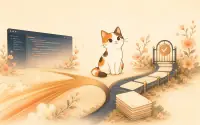
If you want to make your own LINE stickers but feel like “I can’t draw, so I can’t launch them,” this article is written for you. It walks through topic brainstorming, character design, tools, and submission. The focus is not on becoming an illustrator, but on handing visual production to tools and templates while you invest in topic, character, and workflow choices.
This guide uses ordinary static stickers as its example. Under the current LINE Creators Market creation guidelines, a set may contain 8, 16, 24, 32, or 40 stickers. Sixteen is used here as a manageable starting point, not as a platform requirement. Recheck image and review requirements before submission because policies can change.
Quick Overview of the Unorthodox LINE Sticker Launch (TL;DR)
- Target Audience: Creators who aren’t good at drawing, want to try LINE stickers as a side project, but are intimidated by the publishing process.
- Mindset Shift: Stop focusing on drawing skills, and focus on “who will use it,” “in what situations,” and “how to efficiently finish 16 stickers.”
- Core Implementation: First, lock in the audience and characters, then list at least 16 common chat phrases, and finally decide on the visual style and tools.
- Drawing Strategy: Use geometric figures, simple animals, processed photos, or AI drafts to unify a set of styles, without pursuing exquisite details.
- Process Optimization: Leave resizing, naming, and packaging to tools; focus only on selecting and adjusting images.
- Launch Essentials: Avoid common reasons for rejection like messy titles, sensitive content, and image edge flaws to pass the review smoothly.
- Future Operations: Treat the first set as practice to learn the complete launch process, and experiment with multiple topics to accumulate long-tail income and IP assets.
Why “Unorthodox”? Breaking Down the Real Barriers
When it comes to LINE stickers, many people’s first reaction is:
“My drawing skills aren’t good enough, forget it.”
This statement actually confuses two things:
- How good the drawing is (Technical barrier)
- Whether it can be published and if people will buy it (Commercial barrier)
The route this article will take you on is an “unorthodox” one:
- Don’t strive to be an illustrator, and don’t compete with professional artists on details.
- Outsource drawing skills to models.
- Focus your effort on: topic, character settings, and process efficiency.
In other words, we are not abandoning quality, but shifting the battlefield: From “how great the drawing is” to “how right the topic is and how smooth the process is.”
Face Reality: What Really Gets People Stuck with LINE Stickers?
Let’s quickly align on a few key facts:
- Fixed Specification Requirements:
- Standard static stickers: At least 8 images, most creators make 24 or 40.
- Each image must meet the width, height, resolution, and file size limits.
- You also have to make a main image and a chat room icon (tab image).
- The Process is Tedious and Prone to Errors: Naming conventions, resizing, export formats, zip files… a mistake in any step can lead to rejection.
- What really takes time is often not the “drawing” itself, but “production line management”.
So many people get stuck at:
- After genuinely drawing 8 to 40 images, they are exhausted and have no energy left for formatting.
- File naming becomes a mess, and a few days later, they can’t tell which image is the latest version.
- Checking official specs while scaling and compressing images, making mistakes, and starting over.
This is why there is room for the “unorthodox” route: As long as you are willing to use tools and a bit of process design, you can cut out 60% of the pain.
”Unorthodox” Mentality: Outsource Drawing, Put Brainpower into Topics and Characters
First, adjust your mindset:
- Knowing how to draw ≠ It will sell well.
- Not knowing how to draw ≠ It definitely can’t be published.
For most side-project creators, the key to stickers is actually three things:
- Topic: Whose daily life are you talking about? Office workers? Geeks? Cat lovers? Remote workers?
- Character: Is there a protagonist that can be recognized at a glance? (It doesn’t have to be drawn in detail, but it must be consistent.)
- Situational Phrases: Can this set of stickers actually be used for chatting, rather than just as a collectible?
If you do these three things well, even if the art style is very simple (or even just geometric shapes + text), it still has a chance to be loved and used.
As for the drawing aspect, I would suggest you:
- Use simple geometric shapes + limited color palettes to build characters (round face, square body, simple lines for limbs).
- Use processed photos, AI generation, or stock assets as a base, then unify the style.
- What truly needs to be accumulated over time is not brushstrokes, but sensitivity to topics and usage scenarios.
“Unorthodox” doesn’t mean messing around; it means:
Investing limited time in “high-leverage” positions.
From 0 to Launch: The Unorthodox LINE Sticker Roadmap
The following route assumes you have no background as an illustrator but are willing to put in the effort to create your first set of stickers.
Step 1: First Decide “Who” Will Use These Stickers
Don’t open your drawing software yet. Get a pen and paper, and answer three questions:
- Who is this set of stickers for? (The more specific, the better)
- What emotions or keywords do they use most often in daily chats?
- What is the vibe this set of stickers wants to convey? (Furious, lazy, healing, sunny…)
Example:
- Target Audience: Office workers constantly chased by KPIs.
- Key Emotions: Exhausted, endless meetings, broke at the end of the month, pretending to be optimistic.
- Vibe: Smiling on the outside, dark humor of a collapsing inner world.
This step determines the direction of all your subsequent images and text.
This article uses the unorthodox little cat from the beginning of the article as an example, creating a set of stickers with the theme of a “Chuunibyou (Eighth-Grader Syndrome) Kitten”.
Step 2: List 16 Common Situational Phrases
Create a list with at least 16 conversational phrases that are “common, funny, and practical” for your target audience, such as:
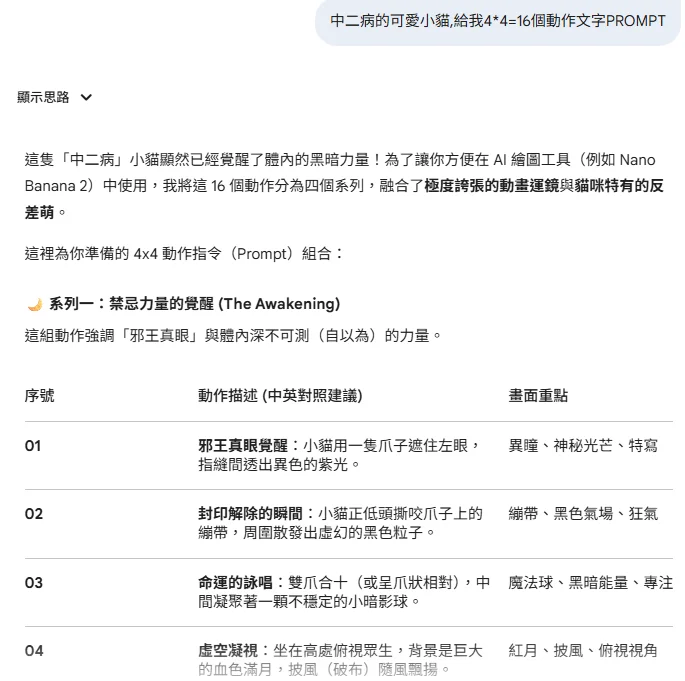
| No. | Action Description (Bilingual suggestion) | Visual Focus |
|---|---|---|
| 01 | Tyrant’s Eye Awakening: The kitten covers its left eye with one paw, a heterochromatic purple light shining through its fingers. | Heterochromia, mysterious light, close-up |
| 02 | Seal Released: The kitten looks down, tearing at the bandage on its paw with its teeth, surrounded by illusory black particles. | Bandage, dark aura, madness |
| 03 | Incantation of Fate: Paws pressed together (or facing each other like claws), an unstable little shadow ball condensing in the middle. | Magic ball, dark energy, focus |
| 04 | Void Gaze: Sitting high up looking down at the masses, background is a giant blood-red full moon, a cape (rag) fluttering in the wind. | Red moon, cape, top-down view |
(The table above only lists the first 4 examples. When implementing, please prepare at least 16 phrases.)
Principles:
- Prioritize phrases you would actually use yourself.
- Avoid overly long sentences; reading burden increases in chat bubbles.
- Mix and match in the same sticker set: questions + roasting + inner monologue + strong emotional words (like “breakdown”).
Step 3: Use LLMs to Assist in Generating Situational Phrases
You can brainstorm the phrases yourself or use LLMs to help generate them; this article uses Gemini generating 16 situational phrases as an example.
Step 4: “Outsourcing Drawing” —— Use Models to Generate Images
Following the situational descriptions generated by Gemini above, enter the following prompt into the chat:
Based on the prompt above, generate a 4x4 sprite sheet, without adding text, with a solid green screen background for easy background removal, and no borders.Generated images:
| Original | Background Removed |
|---|---|
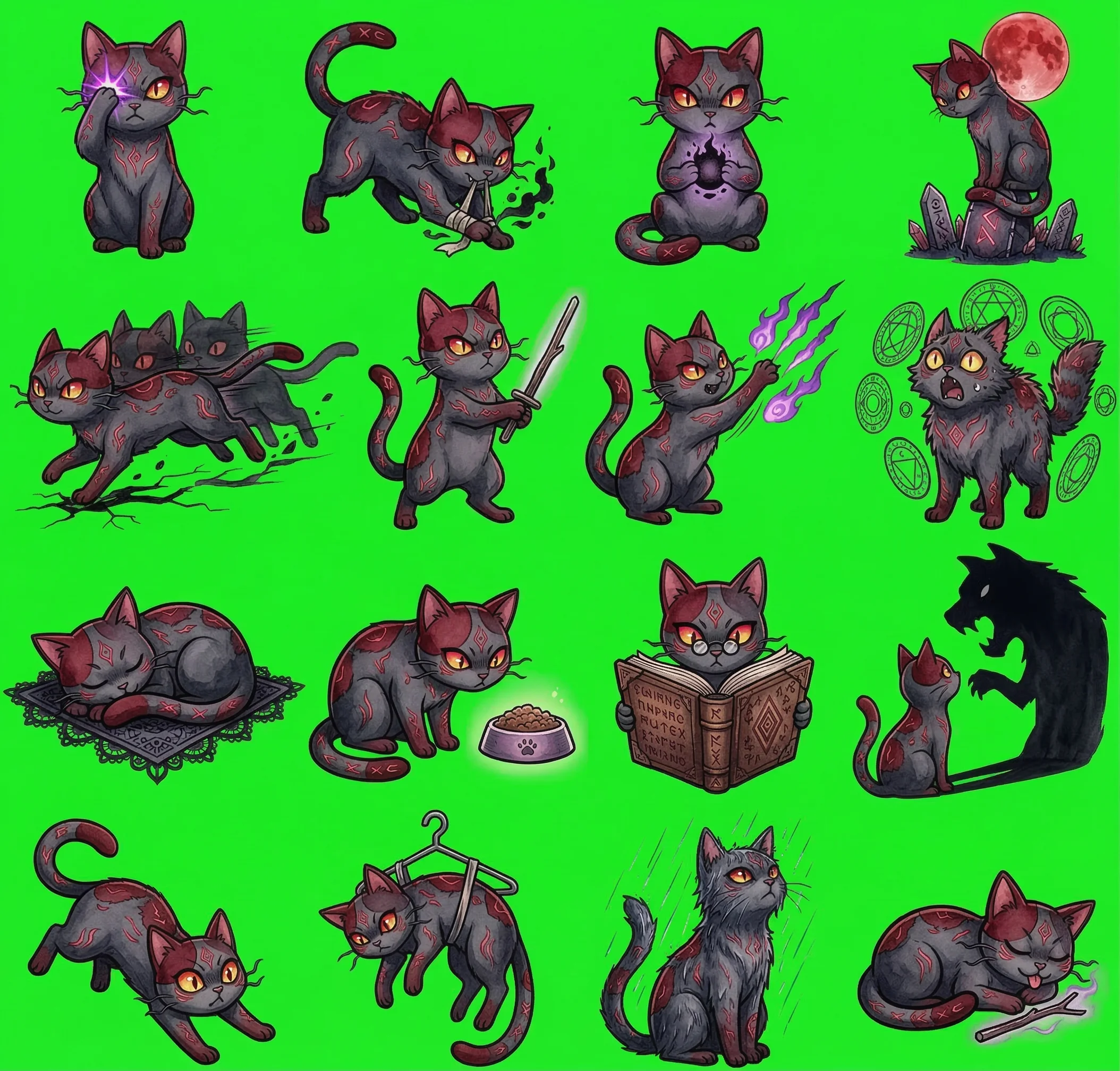 | 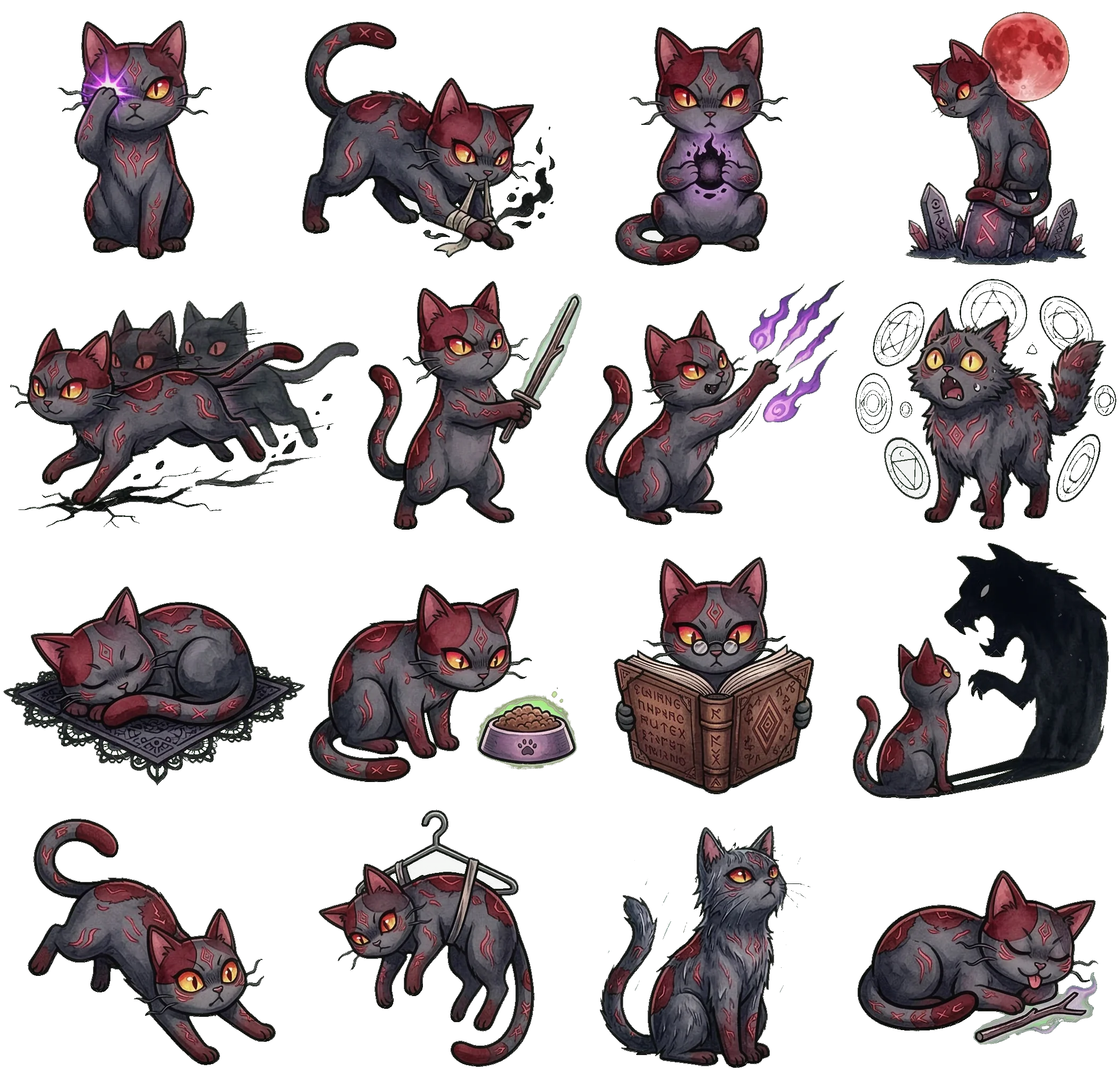 |
The complete Gemini conversation process can be found at: https://gemini.google.com/share/088a5cfae0b8
Step 5: Use Tools to Handle Resizing, Naming, and Packaging (The True Core of Unorthodox Methods)
When you’ve finished 16 (or more) images, the part that really causes breakdowns has just begun:
- Resize each image to the correct dimensions.
- Rename files to
main.png,tab.png,01.png… - Package into a ZIP file that meets LINE’s specifications.
Doing all this manually once will make you question your life. Therefore, it is highly recommended that you make good use of tools to automate this part.
You can:
- Use scripts/batch processing you are familiar with (like ImageMagick, Photoshop Actions, etc.).
- Or refer to the open-source tools introduced on this site:
- line-sticker-packer: One-click resizing and packaging one of the tools introduced.
- sprite-animator, stickermind related workflows can also help handle asset slicing and management.
Detailed descriptions of these tools can be found in the LINE Sticker Tools Section of the website with complete illustrations and use cases:
Handing over “resizing and naming” to tools, so “you only focus on choosing which images make the final cut,” is the true essence of the unorthodox method.
Step 6: Launch on the LINE Creators Market, Avoid Common Pitfalls
When you have:
- Main image
- Chat room icon (tab image)
- N main stickers (8 / 16 / 24 / 32 / 40)
- Correct sizes and naming
You can then log into the LINE Creators Market backend and start the launch process. Here are a few reminders of common pitfalls:
- Title and Description:
- Must match the content, avoid overly exaggerated keywords or those unrelated to the actual stickers.
- It is recommended to point out who the sticker set is suitable for and in what situations it is useful in the description.
- Avoid Sensitive Content:
- Violence, discrimination, and adult content can lead to review failure.
- Dark humor is fine, but don’t cross the policy line.
- Double Check Transparent Backgrounds and Edges:
- Ensure the stickers have no weird white edges or ghosting.
- Be especially careful with the edge noise of AI-generated images.
Title and Description Example:
| Item | English | Traditional Chinese |
|---|---|---|
| Title | Rune Cat: Shadows of the Abyss | Rune Cat: Shadows of the Abyss |
| Description | A mysterious black cat covered in ancient runes from the abyss. Perfect for expressing your cool, edgy, or mysterious side in every chat! | A mysterious black cat from the abyss, covered in ancient runes. Cool and stylish — great when you want to look mysterious, aloof, or a little theatrical. Let the rune cat speak the dark moods you can’t put into words! |
After submitting for review, you can quietly wait for the result. This is also why I recommend making a “small but complete” work first: You will truly complete an end-to-end process once, and every subsequent set will be faster and faster.
After finishing a set like this, you will find:
- You didn’t actually use very complex drawing skills.
- What really takes time is “thinking of phrases” and “choosing which images to keep”.
If you want to see actual launch results and presentations, you can browse the LINE Sticker section of this site, and observe how each set of stickers expands on topics and characters:
- LINE Stickers Overview
- For example:
- mushroom-girl-floral-daily —— A daily style mushroom girl
- energetic-girl —— An energetic character design
You don’t need to copy the art style of any set, but you can learn “how topics are focused” and “how characters remain consistent across multiple images”.
Commercial Reality: Don’t Treat the First Set of Stickers as a Get-Rich-Quick Scheme
As a side project, LINE stickers have a few cruel but important realities:
- Most sticker income is long-tail, small amounts, and slow.
- The probability of a single set going viral is not high; more often it’s accumulated by a “combination of multiple sets”.
- What takes a long time is not the production, but the process of “being seen” and “being used”.
A healthier mindset is:
- Treat the first set as tuition to learn the complete launch process.
- For each subsequent set, experiment with different topics: office workers, cats, couples, remote work…
- Trade quantity and consistency for your market sensitivity.
If you already run a community, blog, or YouTube, you can:
- Treat the stickers as part of the content (e.g., use your own sticker characters for illustrations in articles).
- When the stickers launch, write a behind-the-scenes piece like this, sharing your production process.
Stickers don’t have to be your main source of income, but they can be:
- Your IP business card
- Your portfolio entry point
- The most lightweight form of interaction between you and your fans or users.
Conclusion: Your First Unorthodox Sticker Set Starts Here
Summarizing the whole article into an actionable route:
- Pick a group you are familiar with (office workers, students, cat lovers…), and write a one-sentence character introduction.
- List at least 16 chat phrases this group would “actually use” (can use LLMs for assistance).
- Use geometric figures, simple animals, or AI-generated images to create 16 character images with a consistent style.
- Use tools (or the LINE sticker tools introduced on this site) to handle resizing, naming, and packaging.
- Log in to LINE Creators Market and submit under the current creation and review guidelines.
- After passing the review, use your own community or content to slowly build opportunities to be seen.
If you want to further optimize the production line and reduce repetitive labor, you can look back at this site’s:
- LINE sticker tools and open-source workflows
- Published sticker examples
- For another AI image generation and human-editing workflow, see the BloomRender manual; you still need to verify asset rights and LINE review eligibility.
- If you plan to expand one character into many variants, continue with the Nano Banana 2 Lite specs, costs, and adoption limits and test consistency with a fixed character set.
- Official process: registration, review, and release; official specifications: Creation Guidelines
You don’t have to become an illustrator first; you can also step into the world of LINE stickers in a very “unorthodox” way. What truly determines how far you go is not your drawing skills, but whether you are willing to: Run experiment after experiment, letting your characters, topics, and processes grow together.
Related engineering notes
- Cloud & Platform How to Use Zellij: Shortcuts, Clipboard, and Sessions A current-default reference for Zellij Pane, Tab, Resize, Scroll, Session, clipboard, and mouse operations, including the impact of custom keybindings.
- Cloud & Platform Efficient Academic Paper Reading: The Three-Pass Approach Turning the 'three-pass reading method' into an actionable workflow: 5–10 minutes for screening, 1 hour to grasp methods and evidence, and 'virtually re-implementing' to master details. This article integrates Keshav's three-pass method with Mu Li's practical tips, complete with a checklist and literature review guide.
- AI Engineering AI Software Development Environments: Choosing Between Vibe Coding and Verified Agent Workflows InfoWorld surveys GitHub Copilot, Google Antigravity, JetBrains Air, Kiro, Zed, and Zenflow; this article turns that tour into a selection framework based on autonomy, context, isolation, and verification.