Engineering note
Modern LLM Architecture Comparison: Memory and Routing Trade-offs from DeepSeek V3 to Kimi K2

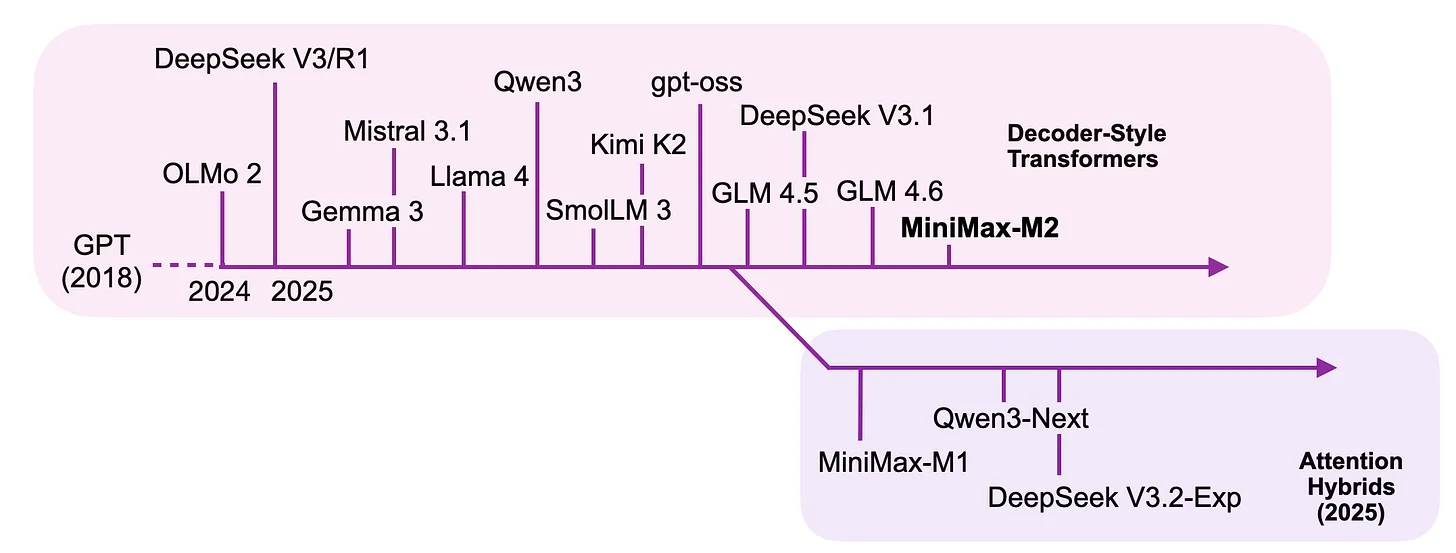
While it has been several years since the original GPT architecture was introduced, the core of contemporary models might look superficially similar. However, if we closely examine the flagship models released in 2025 and 2026 (such as DeepSeek V3, Llama 4, Gemma 3, and Kimi K2), we find that underlying architectures have undergone subtle yet critical evolutions.
Adapted from Sebastian Raschka’s comprehensive analysis (original article), this article breaks down the engineering choices behind today’s leading open-weight models. Why do some models rely heavily on Mixture-of-Experts (MoE)? Why are others redesigning their attention mechanisms and normalization layouts? Let’s dive in.
1. DeepSeek V3’s Efficiency Double-Edged Sword: MLA and MoE
DeepSeek V3 (and its subsequent reasoning offshoot, DeepSeek R1) made waves in the open-source ecosystem largely due to its remarkable computational efficiency. This efficiency is driven by two core techniques: Multi-Head Latent Attention (MLA) and Mixture-of-Experts (MoE).
1.1 Multi-Head Latent Attention (MLA)
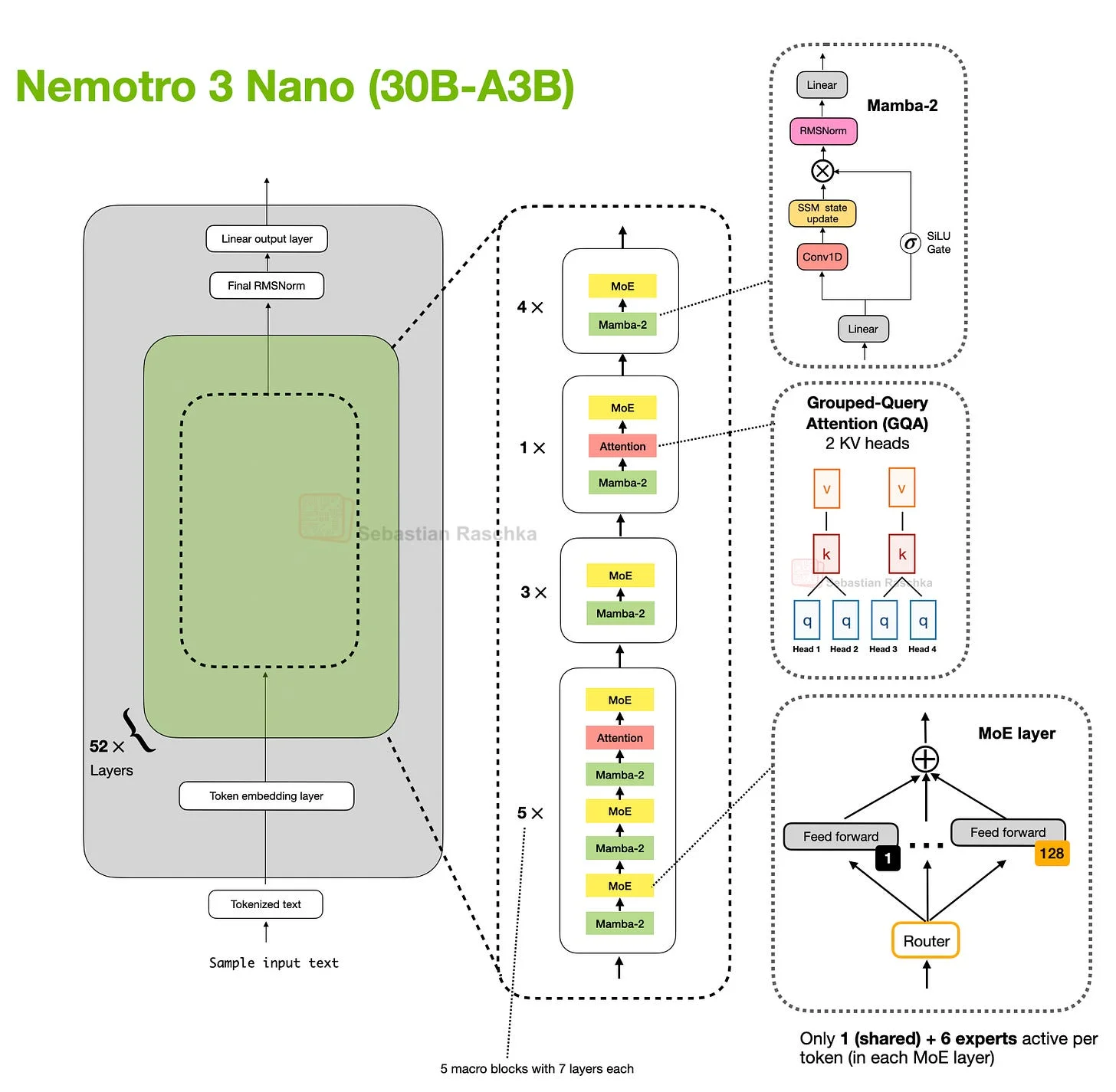
Traditional Multi-Head Attention (MHA) consumes an enormous amount of memory for KV Caching during inference. Historically, Grouped-Query Attention (GQA) mitigated this by having multiple query heads share the same KV heads (e.g., grouping 4 attention heads to share 2 KV groups) to reduce memory bandwidth usage.
DeepSeek V3, however, discarded GQA in favor of their proprietary MLA. Instead of a “sharing” strategy, MLA compresses Key and Value tensors into a lower-dimensional latent space, stores them in the KV cache, and only projects them back to their original dimensions during inference. Studies show this not only saves memory but can even slightly outperform standard MHA and GQA in ablation benchmarks.
1.2 Mixture-of-Experts (MoE) and the Shared Expert
DeepSeek V3 boasts a massive 671 billion parameters, but only activates around 37 billion parameters during inference. It achieves this by replacing the standard FeedForward module with a vast network of experts.
Each of its MoE modules contains 256 experts, routing tokens to just 8 experts at a time, plus 1 permanently active Shared Expert. The Shared Expert absorbs general syntax and foundational logic, leaving the remaining 256 routed experts with more capacity to learn highly specialized, domain-specific knowledge without redundancy.
2. A Compact Engineering Masterclass: OLMo 2 and Gemma 3
While OLMo 2 and Gemma 3 do not boast the staggering parameter counts of DeepSeek, their architectural refinements are textbook examples of efficient design.
2.1 OLMo 2’s QK-Norm and Post-Norm
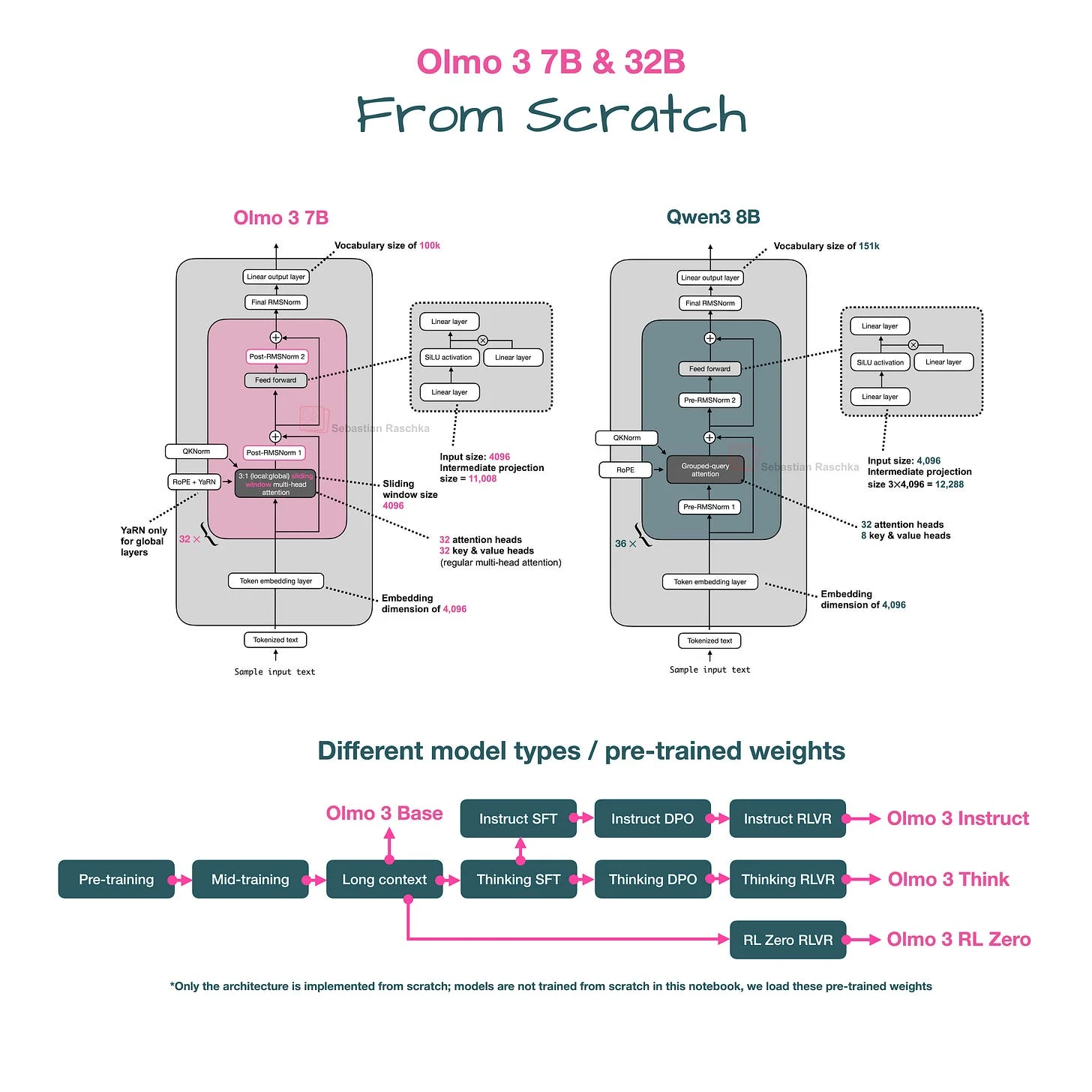
To stabilize training, OLMo 2 adopted a variation of Post-Norm (Post-LN). While the original GPT and Llama families popularized Pre-Norm to ensure stable gradients at initialization, Pre-Norm can suffer from performance degradation in extremely deep networks.
OLMo 2 placed the RMSNorm layers after the Attention and FeedForward modules (though still within the residual connections). Furthermore, they introduced a QK-Norm before the Query and Key dot product. Together, these tweaks effectively smooth out gradients and heavily reduce the risk of training collapse during long-horizon optimization.
2.2 Gemma 3’s Sliding Window Attention
Instead of reducing active parameters like MoE, Gemma 3 solves the computational explosion associated with long-context attention. Gemma 3 mixes Global Attention with Local Attention at a 1:5 ratio. This means only 1 out of 6 layers uses global attention, while the other 5 use a sliding window attention restricted to a 1024-token context. Experiments prove this dramatically cuts down KV Cache usage with minimal impact on generation quality.
3. The Design Philosophies at the Trillion-Parameter Scale
When evaluating even larger models like Qwen3, gpt-oss, Kimi K2, and GLM-4.5, we see clear architectural divergence, particularly around the trade-offs between depth vs. width and expert count vs. expert size.
3.1 Width (gpt-oss) or Depth (Qwen3)?
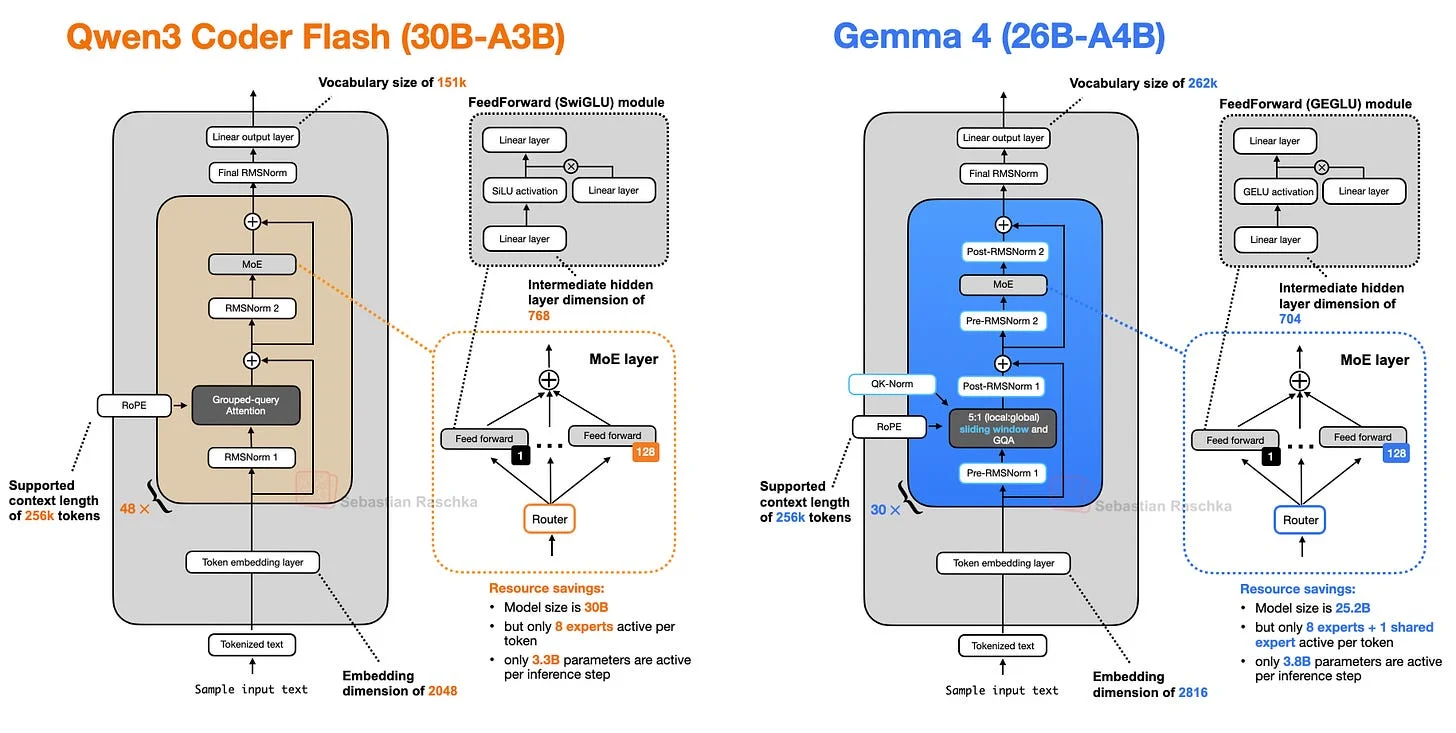
- Qwen3 (30B/235B) leans towards a deeper architecture (e.g., using 48 Transformer blocks). Deeper architectures often yield more complex logical compositions but can suffer from unstable gradients and optimization difficulties during training.
- gpt-oss (20B/120B) opted for a wider architecture. It features only 24 Transformer layers but dramatically increased its embedding dimension to 2880, while also widening the intermediate projection layers. Wider models are generally easier to parallelize across hardware during inference, leading to a much higher
tokens/secgeneration throughput. Furthermore, gpt-oss resurrected the GPT-2 era Attention Bias and introduced “Implicit Attention Sinks.” Instead of prepending actual dummy tokens to absorb useless attention scores, gpt-oss adds a learnable per-head bias logit directly into the attention mechanism to stabilize long-context processing.
3.2 Expert Configurations: Few and Large vs. Many and Small
- Qwen3 and DeepSeek V3 favor a massive number of small experts (e.g., 128 or 256).
- gpt-oss and Grok 2.5 lean toward a handful of massive experts (e.g., just 8 or 32). In gpt-oss, only 4 massive experts are activated during inference, compared to Qwen 3’s 8 active experts. This design is explicitly meant to squeeze maximum utilization out of GPU memory bandwidth constraints.
3.3 GLM-4.5’s Pre-MoE Dense Layers
GLM-4.5 is another trillion-parameter contender whose design philosophy strongly echoes DeepSeek V3 (employing both MLA and MoE). However, it made a very specific tweak in the early stages of the network.
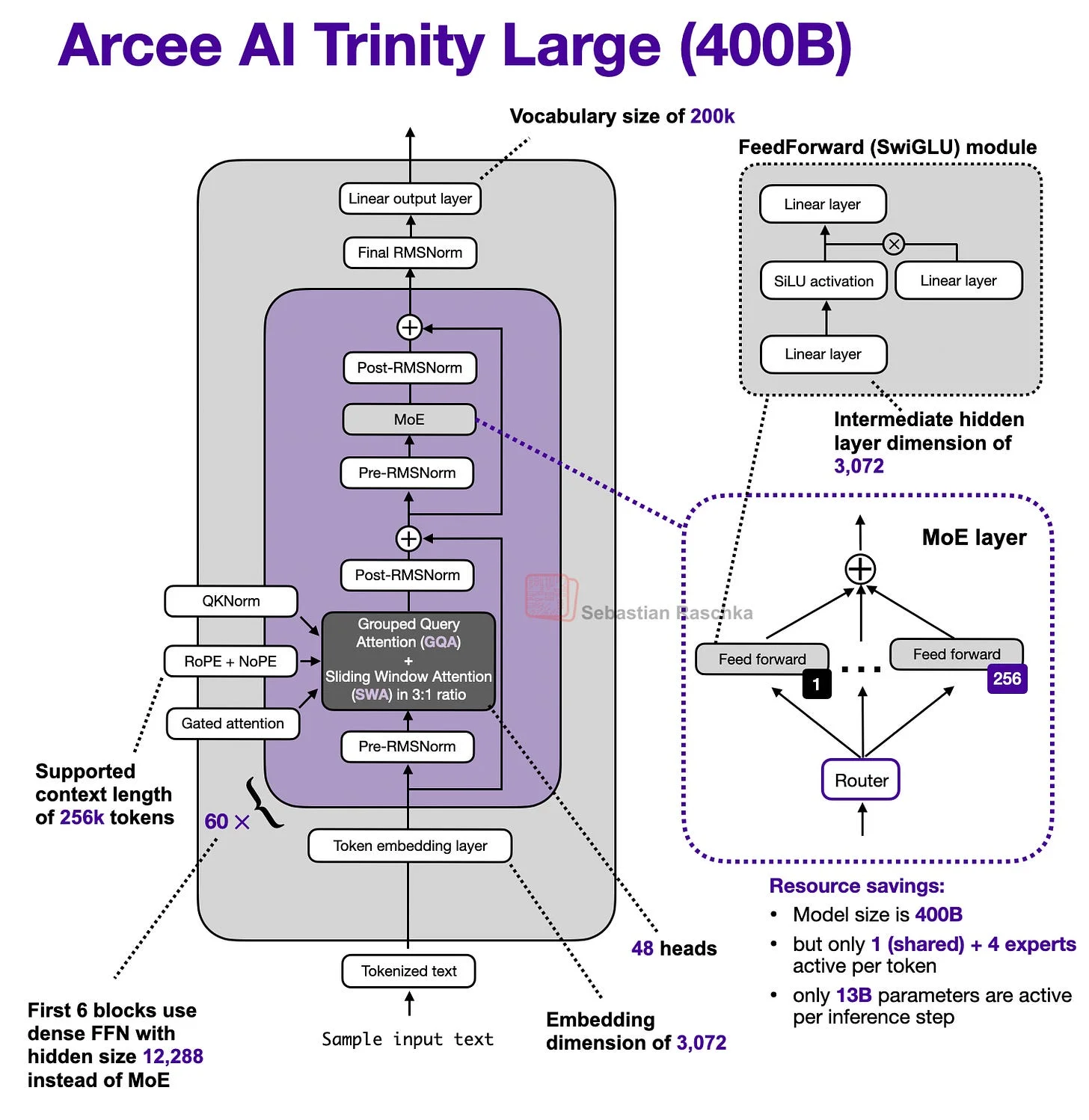
Before routing tokens into the MoE sparse blocks, GLM-4.5 deliberately retains 3 traditional Dense layers. The engineering rationale here is that massive MoE systems often suffer from unstable feature extraction early in training due to the randomness of sparse routing. By keeping the initial layers dense, the model forms a solid foundation for syntactic and semantic feature extraction before handing off high-level logic to the MoE routing mechanism.
3.4 Mistral Small 3.1’s Latency Trade-offs
If Gemma 3 chose to push memory compression to its limits via a 1:5 “sliding window attention” ratio, Mistral Small 3.1 walked the opposite path, obsessively optimizing for low latency. Mistral entirely abandoned its previously championed sliding window attention, reverting to standard Grouped-Query Attention (GQA). While this theoretically increases KV cache memory overhead, reducing the layer count and relying heavily on highly optimized, native backend kernels (like FlashAttention) allows Mistral to achieve significantly faster generation speeds than Gemma 3.
4. SmolLM3 and the Surprise of No Positional Embeddings (NoPE)
Although SmolLM3 is a relatively compact 3-billion-parameter model, its architectural experiments are highly instructive. The most striking design choice is its partial abandonment of traditional positional encodings (like RoPE) in favor of NoPE (No Positional Embeddings).
Historically, Transformers required absolute or relative positional encodings to understand word order. However, NoPE proves that by relying solely on the Causal Attention Mask, the model can implicitly learn sequence directionality. More importantly, NoPE has been shown to significantly improve “Length Generalization”—meaning its performance degrades much slower when confronted with inference sequences longer than its training context. SmolLM3 applies NoPE in every 4th layer, paving a new path for long-context processing in lightweight models.
5. Kimi K2: The Trillion-Parameter Behemoth and Muon Optimizer
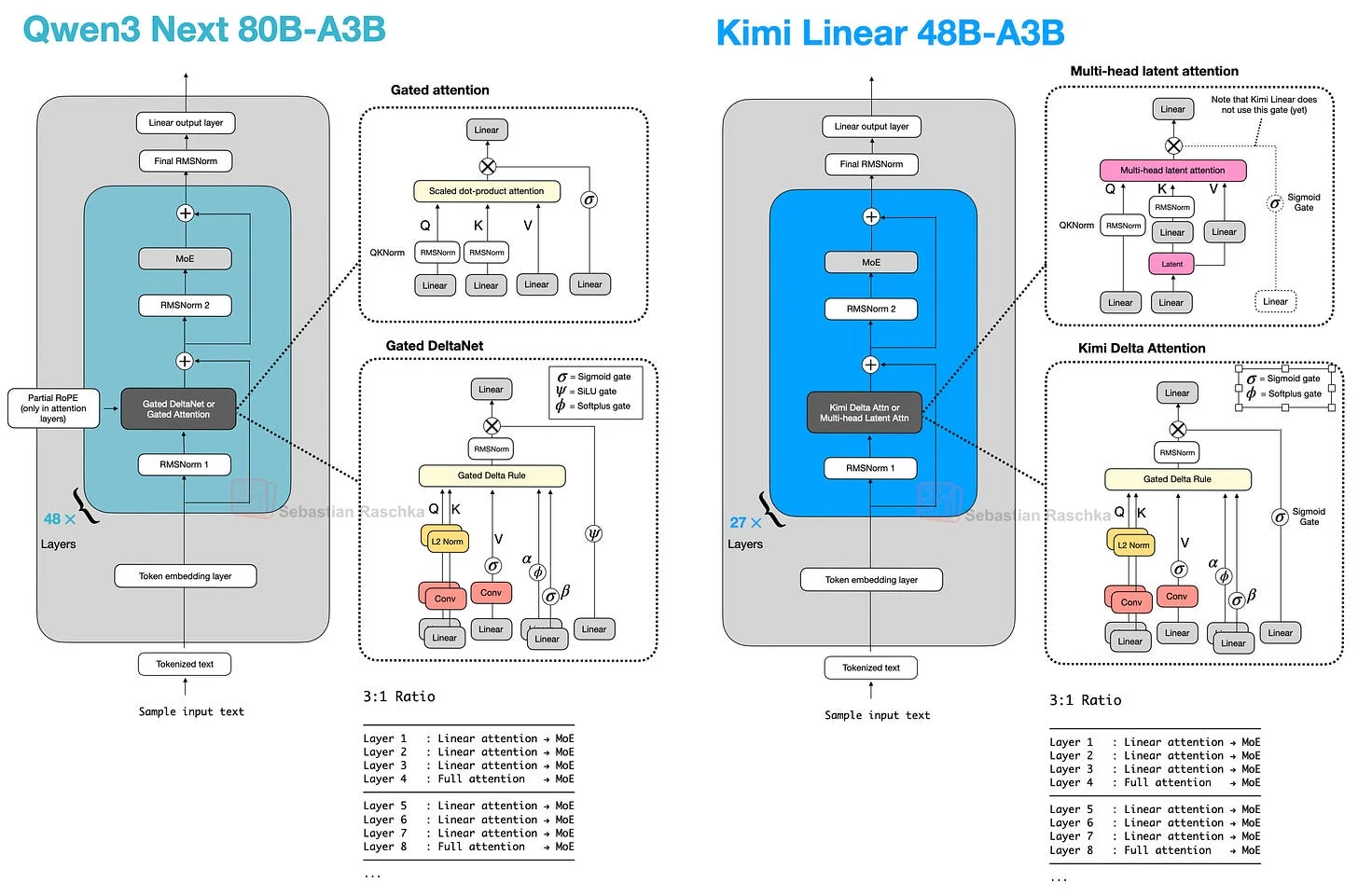
Scaling back up to massive models, Kimi K2 stunned the community with its 1-Trillion parameter scale. Its foundational architecture is essentially a scaled-up version of DeepSeek V3 (employing both MLA and MoE), but it features a major breakthrough in training engineering: ditching the industry-standard AdamW for the Muon optimizer.
This marks the first time Muon has been proven to stabilize convergence at the hundred-billion or trillion scale (it was previously only verified up to 16B). Muon yielded an exceptionally smooth and rapidly decaying training loss curve, which is the underlying reason Kimi K2 is able to rival proprietary models like GPT-4 and Claude 3.5 in modern benchmarks.
Conclusion and Future Outlook
Looking at the leap from 2025 to 2026, LLM architectures have shifted from a blind pursuit of “parameter stacking” to a highly compromised yet perfectly optimized art form tailored for hardware and memory bandwidth. Novel experiments like NoPE (No Positional Embeddings) on SmolLM3, and the revival of Attention Bias and Attention Sinks in gpt-oss, prove that architectural evolution is still full of surprises.
In the short term, we will likely continue to see a polarization between “massive behemoth models” (like Kimi K2) and “on-device micro models” (like Gemma 3n). Will we soon see a new foundational design that completely upends the rules of the game like the Transformer did? We will just have to wait and see.
References / Source Article
- Original Analysis: Sebastian Raschka. “The Big LLM Architecture Comparison.” Ahead of AI. https://magazine.sebastianraschka.com/p/the-big-llm-architecture-comparison
If you are building enterprise agent infrastructure, architecture can inform estimates for KV cache, active parameters, and kernel compatibility, but it does not directly determine GPU count. Capacity must still be measured at the target context length, quantization format, batch strategy, and serving stack.
To understand the limitations of long-horizon reasoning that these models face, refer to our What Is AgentEscapeBench: Measuring Out-of-Domain Tool Reasoning.
Further reading
- GPT-5.6 Architecture Analysis compares the efficiency narrative and evidence boundaries of a closed model.
- Kimi-K3 Enterprise Deployment TCO turns model scale into GPU, electricity, and operational costs.
- Running Kimi-K3 on 80 RTX 5090 GPUs examines memory, interconnect, and reliability limits of consumer hardware.
(Insights and architectural benchmarks synthesized from Sebastian Raschka’s deep dive.)
Related engineering notes
- AI Engineering Kaggle Titanic: From 0.74 to 0.816, Feature Engineering Outperforms Parameter Tuning A complete practical record of the Titanic survival prediction competition: progressive feature engineering, CatBoost and RF ensembling, decoupling CV from Public LB, strict notebook porting, and knowing when to stop. Final Public LB 0.81578.

- AI Engineering Kumo Tabular: Pretrain on Synthetic Tables, Learn New Tasks from Examples NVIDIA Kumo Tabular reframes prediction as in-context learning: a model pretrained on synthetic tables predicts new rows from labeled examples. We examine its method, vendor-reported leaderboards, and enterprise validation requirements.

- AI Engineering GraphRAG In-Depth Analysis: How to Build Smarter AI Retrieval Workflows Using Knowledge Graphs? Explore the highlights of Cassie Shum's talk at QCon AI. Learn from the ground up how GraphRAG solves enterprise RAG pain points through Global Context, Multi-hop Reasoning, and Cypher queries, with practical architectural implementations.