Project note
Receipt OCR API
PaddleOCR · YOLOv7 · Hospital Receipt Structuring · End-to-end Normalization
ENGINEERING CASE STUDY · DOCUMENT INTELLIGENCE
Engineering case study
Converting receipts across hospitals, layouts, and scan conditions into one JSON contract that downstream systems can consume.
Problem & constraints
Problem
Medical receipts vary in layout, labels, table structure, and image quality. Raw OCR can read text but cannot preserve field meaning, monetary relationships, or a stable API format.
Constraints
- Inputs include scans and phone photos with skew, shadows, perspective, and low contrast.
- Hospitals use different labels, table positions, and fee categories.
- Insurance type, dates, totals, and line items must retain their relationships.
- A new hospital must plug in without rewriting the recognition pipeline.
Architecture & decisions
System flow
- 01 Image input Scanned receipts · phone photos
- 02 Image correction UVDoc · deskew · shadow removal · OpenCV
- 03 Layout detection YOLOv7 Stage 1 · region cropping
- 04 Text and table OCR PaddleOCR · YOLOv7 Stage 2
- 05 Hospital normalization HospitalPipeline · regex config · field mapping
- 06 Structured output Unified schema · API-ready JSON
Technology decisions
YOLOv7 + PaddleOCR
Detecting layout regions before OCR preserves field and table order better than reading the full receipt at once.
UVDoc + OpenCV
Treats perspective, skew, and shadows as engineering problems before recognition.
HospitalPipeline
Isolates hospital variation in configuration, regex, and mappings while keeping the core pipeline stable.
Fixed JSON contract
The pipeline is designed backward from what API consumers need, not from raw OCR text.
My contribution
- 01
Designed the end-to-end path from image correction and region detection to JSON.
- 02
Implemented layout selection, field/table detection, regex, and field mappings.
- 03
Built the HospitalPipeline extension boundary for hospital-specific adapters.
- 04
Defined the downstream API schema and verified real receipts field by field.
Evaluation & outcomes
End-to-end acceptance uses real layouts from multiple hospitals. Verification covers insurance type, dates, hospital, department, totals, and line items mapped into one schema, retaining manual review for low-resolution and atypical scans.
Failures & corrections
- Failure
- Full-page OCR produced readable text but unstable field order and table relationships.
- Correction
- Added two-stage YOLO detection before OCR.
- Lesson
- Document understanding includes layout, not only character accuracy.
- Failure
- One shared regex set caused new hospital formats to break old parsing.
- Correction
- Separated each hospital into configuration, mapping, and a pipeline adapter.
- Lesson
- Fast-changing rules belong behind a stable boundary.
- Failure
- Raw OCR output could not be consumed by finance or claims systems.
- Correction
- Defined the JSON contract first, then designed normalization and acceptance fields.
- Lesson
- Integration usability matters more than whether the model can read text.
Evidence & further reading
Deep dive
Technical implementation notes
Detailed workflows, implementation decisions, diagrams, and project artifacts.Context
Medical receipts need to be integrated with financial, claims, or internal systems, but the layout and field formats vary across hospitals, making manual entry time-consuming and prone to errors. The context requires generating unified, machine-readable structured data from scanned documents or photos for direct use by downstream APIs.
Challenge
- The receipt layouts and field positions of major hospitals in Taiwan vary greatly; a single rule cannot cover them all.
- Scan quality (skew, shadows, low resolution) affects OCR recognition rates.
- Some receipts contain tables (fee details), which require block detection before field parsing.
Solution
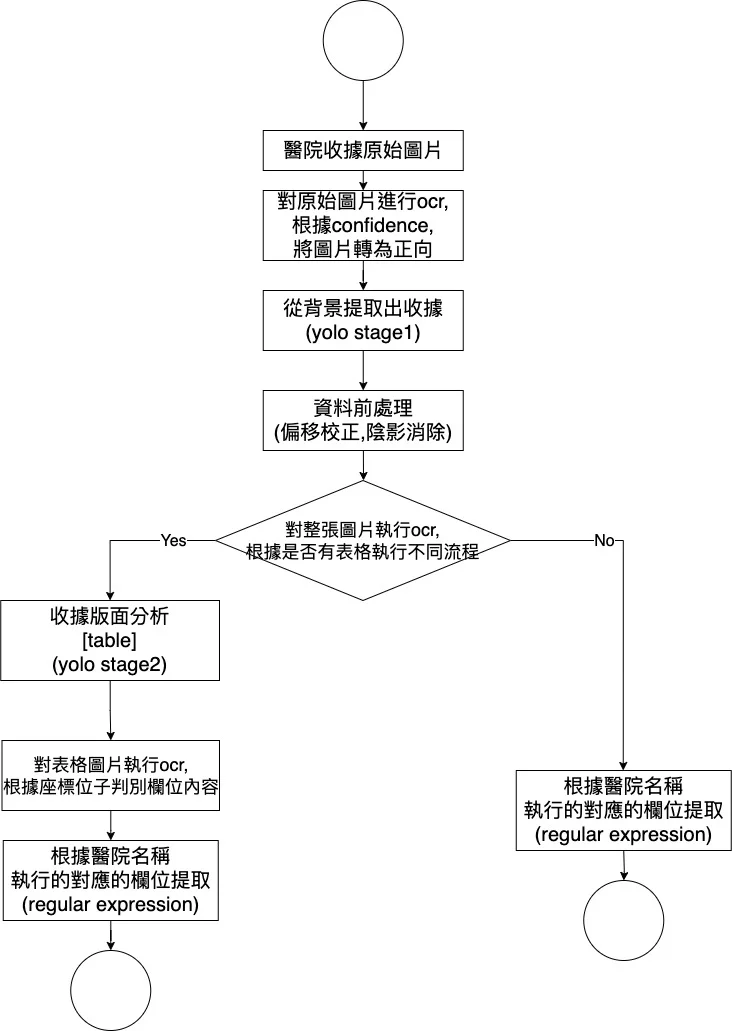
This project implements end-to-end receipt normalization: regardless of differences in scan quality or hospital layouts, it can output a unified structured JSON. The approach automatically switches between a two-stage YOLO detection and hospital-specific field parsing based on “whether a table is included,” paired with UVDoc flattening, skew/shadow correction, and PaddleOCR to reduce errors caused by image quality.
- Supports over 5 common hospitals including NTU Hospital, Chang Gung, CCH, Veterans General Hospital, and Chi Mei, using customized regex and field extraction scripts for recognition.
- Output fields include
nhi,admissionDate,dischargeDate,receivedAmount,items(fee details), etc., which can be integrated with existing APIs.
Processing Pipeline
- Image Preprocessing — Orientation detection, UVDoc flattening, shadow and noise suppression (
ocr_methods.py,correct_skew_eliminate_shadows.py,UVDoc/). - YOLO Stage 1 — Detect receipt regions (
yolov7_detect.py). - Cropping and Re-correction — If necessary, use
crop_image_from_label.pyto crop out blocks. - OCR — Use PaddleOCR (det + rec) to get the full text, and determine the hospital category based on
hospital_key.txt. - Table Detection — If a table is present, enable YOLO Stage 2 to detect table blocks.
- Hospital Pipeline — Enter the corresponding
HospitalPipeline(hospital_pipeline.py), perform field regularization and table enhancement according to the hospital (receipt_uni/info/*.py,receipt_uni/config/regex_*.txt). - Output — Convert to standard JSON with
convert_df_to_api_format.py, and output viagenerate_json_result.
When adding a new hospital, the same logic is applied: determine if a table is included → write field regex and a custom extraction script.
Pipeline and Output Examples
Processing Pipeline — The flow from image input to JSON output.
Below are RFC 8259-compliant JSON samples demonstrating unified output across hospitals (samples use de-identified test data; fields cover NHI status, admission/discharge dates, department, total amount, and fee breakdown).
NTU Hospital
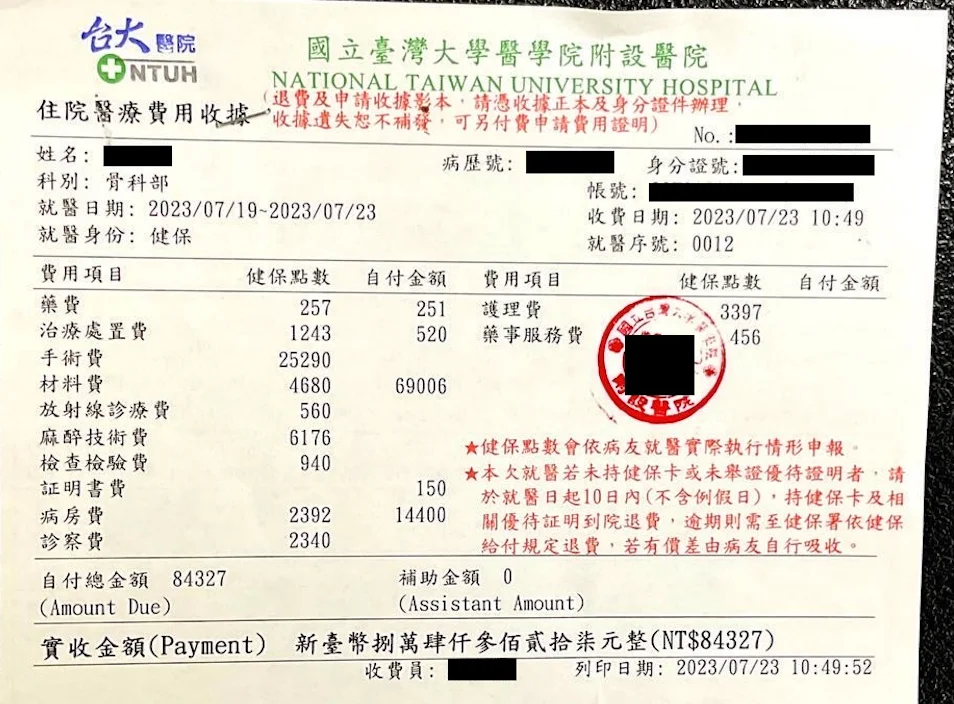
{
  "file": "ntu_sample_1.jpg",
  "result": {
    "nhi": "Y",
    "admissionDate": "2023/07/19",
    "dischargeDate": "2023/07/23",
    "hospitalName": "National Taiwan University Hospital",
    "dept": "Orthopedics",
    "receivedAmount": 84327,
    "items": {
      "medicationFee": 251,
      "treatmentFee": 520,
      "materialFee": 69006,
      "certificateFee": 150,
      "wardFee": 14400
    }
  }
}
Chang Gung Memorial Hospital
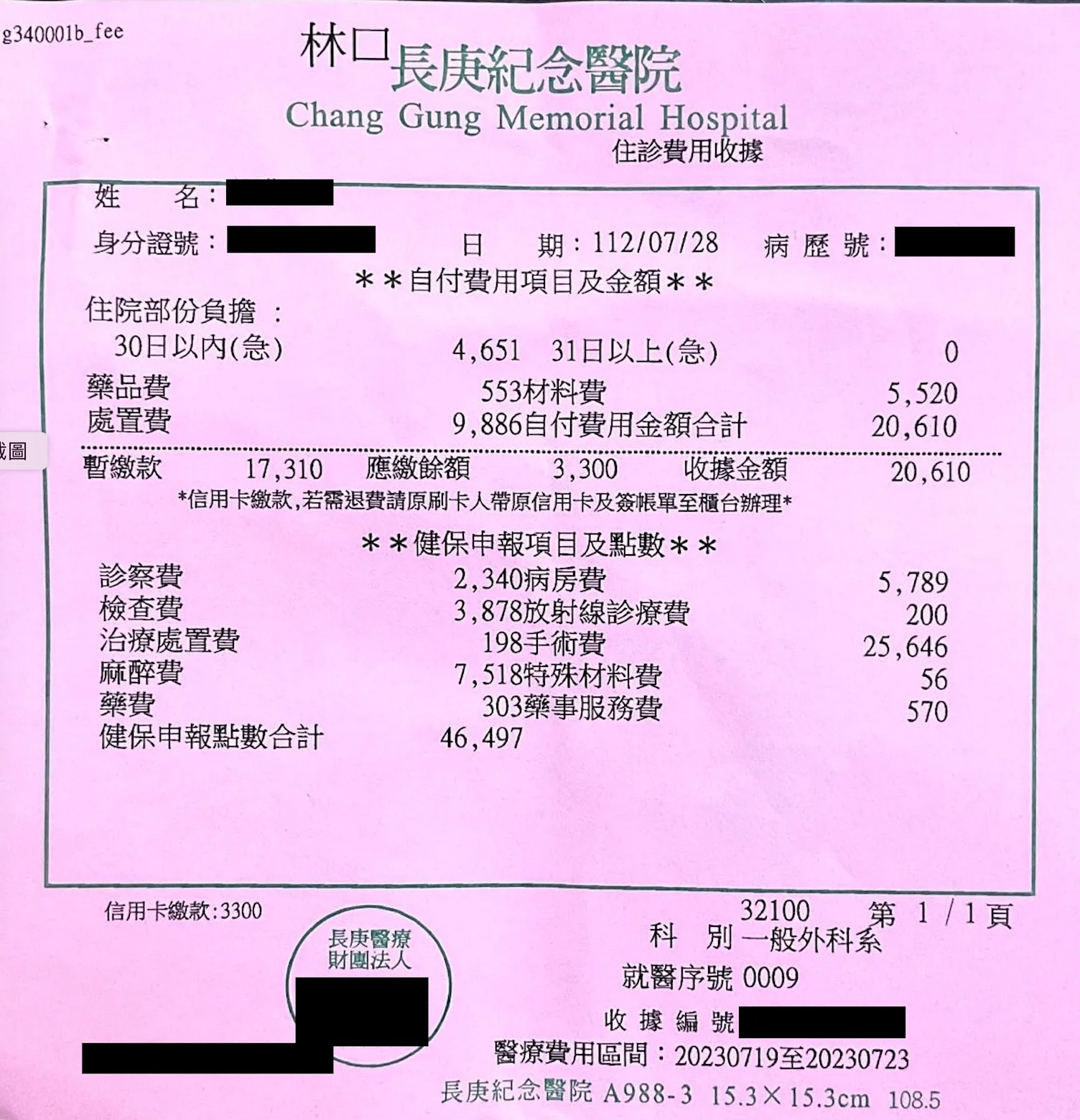
{
  "file": "cg_sample_1.jpg",
  "result": {
    "nhi": "Y",
    "admissionDate": "2023/07/28",
    "dischargeDate": "2023/07/28",
    "hospitalName": "Linkou Chang Gung Memorial Hospital",
    "dept": "General Surgery",
    "receivedAmount": 20610,
    "items": {
      "inpatientCopay": 4651,
      "medicationFee": 553,
      "materialFee": 5520,
      "procedureFee": 9886
    }
  }
}
Changhua Christian Hospital (CCH)
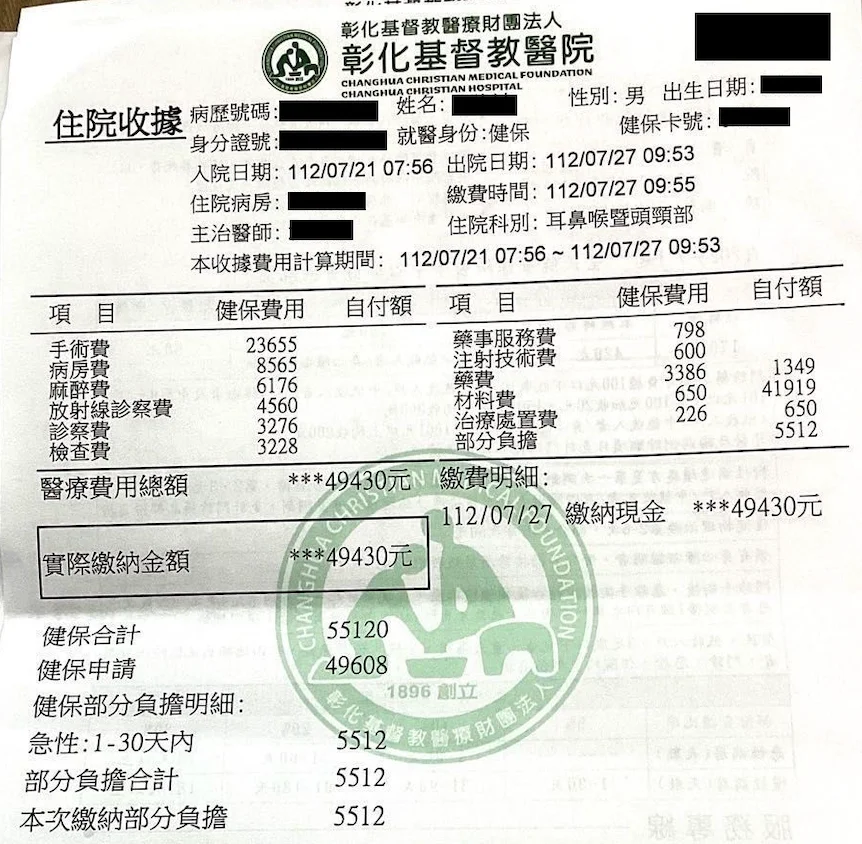
{
  "file": "ck_sample_1.jpg",
  "result": {
    "nhi": "Y",
    "admissionDate": "2023/07/21",
    "dischargeDate": "2023/07/27",
    "hospitalName": "Changhua Christian Hospital",
    "dept": "Otolaryngology — Head and Neck",
    "receivedAmount": 49430,
    "items": {
      "medicationFee": 1349,
      "materialFee": 41919,
      "treatmentFee": 650,
      "copay": 5512
    }
  }
}
Field Mapping and Manual Review Boundaries
- Field Extraction Sources:
hospitalNameis inferred from key detection;nhi,admissionDate, anddischargeDatemap to header text;deptandreceivedAmountare extracted via Stage 1 bounding boxes;itemsfee entries are extracted via Stage 2 table detection and normalized through regex mapping. - Manual Review Triggers:
- Low-resolution scans (< 150 DPI) or severe perspective distortion trigger human review flags instead of forced extrapolation.
- Arithmetic mismatch between fee items sum and
receivedAmounttriggers a validation alert. - Unregistered hospital templates or handwritten receipts are routed directly to manual review.
Tech Stack
- OCR — PaddleOCR (det / rec), Traditional Chinese weights (e.g.,
ch_PP-OCRv4_det,tw_PP-OCRv3_rec). - Detection — YOLOv7 (Stage 1 for receipt regions, Stage 2 for table blocks).
- Image Preprocessing — UVDoc flattening, deskew, shadow elimination; OpenCV, scikit-image.
- Environment — Python 3.9+; Optional CUDA GPU acceleration.
Dependencies: paddleocr, paddlepaddle-gpu, torch, torchvision, opencv-python-headless, numpy, pandas, Pillow, scikit-image, PyYAML, etc.
Expanding to New Hospitals
hospital_pipeline.pydefines the abstract classHospitalPipelineand its implementations for various hospitals (NTU, Chang Gung, CCH, Veterans General Hospital, Chi Mei, etc.).receipt_uni/info/*.pycontains hospital-specific field logic;receipt_uni/config/regex_*.txtholds mappings between fields and regex.
Suggested Steps:
- Add the hospital keyword and key to
hospital_key.txt. - Create a new parsing script in
info/andregex_<HOSP>.txt(andregex_<HOSP>_table.txtif necessary). - Implement a new class in
hospital_pipeline.py(get_ocr_result,crop_from_label,text_info,table_info, etc.). - Adjust
hospital_api_map.txtas needed.
Impact and Boundary Notes
- Format Coverage: Over 5 hospitals supported (NTU, Chang Gung, CCH, Veterans General Hospital, Chi Mei, etc.) with a single unified pipeline.
- Unified Contract: Delivers a stable schema directly consumable by downstream financial/claims APIs without layout-specific code.
- Boundary Clarification: This is a format coverage and structural normalization metric; it does not claim 100% unsupervised accuracy in production. Degraded or atypical scans retain human verification boundaries.
Extension
- Expand to more hospitals and receipt types (outpatient, clinics, long-term care receipts).
- Integrate with claims or billing workflows for one-click completion from scanning to review.
- Add accuracy monitoring and manual sampling interfaces to continuously optimize recognition and field mapping.