Agent Runtime, Security, and Effect Boundaries
Series · 1 posts
-
CONTINUITY: Keeping provenance, authorization, and tool effects continuous across Agent composition
Advanced Agent runtime, safety, and evaluationA critical reading of Zheng and Yang's CONTINUITY (arXiv:2609.05269 v1): security-context contracts, field-level provenance, transformation witnesses, and effect-bound permits for preserving an LLM Agent's instruction-to-effect boundary.
Understand it in 90 seconds
- Problem
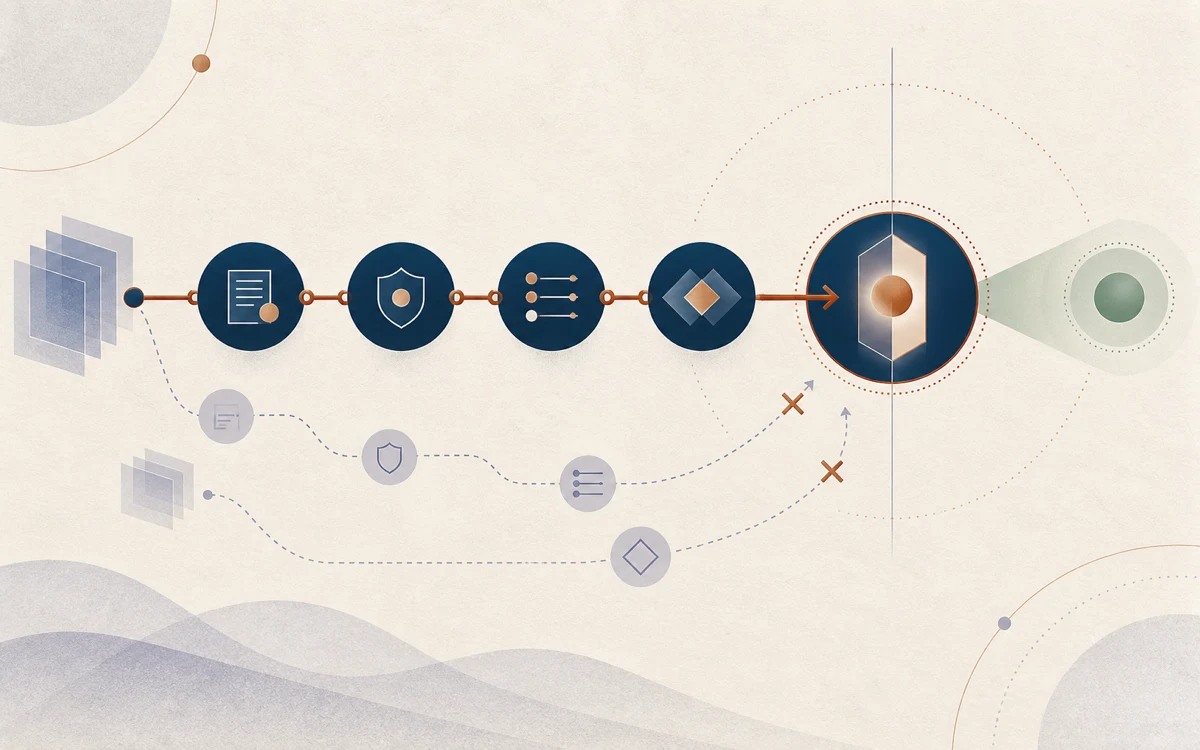
- An Agent security path rarely has one control point. Ingress may track provenance, a gateway may enforce policy, an adapter may change the protocol representation, a tool server may create an effect, and a final sink may check a permit. Each can look locally reasonable while security-critical context is truncated, amplified, rebound, or accepted in a stale or replayed form.
- Core insight
- Give every component an assume–guarantee contract, and make each transition carry verifiable evidence for its root, field provenance, release, role, transformation, and finality state. Security is not “the last signature verifies”; it is whether the effect can be traced to a complete, authorized, current, single-use witness chain (Sections 1, 5, and 6).
- Strongest evidence
- The authors generate 2,560 attack instances from 4 domains, 32 fault classes, and 20 parameterized instances per fault–domain pair, yielding 128 fault–domain classes. The full CONTINUITY configuration records 0/2,560 harmful effects, contains 128/128 classes, completes 700/700 benign tasks, and escalates 200/200 ambiguous tasks (Table 2 and Figure 3).
- Main boundary
- These are exact conformance counts over a generated fault space, not a natural attack distribution or a production attack rate. Trusted roots, validator correctness, context capture, finality sinks, and provider semantics sit in the TCB or deployment assumptions; the artifact is not a production MCP, A2A, OWASP ACS, or cloud-IAM integration (Sections 3, 8.1, and 12).
For speaking invitations, internal engineering sessions, or architecture exchange, see the topics and public work I can bring into the conversation.
Speaking & contact